

Ask any Salesforce admin what OWD stands for, and they’ll answer without thinking. Ask what AWU means, and half the room goes quiet. That’s not a knowledge gap you can blame on inexperience — it’s a vocabulary problem, and it gets worse every year.
Most Salesforce glossaries were written before Agentforce existed. They cover the fundamentals well enough, but they stop before the language shifted. And shift it did: at Dreamforce 2025, Salesforce rebranded most of the core product suite in one go. Sales Cloud is now Agentforce Sales. Data Cloud is now Data 360. CPQ is now Agentforce Revenue Management. Process Builder officially lost Salesforce support on December 31, 2025. If you’ve stumbled on a glossary recently and something felt off with the names, that’s exactly why.
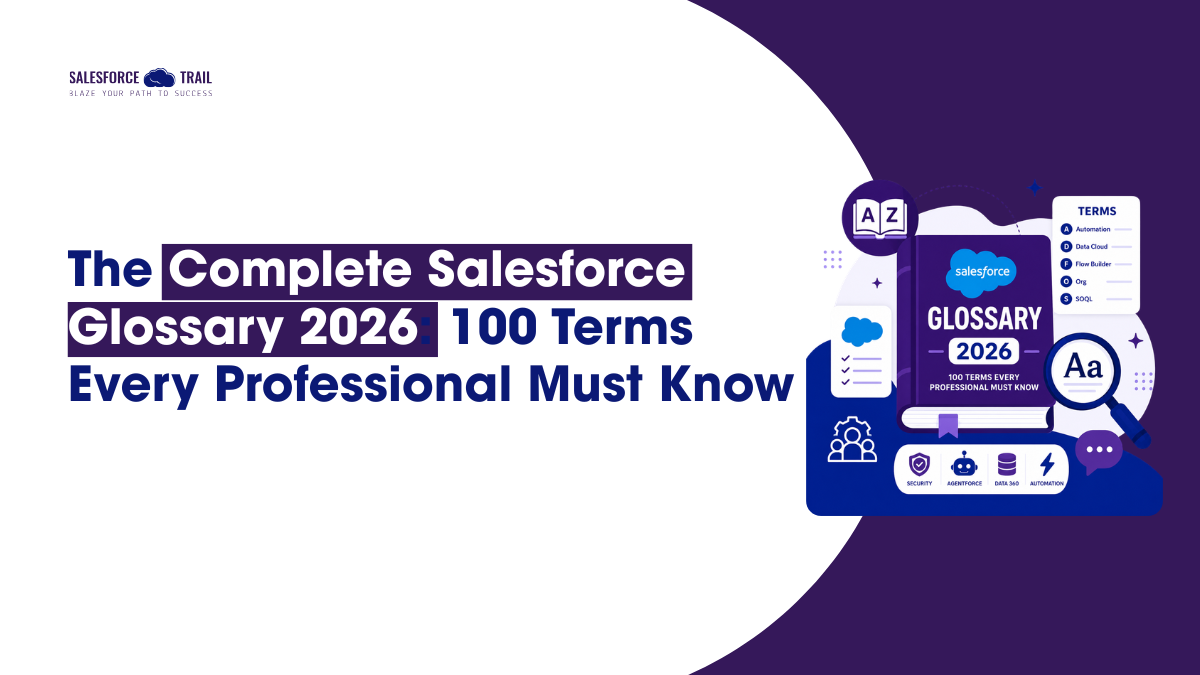
This one is different. All 100 terms are verified against the Dreamforce 2025 announcements and Spring ’26 release notes. They’re organized by category, so whether you’re studying for your first Admin certification, troubleshooting an integration, or scoping an Agentforce rollout, you can jump straight to the section that matters. Use Ctrl+F to find a specific term, and bookmark the page. This gets updated every Salesforce release cycle, three times a year.
Section 1: Core Platform and Org Architecture (Terms 1–15)
Before anything else, you need to understand the container that Salesforce runs inside.
- Org — Your unique Salesforce instance, completely isolated from every other company’s environment.
- Production Org — The live environment with real business data. You don’t test here.
- Sandbox — A copy of production used for development and testing. Four types: Developer, Developer Pro, Partial Copy, Full Copy.
- Scratch Org — A temporary, source-driven org created via the Salesforce CLI. Expires in 1–30 days. Core to modern DX workflows.
- Dev Hub — The org used to create and manage Scratch Orgs. Required for second-generation packaging.
- Standard Object — Pre-built objects Salesforce ships with: Account, Contact, Lead, Opportunity, Case. Configurable but not deletable.
- Custom Object — Objects you create for data that Salesforce doesn’t cover. Identified by the __c suffix in the API name.
- Record — A single row of data in an object. One Account is one record.
- Field — A column storing one data type on a record: text, number, date, picklist, checkbox.
- Tab — The navigation element giving users access to an object’s records. Configurable per profile or app.
- App — A collection of tabs grouped for a business purpose. Lives in the App Launcher (top-left grid icon).
- Metadata — The configuration layer of your org: objects, fields, flows, profiles, layouts. Metadata is what you deploy; data is what users enter. This distinction matters every time you work across environments.
- Schema Builder — A visual canvas in Setup for mapping your data model: objects, fields, and relationships.
- AppExchange — Salesforce’s official marketplace with 7,000+ apps, components, and consulting listings. Now AgentExchange
- Trailhead — Salesforce’s free learning platform. Modules, projects, and Superbadges earn points and rank. Most Salesforce careers start here.
Section 2: Data Model and Relationships (Terms 16–25)
How your objects connect shapes everything downstream — reports, automation, architecture, security.
- Lookup Relationship — A loose link between objects. Deleting the parent leaves child records intact. Example: Contact to Account.
- Master-Detail Relationship — A tight ownership link. Deleting the parent deletes child records. Enables Roll-Up Summary fields.
- Junction Object — A custom object with two Master-Detail relationships, creating a many-to-many link. Campaign Member is the standard example.
- External Object — Maps to data outside Salesforce via Salesforce Connect, making it queryable inside the platform without migration.
- Big Objects — Handle billions of rows. Right for compliance archives and historical data you rarely query.
- SOQL — Salesforce Object Query Language. The platform’s query syntax. Used in Apex, APIs, and the Developer Console: SELECT Id, Name FROM Account WHERE Industry = ‘Technology’.
- SOSL — Salesforce Object Search Language. Searches across multiple objects at once when you don’t know exactly where your data lives.
- Formula Field — A read-only field calculated automatically from a formula. Like spreadsheet formulas, but permanent in your data model.
- Roll-Up Summary Field — Aggregates values from related detail records into a master: COUNT, SUM, MIN, MAX. Requires a Master-Detail relationship.
- Data Loader — Salesforce’s desktop tool for bulk record operations via CSV: insert, update, upsert, delete, export.
Section 3: Automation and Business Logic (Terms 26–38)
Important note for 2026: Process Builder and Workflow Rules officially hit end of support on December 31, 2025. Existing automations still run, but Salesforce no longer provides bug fixes, patches, or support for either tool. All new automation must be built in Flow Builder.
- Flow Builder — Salesforce’s primary visual automation tool. The skill most worth mastering in 2026.
- Screen Flow — Presents interactive screens to users: forms, guided wizards, step-by-step processes. Embeddable in record pages and portals.
- Record-Triggered Flow — Fires automatically when a record is created, updated, or deleted. The direct replacement for most Workflow Rules and Process Builder use cases.
- Scheduled Flow — Runs on a defined schedule for batch updates and automated maintenance tasks.
- Auto-Launched Flow — Runs in the background, triggered by Apex, another Flow, or an API call.
- Apex — Salesforce’s proprietary programming language, similar to Java. Used for logic declarative tools can’t handle.
- Apex Trigger — Code that fires before or after record operations. Powerful, but the governor’s limits don’t forgive careless design.
- Scheduled Apex — Apex queued to run at a specified time using the Schedulable interface.
- Batch Apex — Processes large record volumes asynchronously in chunks, avoiding governor limit violations.
- Governor Limits — Platform-enforced execution caps: 100 SOQL queries per transaction, 150 DML statements per transaction. These exist because Salesforce is multi-tenant. Every developer learns about them, often the hard way.
- Process Builder (Retired) — End of support: December 31, 2025. Existing processes continue to run but receive no bug fixes or updates. You cannot create new automations here. Migrate everything to Flow Builder.
- Workflow Rules (Retired) — End of support: December 31, 2025. Same status as Process Builder — still running, no support or bug fixes, no new rules. Superseded by Record-Triggered Flows.
- Approval Process — A multi-step review requiring human sign-off before a record moves forward. Common for discounts, contracts, and change requests.
Section 4: Security, Access, and Compliance (Terms 39–50)
Miss a layer in Salesforce security and you’ll either lock users out or expose data they shouldn’t see.
- Profile — The baseline security object every user must have. Controls object access, field edits, and app visibility.
- Permission Set — An additive access layer on top of a profile. Modern orgs keep profiles lean and use these for role-specific configurations.
- Permission Set Group — A bundle of Permission Sets assigned together, simplifying access management for specific roles.
- Role Hierarchy — Controls record visibility, not permissions. Users above in the hierarchy see records owned by users below.
- Organization-Wide Defaults (OWD) — The minimum record access for non-owners: Private, Public Read Only, or Public Read/Write.
- Sharing Rules — Exceptions that extend record access beyond OWD for specific groups.
- Field-Level Security (FLS) — Controls which fields users can see and edit, set at the Profile or Permission Set level.
- Shield Platform Encryption — Encrypts data at rest beyond platform defaults. Required for HIPAA, PCI-DSS, and many GDPR scenarios.
- Event Monitoring — Logs detailed user activity: logins, exports, API calls. Used for security audits.
- Named Credentials — Securely stores external endpoint URLs and auth details for Apex callouts, keeping credentials out of code.
- Connected App — The framework external applications use to integrate with Salesforce via OAuth 2.0.
- Multi-Factor Authentication (MFA) — Mandatory for all Salesforce users since 2022. Password plus a second verification method.
Section 5: Agentforce Sales — formerly Sales Cloud (Terms 51–60)
- Lead — An unqualified prospect, converted to an Account, Contact, and Opportunity once vetted.
- Account — A company in your org. The central object that most data connects back to.
- Contact — A person linked to an Account.
- Opportunity — A qualified deal in progress: stage, amount, close date, probability.
- Pipeline — The aggregate of all open Opportunities.
- Forecast — A revenue projection for a period based on Opportunity data.
- Quote — A formal document generated from an Opportunity showing products, pricing, and terms.
- Agentforce Revenue Management (formerly CPQ / Revenue Cloud) — Rebranded at Dreamforce 2025 as part of the Agentforce 360 suite. Automates product configuration, pricing rules, discounting, and contract generation. Note: legacy Salesforce CPQ is now End of Sale for new customers. All innovations are in Agentforce Revenue Management.
- Sales Engagement (Cadences) — Structured, multi-touch outreach sequences with AI-prioritized queues. Formerly High Velocity Sales.
- Einstein Relationship Insights — Surfaces contextual news and data about Accounts and Contacts automatically.
Section 6: Agentforce Service — formerly Service Cloud (Terms 61–68)
- Case — The core Agentforce Service object (formerly Service Cloud). One customer issue equals one Case.
- Entitlement — Defines the level of support a customer qualifies for based on their contract.
- SLA (Service Level Agreement) — Committed response and resolution timeframes managed through Entitlements and Milestones.
- Milestone — A time-bound checkpoint within an Entitlement process. Missing one triggers escalation.
- Knowledge Base — A library of searchable articles for agents and customers. Supports versioning and channel-specific publishing.
- Omni-Channel — Routes incoming work (Cases, chats, messages) to agents by skill, availability, and capacity in real time.
- Agentforce Field Service (formerly Field Service Lightning / FSL) — Rebranded in 2025 under the Agentforce umbrella. Manages mobile field operations: dispatching technicians, scheduling appointments, tracking assets, and completing work orders from a mobile device.
- Digital Engagement — Connects Agentforce Service to messaging channels, including WhatsApp, SMS, Apple Messages for Business, and Facebook Messenger — all managed from one unified agent console.
Section 7: Developer and DevOps Terms (Terms 69–80)
- REST API — The most used Salesforce API. JSON over HTTPS. Standard for external integrations and mobile apps.
- SOAP API — An XML-based API is still common in enterprise and legacy middleware integrations.
- 71. Bulk API — Processes 50,000+ records asynchronously. Version 2 (Bulk API 2.0) is currently for large data operations.
- Platform Events and Streaming API — Platform Events publish real-time messages across systems. Streaming API pushes record change notifications without polling.
- Lightning Web Components (LWC) — Salesforce’s modern UI framework based on native web standards. Current standard for custom interfaces.
- Aura Components — LWC’s predecessor. Still in existing packages, but not recommended for new builds.
- Visualforce — Salesforce’s original custom page markup language, found in legacy orgs and older packages.
- Salesforce CLI (sf) — Creates scratch orgs, deploys metadata, manages packages, and drives CI/CD. The sf command replaced sfdx in 2022.
- Change Sets — UI-based metadata deployment between connected orgs. No version control, no automation. Too limited for real pipelines.
- Unlocked Package — A modular, version-controlled package type for internal org customization.
- 2nd Generation Packaging (2GP) — Salesforce’s current CLI-driven packaging system for both managed (AppExchange) and unlocked (internal) packages.
- DevOps Center — Salesforce’s native pipeline-based change management tool. A practical step up from Change Sets.
Section 8: AI, Agentforce, and Emerging Technology (Terms 81–95)
This is the section that separates a current Salesforce glossary from one written in 2022. These terms are in active client conversations, architecture reviews, and project scopes right now.
- Agentforce — Salesforce’s autonomous AI agent platform, central to the 2025–2026 product strategy. Agentforce agents complete multi-step tasks independently across sales, service, and operations without waiting for a human prompt at each step. The distinction from chatbots is architectural, not just marketing.
- AWU (Agent Work Units) — The consumption-based billing metric for Agentforce. Every task or resolved interaction an agent handles uses AWUs. Understanding this is non-negotiable when scoping any Agentforce rollout.
- Agent Action — A discrete task an Agentforce agent can take: look up a record, create a case, trigger a Flow, send a message. Actions are the building blocks of agent capability.
- Agent Topic — The bounded area of responsibility for an agent: “Billing Support,” “Order Inquiries.” Topics map agents to the right Actions and system instructions.
- Agent Script — Pre-defined conversation guidance built into an Agentforce agent. Useful wherever compliance or brand consistency requirements apply to customer interactions.
- Einstein Trust Layer — Salesforce’s security framework for enterprise AI. It sits between your org and any external LLM, masking PII before it reaches the model, enforcing zero data retention by AI vendors, and maintaining full audit trails. This is what makes Salesforce’s AI approach viable in healthcare, finance, and regulated industries.
- Headless 360 — Salesforce Headless 360 is an architecture that decouples the Salesforce platform from its user interface. Every capability from CRM data to approval workflows becomes accessible through APIs, MCP tools, or CLI commands, meaning both AI agents and human developers can build and act on the platform without a browser.
- AgentExchange — Salesforce’s marketplace for pre-built Agentforce agents, actions, and templates. Launched in 2025, it operates similarly to AppExchange but specifically for AI agent components.
- Prompt Builder — A no-code tool in Setup for creating and deploying AI prompts with dynamic data injection from records and Data 360. Powers Einstein features, Flow AI actions, and Agentforce agents.
- Data 360 (formerly Data Cloud) — Renamed at Dreamforce 2025 (October 14, 2025) as the sixth iteration of this product: Customer 360 Audiences → Salesforce CDP → Marketing Cloud Customer Data Platform → Salesforce Genie → Data Cloud → Data 360. Now positioned as the real-time data and intelligence layer that powers all Agentforce agents and Salesforce products. Ingests and unifies customer data from any source into a single profile. The functional capabilities are unchanged; the strategic framing has shifted from “data warehouse” to “live context engine for AI agents.
- Grounding — Connecting an AI agent’s responses to your actual Salesforce data rather than generic model knowledge. Without it, agents generate accurate-sounding answers that may not reflect your business.
- RAG (Retrieval-Augmented Generation) — The technique behind grounding. Before generating a response, the model retrieves relevant data from a knowledge store and uses it as context — why an Agentforce agent can accurately answer questions about your specific products and policies.
- Vector Database — A database for storing and querying embeddings: mathematical representations of text that capture meaning rather than keywords. Enables semantic search in Data 360.
- Einstein Copilot (Deprecated) — Salesforce’s conversational AI assistant launched in early 2024 and was replaced by Agentforce in 2025. Still referenced in older documentation and pre-2025 implementations.
- Model Builder — A tool for configuring and connecting AI models in Salesforce, including third-party LLMs from OpenAI, Anthropic, and Google.
Section 9: Analytics, Reporting, and Integration (Terms 96–100)
- Reports and Dashboards — Native tools for querying and visualizing data. Reports pull records in table, summary, or matrix formats. Dashboards display multiple reports on a single real-time canvas.
- CRM Analytics — The advanced analytics platform for interactive dashboards beyond native reports. Previously, Tableau CRM, Einstein Analytics, and Wave — the naming history is genuinely confusing.
- Einstein Discovery — An AI analytics feature that surfaces predictive insights and patterns automatically. Used for churn scoring, deal probability, and anomaly detection.
- MuleSoft — Salesforce’s integration platform for connecting with external systems: SAP, Workday, Oracle, custom APIs, and databases.
- Change Data Capture (CDC) — Publishes real-time notifications when Salesforce records change, allowing external systems to stay synchronized without polling the API.
Final Thoughts
A hundred terms are a lot to absorb. You don’t need all of it at once. Most practitioners focus on the vocabulary relevant to their current role and expand from there.
What makes 2026 different from prior years is the scale of the rename cycle. Dreamforce 2025 touched almost every major product. This glossary has been accuracy-audited against Dreamforce 2025 announcements and the Spring ’26 release. Salesforce releases three platform updates a year we will update this page accordingly
Frequently Asked Questions (FAQ)
Start with Org, Object, Record, Field, Profile, and Flow Builder. These appear in almost every Salesforce conversation. Everything else builds on them.
It’s Salesforce’s platform for deploying AI agents that handle tasks autonomously. Unlike a chatbot, an agent doesn’t wait for instructions at each step — it reasons, acts, and completes. Think of it as the difference between a tool and an independent worker.
Salesforce’s security architecture for enterprise AI. It masks PII before it reaches any external AI model, enforces zero data retention by AI vendors, and keeps audit logs of every AI interaction. It’s what makes AI deployments viable in regulated industries.
A Profile is the baseline every user has. Permission Sets add access on top. Modern best practice: keep profiles minimal and manage role-specific access through Permission Set Groups.
Quite a few. Sales Cloud became Agentforce Sales. Service Cloud became Agentforce Service. Field Service Lightning became Agentforce Field Service. Revenue Cloud became Agentforce Revenue Management. Data Cloud became Data 360. All fall under the Agentforce 360 umbrella. The underlying functionality didn’t change — the naming reflects the AI-first strategic positioning Salesforce adopted across the entire product suite.
Technically, yes — existing automations continue to run. But Salesforce ended support on December 31, 2025, which means there will be no bug fixes, no patches, and no help from Salesforce if something breaks. You can no longer create new Process Builder automations either. Migrating to Flow Builder is the only safe path forward.
- Akanksha Shukla