

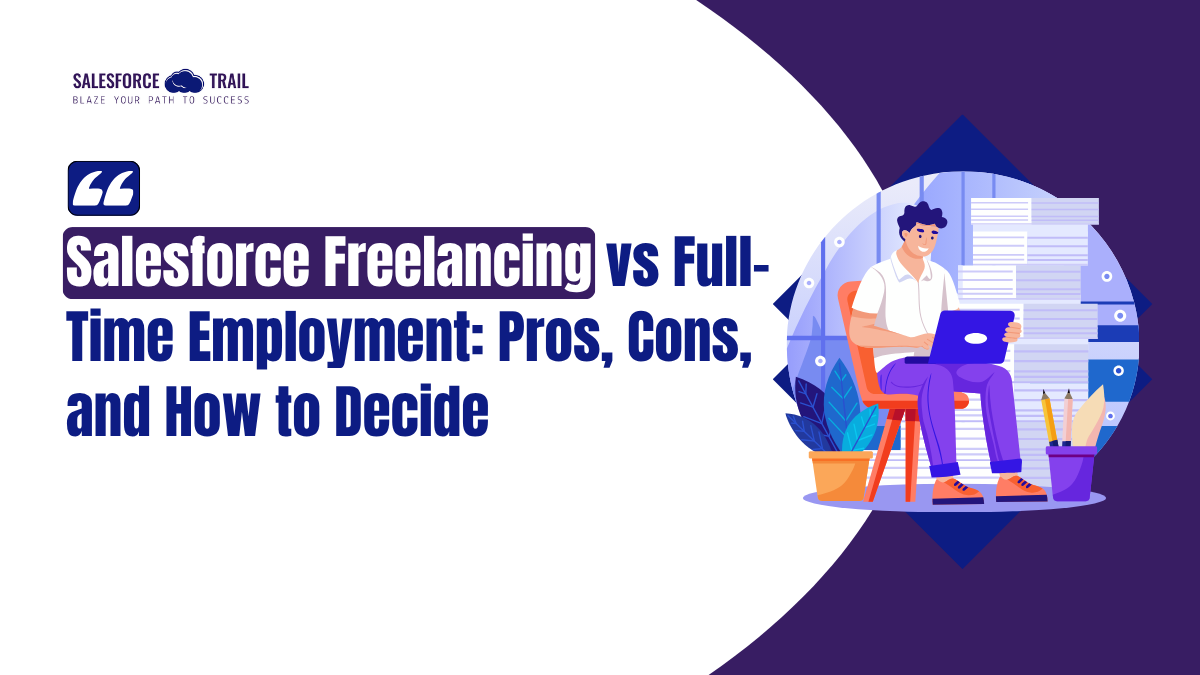
Maybe you are an expert with multiple Salesforce certifications and have a few years of solid hands-on experience under your belt. Now, two very different opportunities are sitting on your desk: a full-time offer from a solid company and a freelance contract that pays nearly double the hourly rate. Which one do you take?
This is one of the most real career dilemmas in the Salesforce ecosystem right now. And the honest answer? There’s no universally right choice. The best path depends on where you are in your career, what you want your life to look like, and how much uncertainty you’re comfortable sitting with. This article breaks it all down, no fluff, just the real trade-offs, so you can make a decision that actually fits your situation.
Table of Contents
What Does Salesforce Freelancing Actually Look Like?
Before discussing its pros and cons, it would be helpful to understand what Salesforce freelancing actually means.
Freelancing in Salesforce typically means working as an independent consultant; you take on project-based contracts with businesses that need Salesforce implementation, customization, or ongoing support, but don’t want to hire a full-time specialist. You might find clients through platforms like Upwork, Toptal, or Fiverr, or through direct referrals and LinkedIn.
Common freelance roles include Salesforce Consultant, Administrator, Developer, and Solution Architect. Engagements are usually structured as hourly contracts, fixed-price projects, or monthly retainers. Some freelancers juggle two or three clients at once; others prefer one focused engagement at a time.
Pros of Salesforce Freelancing
Higher Earning Potential:
This is the one that gets people’s attention first, and for good reason. Experienced Salesforce freelancers in the US typically charge between $85 and $200+ per hour, depending on their specialization and reputation. Globally, rates range from $40 to $150+ per hour, with demand particularly strong in the UK, Australia, Canada, and the Middle East. A skilled Salesforce Developer billing 30 hours a week can comfortably out-earn most full-time salaries.
Flexibility and Autonomy:
You choose your clients, your schedule, and your workspace. Want to work from Lisbon for three months? Nobody’s stopping you. This level of control is genuinely life-changing for the right person.
Accelerated Skill Growth:
Working across multiple industries and Salesforce clouds, Sales Cloud, Service Cloud, Marketing Cloud, within a single year, exposes you to more varied challenges than most in-house roles offer in three. Your skills diversify fast.
Location Independence:
Remote Salesforce freelancing is the norm, not the exception. Your client could be in New York while you’re working from Nairobi, or Manchester; geography rarely limits your options.
Cons of Salesforce Freelancing
Inconsistent Income:
This is the part freelance highlight reels never show. Dry spells between contracts are real, especially when you’re starting. If you don’t have three to six months of savings as a buffer, slow months can feel genuinely stressful.
No Benefits Package:
Health insurance, paid time off, retirement contributions- these don’t come standard. You’ll need to account for them yourself, which quietly eats into that attractive hourly rate.
You’re running a Business, not just doing Salesforce Work:
Invoicing, contracts, taxes, chasing late payments, managing scope creep, all of that lands on you. It’s more overhead than most people expect.
Client Management can be Exhausting:
Difficult clients, shifting requirements, and scope creep are occupational hazards. And since your income depends on keeping clients happy, saying no requires confidence and experience.
Isolation is Real:
Without a team around you, motivation can dip. Many freelancers, especially those coming from collaborative office environments, underestimate how much they’ll miss the casual professional connection.
Pros of Full-Time Salesforce Employment
Full-time employment isn’t the “safe but boring” option for many Salesforce professionals; it’s the smartest strategic move.
Stable, Predictable Income with Benefits:
A full-time Salesforce Administrator in the US earns between $70,000 and $110,000 annually. Salesforce Developers and Architects regularly earn $120,000 to $160,000+. Globally, salaries are competitive in the UK (£35,000–£57,000), Australia (AUD 100,000–150,000), and Canada (CAD 90,000–130,000). Add health insurance, pension contributions, and paid leave, and the total compensation picture is strong.
Clear Career Progression:
Most organizations offer structured growth paths from Admin to Senior Admin to Salesforce Manager or Architect. You get performance reviews, mentorship, and a defined ladder to climb.
Company-funded Learning:
Many employers pay for Salesforce certifications, Trailhead training, and Dreamforce attendance. That’s thousands of dollars in professional development that comes at no cost to you.
Team Collaboration and Knowledge Sharing:
Working alongside other Salesforce professionals, whether that’s a team of three or thirty, creates a learning environment that’s hard to replicate on your own.
Cons of Full-Time Salesforce Employment
Earning Ceiling:
Salaries are competitive, but there is a cap on them. Top-performing freelancers, once they have built a strong client base, can earn far more than the salary offered by a full-time job.
Less Autonomy:
You work the hours expected by your employer and on the projects they prioritize. Office regulations, organizational politics, and slow decision-making processes are some of the frustrations that ultimately lead many Salesforce professionals to opt for freelancing.
Narrow Skill Exposure:
Working in a single Salesforce org limits the variety of challenges you encounter. Skill diversification happens more slowly than freelancing.
Layoff Risk:
Particularly relevant in today’s tech hiring climate, even well-established roles can be restructured without warning.
Key Factors to Help You Decide
Here’s a simple self-assessment framework. Answer honestly:
- Do you have 3–6 months of savings? If not, freelancing’s income gaps could become genuinely harmful rather than just uncomfortable.
- Are you senior enough to command premium rates? Freelancing rewards deep expertise. If you’re still building foundational skills, employment gives you a safer space to grow.
- How do you respond to uncertainty? Some people are energized by it. Others find it genuinely destabilizing. Neither reaction is negative.
- What are your lifestyle commitments? Mortgages, young children, or ongoing medical needs, for these reasons, job stability can prove to be a more sensible option in the short term.
- How strong is your professional network? Freelancing runs on referrals. Without warm connections to start with, building a client pipeline takes longer than most people expect.
- What does your five-year vision look like? Building a personal consulting brand and running a freelance practice is a completely different five-year journey from climbing to a Senior Architect role inside a growing company. Neither is wrong, just different.
The Hybrid Path: Worth Considering
There’s a third option that often gets overlooked: doing both carefully. A growing number of Salesforce professionals take on small consulting projects or retainer clients alongside their full-time roles. It’s a practical way to test the freelance waters, build your client pipeline, and grow your savings buffer before making a full leap.
Just make sure to review your employment contract first. Some organizations include clauses that restrict outside consulting work, particularly if it overlaps with their industry.
Final Thoughts
Salesforce freelancing offers freedom, variety, and serious income potential. Full-time employment offers stability, structure, and a clear path forward. The question was never which one is better; it’s which one is better for you, right now.
Take the self-assessment questions above seriously. Talk to Salesforce professionals who’ve walked both paths. And remember, your career isn’t a one-way door. Many of the most respected professionals in the Salesforce ecosystem have done both at different stages of their lives.

Priya Rastogi
Priya is a 3x Salesforce Certified who believes in the power of continuous learning and collaboration. She’s passionate about exploring how Salesforce can simplify work, boost productivity, and create better user experiences. When she’s not experimenting with new features or automating processes, Priya enjoys connecting with fellow Trailblazers and sharing insights to help others grow in their Salesforce journey.
- Priya Rastogi
- Priya Rastogi

- Priya Rastogi
- Priya Rastogi