

I have noticed this pattern many times. A skilled administrator decides to pursue their first ‘Architect Certification.’ They develop a solid understanding of the differences between ‘master-detail’ and ‘lookup’ relationships, memorize ‘skew thresholds,’ and commit ‘governor limits’ to heart. Yet, when they take the exam, they realize that memorizing these details has little real value.
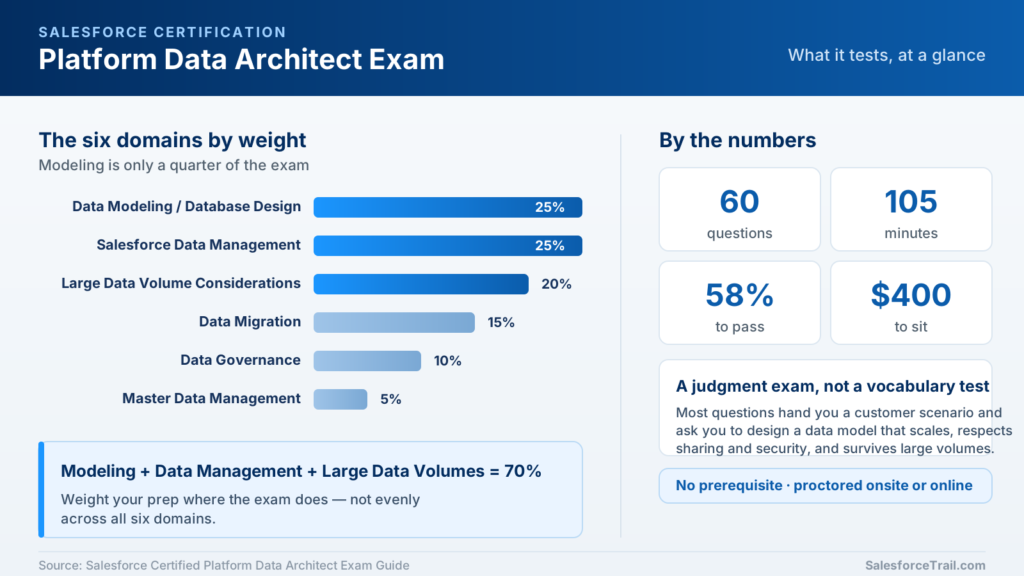
The ‘Platform Data Architect’ exam is not truly a test of facts; rather, it is an assessment of ‘judgment’ disguised as a test of facts. In almost every question, you are presented with a client, a business context, and a specific problem, and you are tasked with designing a solution that is both practical and sustainable. That’s exactly why many capable individuals underestimate the exam. Consequently, preparing for the exam in the right way not only improves your chances of passing but also makes you more proficient in your professional work.
Table of Contents
First, the name change that confuses people up
If you’re confused about what this credential is called, you’re not alone. Salesforce renamed it from Salesforce Certified Data Architect to Salesforce Certified Platform Data Architect on July 21, 2025, when it moved certifications over to Trailhead Academy. It was part of a wider cleanup that touched 35 certifications.
If you already hold the old Data Architect cert, you don’t need to do anything. Your record updated on its own. And its sibling in the architect path, Sharing and Visibility Architect, became Platform Sharing and Visibility Architect in the same wave, so expect to see “Platform” bolted onto a lot of titles you used to know without it.
What the exam actually is
Read the official exam objectives and a pattern jumps out fast. They’re almost all phrased as “Given a customer scenario, recommend…” or “Compare and contrast…” You’re not being asked what a skinny table is. You’re being handed a situation and asked to pick the design that survives it, then live with the trade-offs.
That’s the part strong admins miss. They prep like it’s a glossary, walk in, and meet a two-paragraph story about a company with messy data and a sharing model that’s fighting their proposed design. Knowing more facts doesn’t rescue you there. Reasoning does.
The exam at a glance
Straight from the official exam guide:
| Detail | What to expect |
|---|---|
| Questions | 60 scored multiple-choice (plus up to 5 unscored) |
| Time | 105 minutes |
| Passing score | 58% |
| Registration fee | $400 (plus tax) |
| Retake fee | $200 (plus tax) |
| Prerequisite | None |
| Format | Proctored, on-site or online |
The blueprint surprise: modeling is only a quarter of it
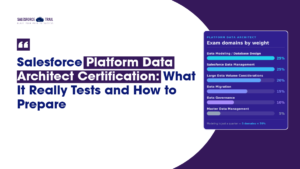
Most people hear “Data Architect” and assume the exam is mostly data modeling. It isn’t. Modeling is one of six domains, and it shares top billing rather than owning the test.
| Domain | Weight |
|---|---|
| Data Modeling / Database Design | 25% |
| Salesforce Data Management | 25% |
| Large Data Volume Considerations | 20% |
| Data Migration | 15% |
| Data Governance | 10% |
| Master Data Management | 5% |
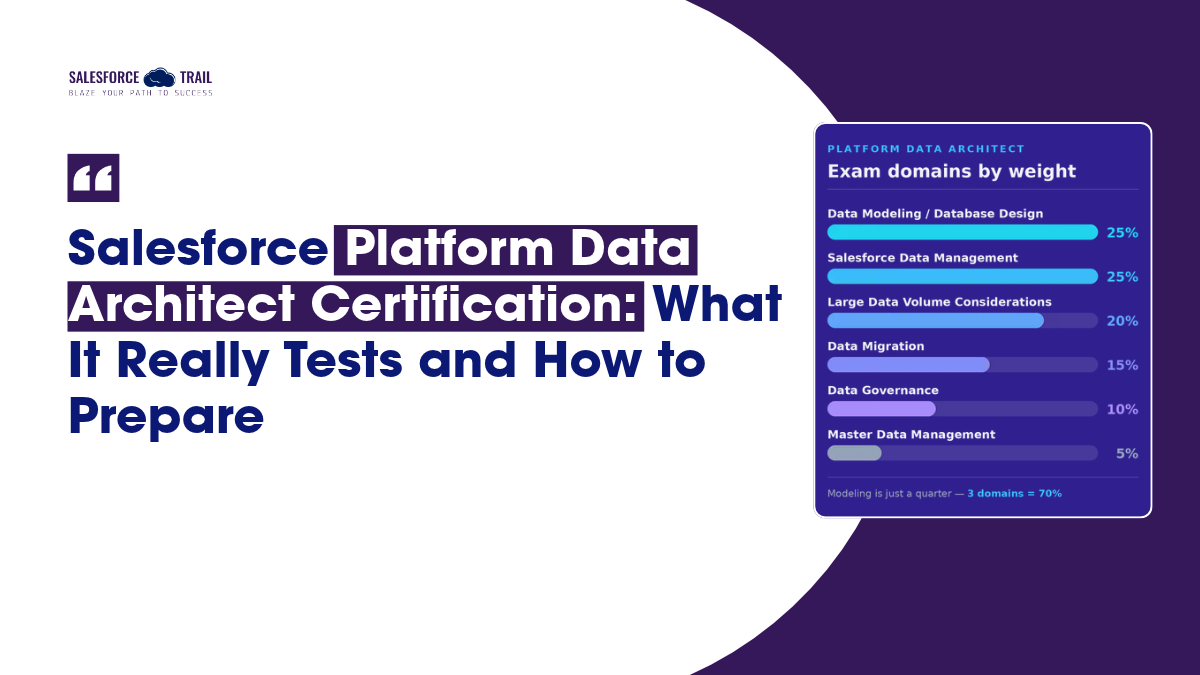
Look at where the weight actually sits. Data Modeling and Salesforce Data Management are tied at 25% each, and once you add Large Data Volume Considerations, those three cover 70% of the exam between them. Master Data Management, the one with the intimidating name, is a rounding error at 5%.
So if you budget your study time as though all six domains matter equally, you’ll end up hours into the wrong corner. The person who over-studies MDM and under-studies large data volumes walks out rattled. Weight your prep the way Salesforce weights the exam.
The technical ground you do need, held as reasoning
You still have to know the platform. The trick is to hold each number as something you reason from, not something you recite. The exam rarely asks for a threshold outright. It builds a scenario where the threshold decides the answer, and you have to notice.
Data skew and relationship design
Salesforce flags data skew once more than 10,000 child records hang off a single parent. That shows up as account skew, ownership skew, and lookup skew, and it causes record-locking and sharing-recalculation pain at scale. The classic fix for an unavoidable skewed owner is to keep that user out of roles and public groups so sharing recalculations don’t cascade.
This is where master-detail versus lookup stops being a definition. In a scenario, the real question is what each relationship does to sharing and skew, not which one cascades deletes.
Large data volumes, selectivity, and skinny tables
A query is selective when its filter is narrow enough to use an index. As a rough feel, a standard index kicks in under roughly 30% of the first million rows; a custom index under about 10%. You won’t be asked to quote those percentages. You’ll be shown a slow query over millions of records and asked why it’s crawling.
One detail worth getting right because so many sources get it wrong: skinny tables hold up to 200 columns, not 100. The old figure was 100, and stale study guides still repeat it.
Migration and virtualization choices
For big loads and extracts, PK chunking is the tool once you’re past about 10 million records, and Bulk API handles the volume. The sharper skill is choosing the right home for data: big objects for massive archival datasets you query rarely, external objects via Salesforce Connect when the data should stay in another system, or an archive-and-purge plan when the org just needs to shed weight. That choice is prime scenario territory.
How to actually prepare
Prep for this one splits cleanly into two: learn the material in the right order, then train the skill the exam actually measures.
Work the official resources in sequence.
Start with the Architect Journey: Data Architecture trailmix. It maps to the domains and gives you the modeling and governance foundation.
Then spend real time in the Best Practices for Deployments with Large Data Volumes guide. If you read one document end to end, make it this one. It carries most of what you need for the LDV and migration domains, which together are 35% of the exam. Round it out with the big objects and Salesforce Connect docs. If you prefer instructor-led learning, Salesforce’s ARC201 course covers the same ground with a teacher in the room.
Train the scenario, not the flashcard
This is the part that actually moves your score. For each domain, practice reading a requirement and defending a design out loud. What are the real options? What breaks when the data grows? Which one wins, and why would you say no to the others?
Instead of relying on practice questions: take a real org you know and redesign a skewed object properly, or sketch out survivorship rules for building one golden customer record from three source systems. Thirty minutes of that teaches more than an evening of memorizing limits, because it forces you to reason the way the exam does. It’s also the exact skill the job needs.
Mistakes to avoid
A few patterns sink more candidates than any single hard topic:
- Treating it as a vocabulary test. Memorizing definitions without practicing scenarios is the number one reason prepared people fail. The exam asks you to decide, not to recite.
- Over-studying Master Data Management. It’s 5% of the exam. Give it an afternoon, not a weekend.
- Skipping Salesforce Data Management. It’s tied with modeling at 25%, and it’s the domain people forget exists. License and object combinations, a single view of the customer, and consolidating multiple orgs all live here.
- Ignoring the archiving and purging story. Large data volume questions often ask when to virtualize, archive, and purge. “Add more custom fields” is rarely the answer.
- Trusting stale numbers. Skinny tables are 200 columns now, the pass mark is 58%, and there are 60 questions. Old guides repeat outdated figures. Check anything that smells dated against the official exam guide.
Where this fits in your architect journey
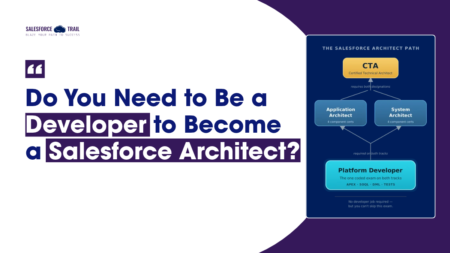
For most admins and developers, this is the first real “architect” exam they attempt, and it’s a stepping stone rather than a destination. Platform Data Architect is one of four certifications that together earn you Application Architect: Platform App Builder, Platform Developer, Platform Data Architect, and Platform Sharing and Visibility Architect. Pass all four and Application Architect is granted automatically. There’s no separate exam to sit.
From there, Application Architect plus System Architect sets you up for the Certified Technical Architect review board, the top of the pyramid.
One heads-up on planning. Don’t line up B2B Solution Architect as your next step, since that credential is being retired on February 1, 2027.
The deeper reason to take this seriously is that it changes how you work. It marks the shift from building what you’re told to designing what the business actually needs. Get that mindset right here, and it carries into everything that follows.
Final Thoughts
Open the exam objectives on the official guide, pick the one domain you understand least, and work a single real-world scenario in it this week. Say the design out loud, name the trade-offs, defend the call. Do that six times, once per domain, and you’ll be ready in a way no flashcard stack can match.
Frequently Asked Questions
It’s challenging, mostly because it tests judgment rather than memory. If you have a few years of hands-on Salesforce experience and you practice scenario-based reasoning, it’s very passable. People who only memorize facts tend to struggle.
58%. With 60 scored questions, that’s roughly 35 correct answers.
$400 to register and $200 to retake, plus any applicable tax.
Yes. It’s one of four required credentials, alongside Platform App Builder, Platform Developer, and Platform Sharing and Visibility Architect. Earn all four, and Application Architect is granted automatically.
It depends on your background, but most people with solid platform experience spend several weeks working the official trail mix and the large data volumes guide, plus scenario practice. Give the heavier domains more time than the 5% MDM section.
Yes. Salesforce renamed Data Architect to Platform Data Architect in July 2025. It’s the same credential, just a newer name.

Arun Kumar
Arun Kumar is a 4x Salesforce Certified professional. He designs and implements scalable solutions that improve customer engagement, streamline business processes, and drive measurable results. Passionate about exploring the latest Salesforce innovations, Arun enjoys sharing practical insights and best practices to help businesses build smarter, data-driven strategies.
- Arun Kumar