

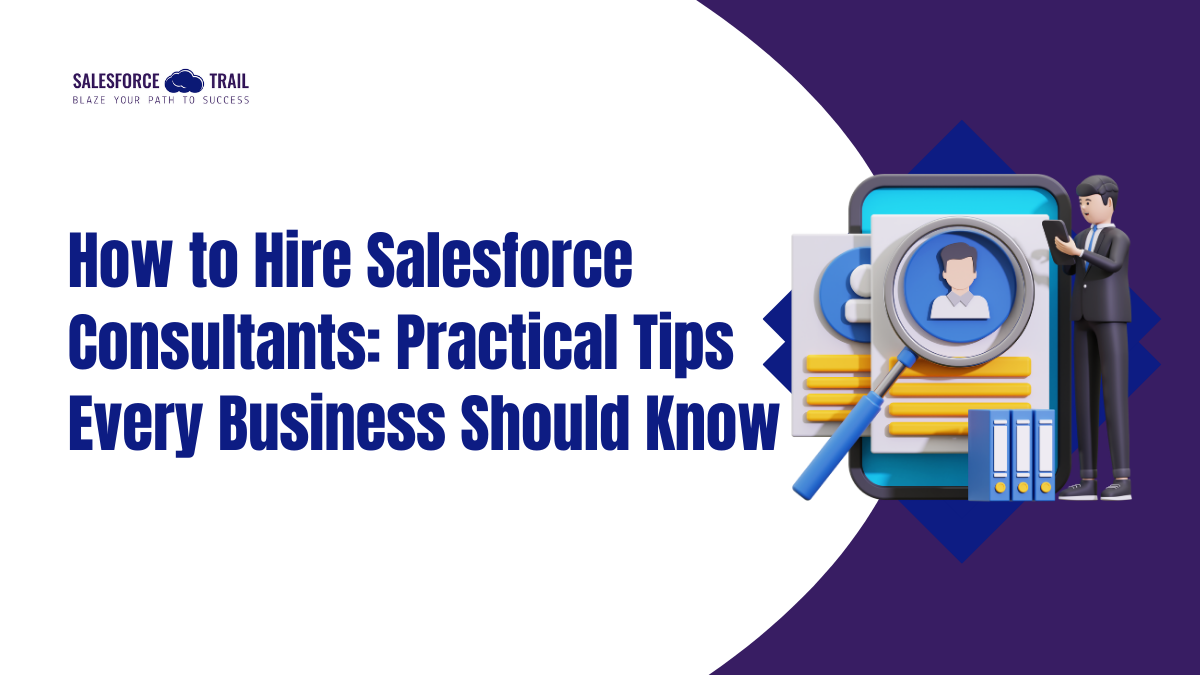
Investing in Salesforce is a strategic decision. But how do you find the right Salesforce consultant? That’s what really matters when it comes to getting a good return on your investment or just wasting money on a lesson.
Many businesses believe that buying Salesforce licenses will lead to success. The truth is that the platform’s power depends on how it is set up, designed, and adopted. A good Salesforce consultant can make things run more smoothly, make things easier to see, and boost productivity. The wrong one can make automation too complicated, data structures too messy, and users angry.
This guide will help you make a smart, confident choice when you’re planning to hire a Salesforce consultant. In this guide, we’ll explain who a Salesforce consultant is, what they do, what skills to look for, and how to check their real-world experience.
Who Is a Salesforce Consultant?
A Salesforce consultant is someone who helps businesses design, improve, and grow their Salesforce environment. They act as a bridge between business stakeholders and the Salesforce platform.
A Consultant usually works at the intersection of business strategy and system design, unlike a developer, who mostly works with code, or an admin, who handles day-to-day configuration. They need to know how your sales, service, marketing, or operations teams work and then turn those processes into a well-organized Salesforce solution.
At a high level, a Salesforce consultant:
- Analyzes business workflows
- Identifies inefficiencies or gaps
- Recommends best practices
- Ensures the system supports long-term growth
In simple terms, they don’t just “build in Salesforce.” They design a system that supports your business outcomes.
What Does a Salesforce Consultant Actually Do?
- Structuring objects and relationships in the Salesforce data model
- Designing automation with Flows and approval processes
- Setting up profiles, roles, and rules for sharing to keep things secure
- Making plans for how to connect with other systems
- Setting up reporting structures to make things clear
- Will this solution still work when the company doubles in size?
- Is this customization necessary, or can standard features solve the problem?
- How will this impact future upgrades?
Types of Salesforce Consultants You Can Hire
Not all Salesforce consultants have the same expertise. Understanding the different types helps you hire the right fit for your needs.
Functional Salesforce Consultant
A functional consultant’s job is to focus on business processes and configuration. They are ideal for multi-cloud expertise, dashboards, reporting, and automating workflows. This might be the best choice for your project if your project revolves around optimizing processes and setting up standard configurations.
Technical Consultant
Technical consultants handle complex needs, including development, integrations, and custom logic. You might need someone with extensive technical knowledge if your business requires advanced automation or system integrations.
Freelancer vs Consulting Firm
Freelancers are often more flexible and cost-effective, which makes them a good choice for smaller projects. Consulting firms have more knowledge, follow structured methods, and can grow. Your choice depends on project size, complexity, and risk tolerance.
Skills Every Good Salesforce Consultant Should Have
When evaluating candidates, certifications alone are not enough. Look for a balanced mix of technical, functional, and strategic skills.
Core Technical Skills
A strong consultant must understand:
- Salesforce data modeling and object relationships
- Automation tools such as Flow and validation rules
- Security and sharing model design
- Reporting and dashboard configuration
- Integration fundamentals and API awareness
- Data migration strategies and data quality best practices
Without these fundamentals, even well-intentioned implementations can fail.
Business and Functional Skills
Technical knowledge must be paired with business insight. A good Salesforce consultant should:
- Conduct structured requirement-gathering sessions.
- Translate business needs into practical system designs.
- Understand how different departments operate.
- Focus on measurable ROI
They should speak both “business” and “Salesforce.”
Communication and Soft Skills
Projects often fail due to communication breakdowns, not technical errors. Look for consultants who:
- Explain complex concepts in simple language.
- Document their work clearly.
- Manage stakeholder expectations
- Ask thoughtful follow-up questions.
Strong communication reduces misunderstandings and scope creep.
Strategic Thinking
A high-quality Salesforce consultant avoids unnecessary customization. They design solutions that scale and align with Salesforce best practices. Their mindset should always include long-term maintainability and user adoption.
How to Evaluate a Salesforce Consultant’s Experience
Experience is best evaluated through conversation and evidence, not just resumes.
Start by reviewing case studies or asking for real project examples. Instead of asking, “Have you implemented Salesforce before?” ask:
- What was the business problem in your last project?
- What challenges did you face?
- What would you do differently today?
Pay attention to how they describe outcomes. Do they talk about increased sales visibility, improved reporting accuracy, or streamlined processes? Or do they focus only on features that have been implemented?
Clarify their exact role in past projects. Were they leading the solution design or supporting another consultant?
You can also evaluate experience by observing their discovery process. A skilled consultant asks detailed questions about your workflows and plans. If they immediately suggest solutions without understanding your business, that’s a red flag.
Certifications can validate baseline knowledge, but hands-on experience in real business scenarios carries more weight.
Key Questions to Ask Before Hiring a Salesforce Consultant
Strong interview questions uncover depth.
Business-Focused Questions
- How do you approach requirement gathering?
- How do you ensure Salesforce aligns with business goals?
- How do you prioritize features when timelines are tight?
These reveal strategic thinking.
Technical Judgment Questions
- When would you avoid custom development?
- How do you approach data migration risks?
- How do you design automation without creating complexity?
Good consultants emphasize simplicity and scalability.
Delivery and Process Questions
- How do you handle scope changes mid-project?
- What does your testing process look like?
- How do you ensure knowledge transfer after go-live?
A consultant who plans for documentation and handover reduces long-term dependency.

Final Thoughts
Hiring a Salesforce consultant is not just a procurement decision; it’s a strategic investment in your CRM foundation. The right consultant understands your business before touching configuration. They design scalable solutions, communicate clearly, and focus on long-term value. They act as a partner, not just a service provider.
Take time to define your needs, evaluate skills thoughtfully, and ask meaningful questions. When done correctly, hiring the right Salesforce consultant can transform Salesforce from a tool you use into a platform that drives measurable growth.
If your goal is to maximize ROI, improve user adoption, and build a system that supports your plans, approach the hiring process carefully. Salesforce success starts with choosing the right expertise.
Frequently Asked Questions (FAQ)
A Salesforce consultant helps businesses design, implement, and optimize Salesforce solutions based on their business processes. They gather requirements, configure automation, structure data models, build reports, and guide integrations with other systems. Their main goal is to ensure Salesforce supports business operations efficiently and delivers measurable value.
Businesses should consider hiring a Salesforce consultant when implementing Salesforce for the first time, optimizing an existing setup, migrating from another CRM, or adding complex automation and integrations. Consultants are also valuable when teams struggle with low user adoption, inefficient processes, or poor data visibility.
A strong Salesforce consultant combines platform expertise with business understanding. Key skills include Salesforce configuration, automation using Flows, data modeling, security management, reporting, and integration awareness. Equally important are communication, requirement analysis, and the ability to design scalable solutions that support long-term growth.
Salesforce certifications demonstrate knowledge of platform features and best practices, but they should not be the only hiring factor. Practical experience with real implementations, problem-solving ability, and understanding of business processes are often more important than certifications alone.
Important questions include how they gather requirements, how they approach automation and integrations, and how they ensure user adoption after implementation. You should also ask about testing processes, documentation, and post-deployment support to understand their overall delivery approach.
Freelance consultants are often suitable for smaller projects and offer flexibility and cost efficiency. Consulting firms typically provide larger teams, broader expertise, and structured delivery processes. The right option depends on project complexity, budget, and long-term Salesforce support needs.
Most Reads:
- Agentforce for Flow: A Hands-On Guide to the AI Features Changing How We Automate
- Salesforce Business Rules Engine (BRE) Explained: Smarter Decisioning Beyond Apex & Custom Metadata
- Salesforce Deployment Explained: Packaging vs CI/CD (When to Use Each and Why It Matters)
- TDX 2026 Call for Participation Is Live: Everything you Need to know

- Akanksha Shukla

- Akanksha Shukla