

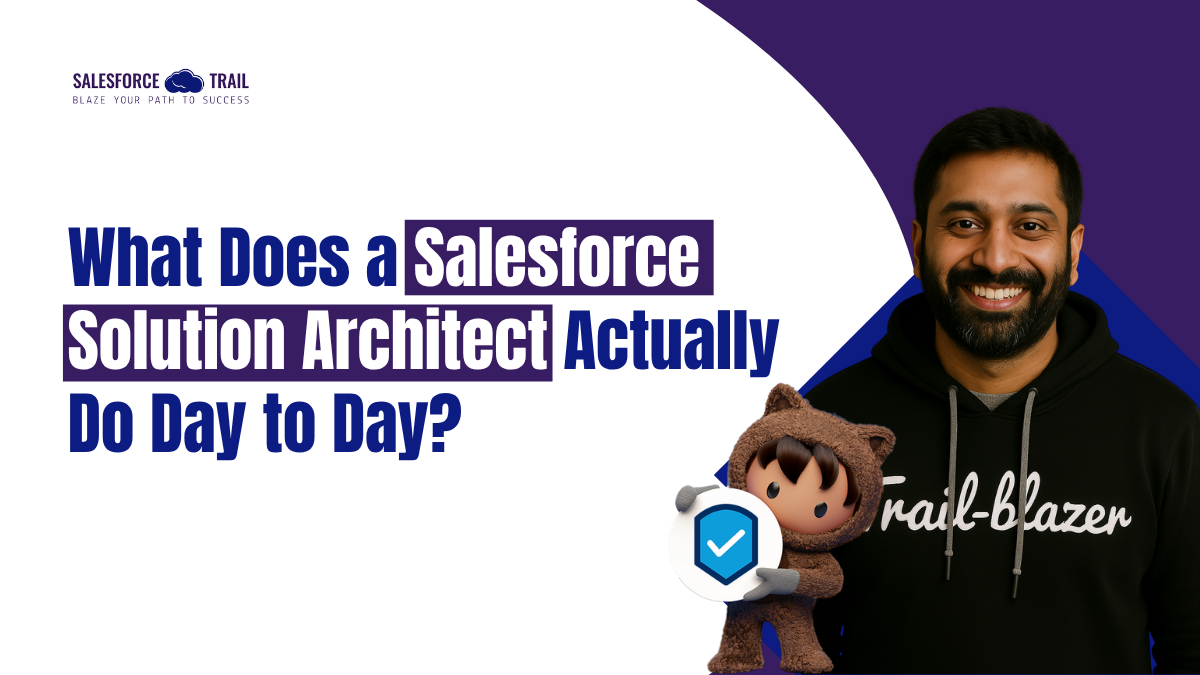
If you’ve spent any time exploring Salesforce career paths, you’ve probably come across the title Salesforce Solution Architect and wondered what it actually means in practice. Is it a senior developer? A senior consultant? Someone who draws boxes on whiteboards all day?
The truth is that this is everything, and at the same time, none of it is completely. The Salesforce Solution Architect role is one of the most misunderstood positions in the ecosystem, yet it’s also one of the most impactful. This article breaks down what the role truly involves, what a realistic workday looks like, and what it takes to get there.
Table of Contents
What Is a Salesforce Solution Architect?
A Salesforce Solution Architect is the person responsible for designing the overall technical solution on a Salesforce project. They bridge the gap between what a business needs and how Salesforce can deliver it, translating messy, real-world requirements into scalable, well-structured solutions.
It’s worth clarifying where this role sits relative to others:
- A Salesforce Admin manages and configures an existing org.
- A Salesforce Developer builds custom functionality through code.
- A Solution Architect designs the entire blueprint, deciding what gets built, how it connects, and why certain approaches are chosen over others.
Think of a Solution Architect as the lead designer of a building. The developers are the construction crew, skilled and essential, but the architect ensures the entire structure is well designed.
What does a Solutions Architect do?
This is where job descriptions often fall short. On paper, the role looks like a list of buzzwords. In reality, a Salesforce architect owns several high-stakes responsibilities across the full project lifecycle:
Translating Business Requirements into Scalable Solutions: Before any configuration or code begins, the architect runs discovery sessions to understand the client’s pain points, goals, and constraints, then maps those to a Salesforce solution that actually works long-term.
Designing the Solution Blueprint: This includes data model design, integration architecture, automation logic, and defining which Salesforce clouds or third-party tools are involved. Every major technical decision flows through this blueprint.
Governing Solution Quality: Architects review developer work, catch design flaws early, and ensure the team doesn’t build something that works today but breaks at scale tomorrow.
Documenting Architecture Decisions: A Solution Design Document (SDD) captures the what and why behind key decisions, an artifact that protects the project when team members change or the scope evolves.
Managing Trade-Offs: Budget is tight. Timeline is tighter. The architect constantly balances the ideal solution against what’s actually feasible, making decisions they can defend to both technical teams and business stakeholders.
A Day in the Life: Real Work, Not a Job Description
Here’s what a realistic day often looks like for a Salesforce Solution Architect.
Morning typically starts with a discovery call or sprint planning session. The architect is listening carefully not just for requirements, but for unstated assumptions, conflicting priorities, and gaps that could derail the project later. They might spend time reviewing user stories created by a business analyst, flagging any that have technical implications the team hasn’t accounted for.
Midday often involves deeper technical work, whiteboarding a multi-cloud solution, reviewing a developer’s proposed data model, or evaluating whether a third-party AppExchange tool is a better fit than a custom build. This is where the architect’s platform depth really matters. They need to understand Governor Limits, API constraints, and how decisions in one area ripple across the org.
Afternoon shifts back toward communication, presenting a solution design to a client’s leadership team, facilitating alignment between departments that want different things, or writing up architecture decisions for the project record.
No two days are identical. But that constant shift between deep technical thinking and clear business communication is the defining rhythm of the role.
Stakeholder Interactions: The Salesforce Architect as Translator
One of the most underappreciated aspects of the Salesforce architect role is how much time is spent managing people, not platforms.
A Solution Architect regularly works with:
- Executive sponsors, who need to understand ROI and risk, not technical details
- Project managers, who need scope and timeline inputs to keep delivery on track
- Developers and admins, who need clear direction and quick answers to implementation questions
- End users, who need the solution to reflect how they actually work
- Third-party vendors, whose tools need to integrate cleanly with the Salesforce environment
The architect is the connective tissue holding all of these conversations together. When a business stakeholder says “we want everything automated” and a developer says “that’ll take six months,” the architect finds the middle path and explains it clearly to both sides.
Skills That Separate Good Architects from Great Ones
On the technical side, strong architects have deep Salesforce platform knowledge across both declarative and programmatic layers. They understand integration patterns, data architecture principles, and how to design for scalability, not just functionality. Familiarity with DevOps practices, CI/CD pipelines, and Salesforce DX is increasingly expected.
On the human side, the best architects communicate with clarity and confidence across every level of an organization. They run workshops that build alignment rather than confusion. They push back diplomatically when a client’s request would create long-term problems, and they bring the receipts to back it up.
Technical depth gets you in the room. Communication skills determine how long you stay there.
How to Become a Salesforce Solution Architect
The most common path looks like this: Admin or Developer → Senior Consultant → Solution Architect. Most professionals reach the architect level after five to eight years of hands-on Salesforce experience, though the timeline varies based on the complexity of projects you’re exposed to.
If you’re mid-level and want to accelerate that path, here’s practical advice:
- Volunteer to design solutions on your current projects, even informally
- Document your architecture decisions and ask senior peers to critique them
- Shadow architects on client calls whenever you get the opportunity
- Use the Architecture Center; it’s a resource with excellent learning
The transition into architecture isn’t about a single certification or title change. It’s a gradual shift in how you think about problems from “how do I build this?” to “should we build this, and if so, how do we build it so it lasts?”
Common Misconceptions Worth Addressing
A few things the title often gets wrong in people’s minds:
“You need to write code every day.” Not true. Architects govern and guide, but they don’t always build. Many strong architects are primarily declarative thinkers.
“It’s a purely technical role.” Business acumen is equally important. Understanding why a company operates the way it does shapes better solutions than knowing every Apex class ever written.
“The role is the same everywhere.” It isn’t. An architect at a Salesforce consulting partner works very differently from one embedded in an end-user organization or an ISV.

Is the Salesforce Solution Architect Role Right for You?
If you enjoy solving ambiguous business problems through structured thinking, thrive at the intersection of technology and people, and want a role with genuine strategic influence, this path is worth pursuing seriously.
It demands technical depth, business fluency, and leadership presence all at once. That’s a hard combination to develop, which is exactly why experienced Salesforce architects are consistently in high demand. The path isn’t always linear, but for the right person, it’s one of the most rewarding places to land in the entire Salesforce ecosystem.

Priya Rastogi
Priya is a 3x Salesforce Certified who believes in the power of continuous learning and collaboration. She’s passionate about exploring how Salesforce can simplify work, boost productivity, and create better user experiences. When she’s not experimenting with new features or automating processes, Priya enjoys connecting with fellow Trailblazers and sharing insights to help others grow in their Salesforce journey.
- Priya Rastogi

- Priya Rastogi
- Priya Rastogi
- Priya Rastogi