


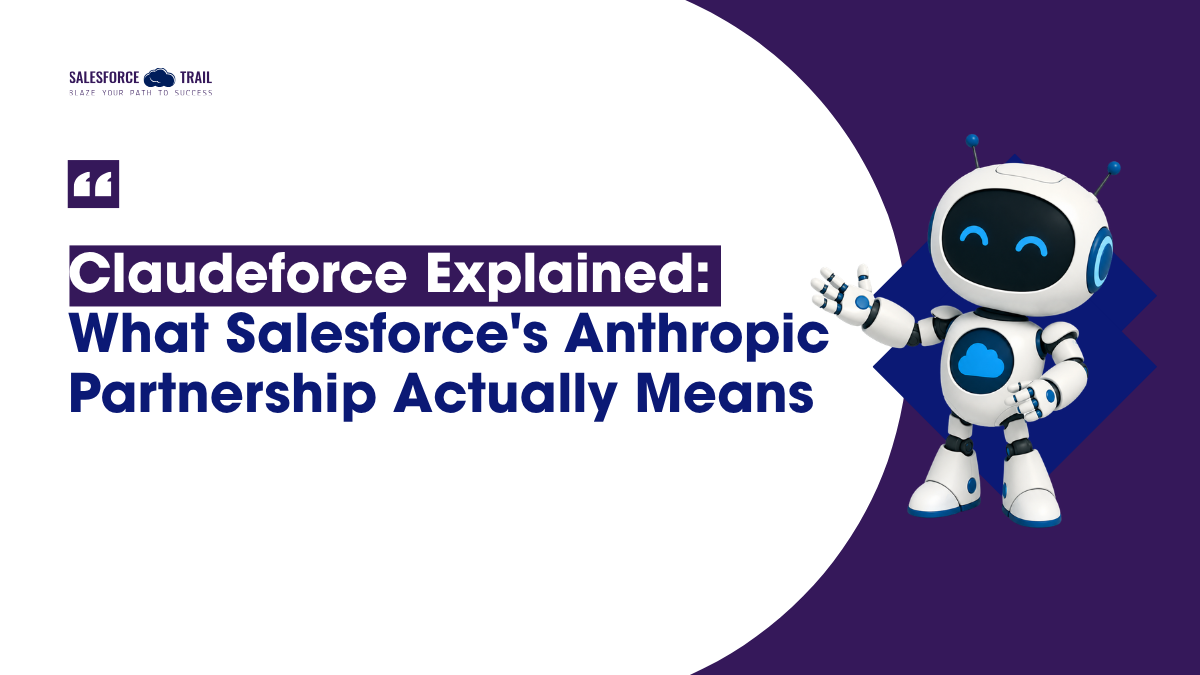
Salesforce and Anthropic have teamed up on something called Claudeforce, announced on August 26, 2026. It’s worth a closer look than most partnership news gets.
Salesforce is letting Claude work directly with your CRM data. This doesn’t involve screen-scraping or a chatbot tacked onto the side of a record page; it is your actual data working directly within the AI, governed by your actual permissions.
Whether that sounds exciting or a little unnerving probably depends on how much you trust what’s happening under the hood. So let me break down what’s real today, what’s still just a roadmap, and the governance questions I’d want answered before letting an agent near a live pipeline.
Key takeaways
- Claudeforce is the Salesforce–Anthropic partnership; Salesforce in Claude is its first product, a plugin with 37 sales skills.
- The connection runs over MCP through Headless 360, so Claude queries your org under the user’s permissions instead of getting a data dump.
- Governance specifics like zero data retention are concrete, but a few enterprise controls are still being built.
- Sales is live in pilot; open beta is planned for September 2026, with other clouds on a roadmap.
Table of Contents
What is Claudeforce?
Claudeforce is a partnership between Salesforce and Anthropic that lets Claude work directly with your Salesforce data, permissions, and business rules. Its first product, Salesforce in Claude, is a plugin with 37 prebuilt sales skills, available to pilot customers now and in open beta from September 2026.
What Salesforce actually announced
The headline is Salesforce in Claude, a plugin that ships with 37 prebuilt sales skills: call prep, pipeline review, deal health, forecast narratives, even an sfdc-hygiene-check. These run as skill files inside Claude, and they pull live data from your org. So a rep can ask “What was missed this week and what should I do about it?” and get an answer grounded in real records instead of guesswork.
The rest of the announcement covers ground the two companies had already been walking. Claude runs inside Agentforce as a reasoning model. It’s now the default model across Slack, including Slackbot and Claude Tag. And the two are customers of each other, which Salesforce says has produced 8.1 million hours of annualized internal productivity through Slackbot. Treat that figure as a vendor number, because it is one.
How Claude actually reaches your data
The connection runs through Headless 360, Salesforce’s way of exposing platform capabilities (data, workflows, business logic, permissions) over MCP, the Model Context Protocol, with no custom integration work. In plain terms: Claude doesn’t get a copy of your data dumped into a prompt. It calls Salesforce, and Salesforce answers with what that specific user is allowed to see.
The write side is where it gets interesting. When Claude updates a record, Salesforce says the action routes back through your existing rules, so validation, sharing, and field-level security still apply. An admin connects it once. Nobody rebuilds a permission model. That last part is genuinely appealing if it holds up, because “connect once, no re-audit” sounds great in a keynote and gets complicated fast in a real org carrying fifteen years of custom sharing logic.
The Governance Question, Front and Center
Salesforce is putting a lot of weight on trust, and they’ve shared some real specifics. Claude only sees what a given user is allowed to see, and it can act only within that user’s permissions. Sonnet, Opus, and Haiku retain zero data. On writes, you stay in control: Claude can ask before it emails anyone outside your company, or send on its own once you allow it, and it changes only the field it said it would. Their summary is “humans direct, agents execute, Salesforce governs,” which is a clear way to think about it.
Salesforce also says it’s working with Anthropic on more enterprise controls, including where your data is stored, who can access it, and automated review that catches problems before they reach customers.
Claudeforce vs Agentforce: the overlap nobody’s explaining
If you already run Agentforce, you’re probably asking the obvious question. Both put an agent on top of your CRM data. So what’s the actual difference?
The simplest way to see it: Agentforce builds agents inside Salesforce’s own screens. Salesforce in Claude brings that same data into Claude instead. Same information underneath, just a different place to work. A rep who spends the day in Claude gets the CRM brought to them. A team built around Agentforce keeps working in Salesforce. They’re not really competing. They fit different ways of working.
What’s shipping vs what’s a slide
Salesforce in Claude is in pilot today, with open beta planned for September 2026, and it launches with Sales first.
The rest of what Salesforce previewed (Service, Marketing, Commerce, Revenue, Field Service, Tableau, Data 360, and more) is listed as “coming soon.” Salesforce says it will add skills for other teams over the next few months. For now, plan around the Sales beta.
Mistakes to avoid
- Connecting a production org on day one of beta. Start in a sandbox and watch exactly what the write actions do to your records.
- Assuming “governed” means governed your way. Test it against your real sharing model and custom automation, not a clean demo org.
- Reading the productivity numbers as independent proof. They’re Salesforce’s own figures. Good signal, not gospel.
- Waiting passively for GA. The waitlist and the Sales beta are where you’ll actually learn what this does with your data.
Final Thoughts
If your sales team lives in Claude or Slack, this is worth a real test, not just a read. Get on the Claudeforce waitlist, and when beta opens in September, grab sandbox access, point it at a handful of live deals, and watch how it handles writes before you trust it with anything that matters. Salesforce is also demoing it at Dreamforce (September 15–17), which is the quickest way to see whether the governance story holds up outside a scripted stage demo.
Frequently Asked Questions (FAQ)
No. Claudeforce is the overall partnership. Salesforce in Claude is its first product, the sales plugin.
Pilot access is open now, and Salesforce plans an open beta from September 2026, starting with Sales.
No. An admin connects it once and the team gets access under existing Salesforce permissions, with nothing to re-audit account by account.
Access follows your Salesforce permissions, write actions route back through your business rules, and Salesforce lists zero data retention on Sonnet, Opus, and Haiku.
Agentforce runs agents inside Salesforce’s surfaces. Salesforce in Claude brings the same governed data into Claude, for people who work there.

Priya Rastogi
Priya is a 3x Salesforce Certified who believes in the power of continuous learning and collaboration. She’s passionate about exploring how Salesforce can simplify work, boost productivity, and create better user experiences. When she’s not experimenting with new features or automating processes, Priya enjoys connecting with fellow Trailblazers and sharing insights to help others grow in their Salesforce journey.
- Priya Rastogi
- Priya Rastogi

- Priya Rastogi

- Priya Rastogi