


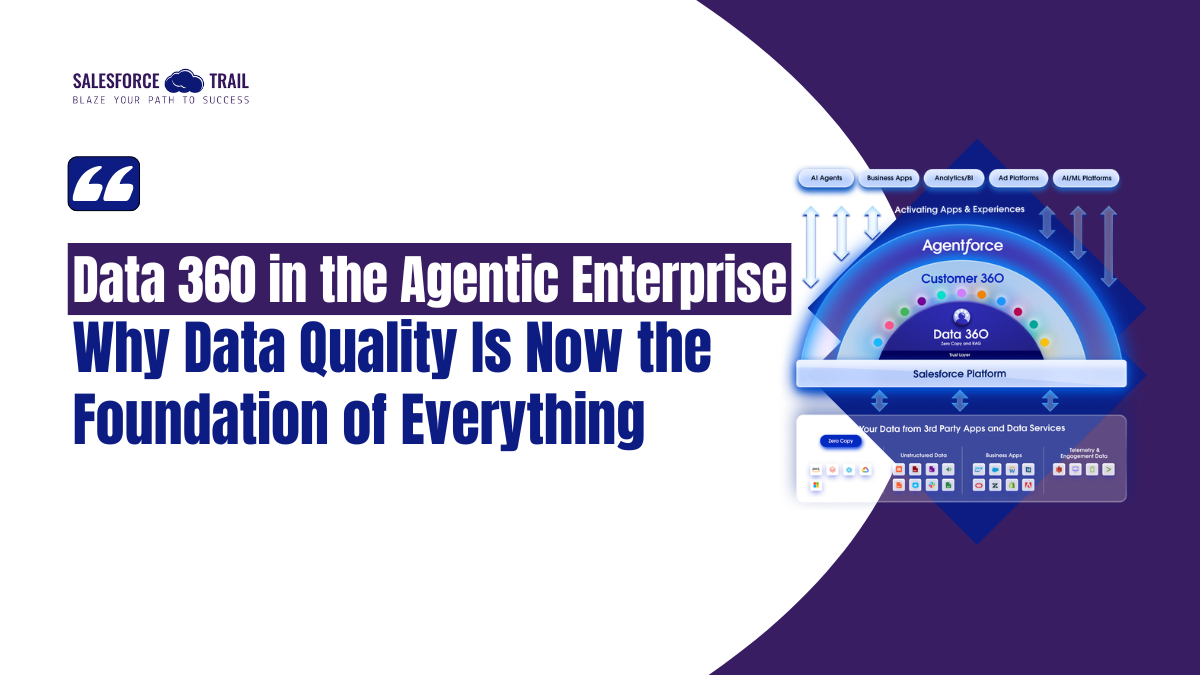
Most teams building on Agentforce spend their time on the right prompt structures, the cleanest agent logic, and the tightest guardrails. That work matters. But there’s a layer beneath all of it that quietly determines whether any of it works in production, and it’s rarely the first thing on the architecture checklist. Bad data breaks agents. Not occasionally. Consistently.
Salesforce Data 360 is built specifically to solve this. Salesforce formally positioned it as the “context layer” of the entire Agentforce 360 platform. Every agent, every workflow, every API call runs on top of it. If your data is fragmented, inconsistent, or stale, your agents will be too, regardless of how well you’ve written your instructions or tuned your models.
This article breaks down what Salesforce Data 360 actually is, how it fits into the agentic enterprise, and what a solid data architecture looks like for teams building on Agentforce today.
What Is Salesforce Data 360? (And What Happened to Data Cloud?)
If you’ve been in the Salesforce ecosystem for a while, you might know this platform by a different name. Salesforce Data Cloud was rebranded to Data 360 at Dreamforce 2025, becoming a formal part of the Agentforce 360 suite.
The name change isn’t just marketing. It reflects a real architectural shift in how Salesforce positions the platform’s role.
The old Data Cloud was primarily a marketing tool, built for audience segmentation, campaign activation, and customer data platform use cases. Data 360 serves the entire Agentforce 360 ecosystem. Sales agents, service agents, employee agents, and developer workflows all depend on it for context.
At its core, Data 360 is a real-time data platform that pulls in customer and operational data from any source: your CRM, ERP, data lakes, web logs, billing systems, IoT feeds, and external warehouses. It unifies all of that into a single unified customer profile and makes it available to agents in real time. In Q3 FY2026, Data 360 ingested 32 trillion records, up 119% year-over-year. That scale gives you a sense of the workload it’s designed to handle.
Agents Don’t Fail Because of Bad Prompts. They Fail Because of Bad Data.
Picture this: a customer contacts your AI agent and asks, “What’s the status of my return?”
A generic LLM without proper grounding answers with your company’s general return policy. It sounds confident, but it’s completely useless. The customer already knows the policy; they want to know about their return.
A Data 360-grounded agent pulls up the customer’s actual return record, their order history, their loyalty points balance, and the exact status of the item in transit. It resolves the case in one turn.
The difference between those two outcomes has nothing to do with prompting. It’s data.
This is what agent hallucination actually looks like in enterprise deployments. When customer records are scattered across the CRM, ERP, and data lake, with each system holding a slightly different version of the same customer, agents are forced to guess. And they guess confidently, which is worse than saying nothing at all.
Salesforce’s own Data Quality Management Framework makes it clear: fields that are unused, inconsistently populated, or filled with default values lead agents to produce incorrect answers. Data reliability isn’t something you fix once at deployment; it’s something you monitor continuously, because new integrations and process changes introduce new inconsistencies over time.
How Data 360 Fits Inside the Agentforce 360 Platform
The Agentforce 360 platform has four layers:
- Data 360 — the context layer. Real-time, unified organizational data.
- Customer 360 — the work layer. CRM, sales, service, and commerce workflows.
- Agentforce — the agency layer. Autonomous AI execution across all use cases.
- Slack — the engagement layer. Where humans and agents collaborate.
Data 360 sits at the foundation. The three layers above it only work as well as the data beneath them.
Architecturally, Salesforce Data 360 handles multiple tasks simultaneously. Identity resolution consolidates fragmented customer records into a single, trusted Customer 360 profile. Zero Copy integration, which grew 341% year-over-year in Q3 FY2026, allows agents to query data from external systems such as Databricks, Snowflake, and Google BigQuery without moving the data. Low-latency key-value stores enable millisecond response times for real-time personalization. And unstructured data pipelines handle chunking, vectorization, and embedding generation for RAG (Retrieval-Augmented Generation) across documents, transcripts, PDFs, and other formats.
With TDX 2026’s Headless 360 launch, Data 360 is now also exposed as MCP tools and CLI commands, meaning coding agents like Claude Code and Cursor can query live organizational data directly without navigating any UI.
What a Data-Ready Architecture for Agentforce Actually Looks Like
Before deploying any agent, here are five things that should be true about your data architecture.
Data Quality comes before Agent Deployment:
Run a profiling audit. Find the fields that are empty, inconsistently populated, or defaulted to placeholder values. Agents that reason with those fields produce wrong answers. Clean data first, then build.Choose your Latency Model Early:
Not all data needs to stream in real time. A case deflection agent needs millisecond response times. A campaign optimisation agent can batch-process overnight. Architect your Data 360 pipelines to match the latency each agent actually requires. Over-engineering for real-time across the board adds cost without adding value.Build Governance into the Data Layer, Not Around it.
Data 360 uses a consumption-based billing model broad access without proper controls creates real cost exposure. Implement data scoping, role-based access, and usage monitoring from day one.Treat Data Reliability as an Ongoing Concern, not a one-time Setup.
New integrations and process changes introduce new inconsistencies. Feed production session traces back to your data quality monitoring as part of the Agent Development Life Cycle. An agent that worked perfectly at launch can drift as the underlying data changes.
No Data Strategy, No Agent Strategy
There’s a version of this article that ends with “the future is bright” and a list of things to look forward to. That’s not what architects need.
Salesforce Data 360 is not one component of your agentic strategy; it’s the prerequisite for all of it. You can have perfect agent logic, tight guardrails, well-tuned models, and a clean Agent Script definition. If the data your agents reason from is fragmented, inconsistent, or stale, none of that saves you from producing wrong answers at production scale.
Frequently Asked Questions (FAQ)
Salesforce Data 360 is a real-time data platform that pulls in customer and operational data from across your entire tech stack, CRM, ERP, data lakes, web behaviour, and external warehouses and unifies it into a single, trusted customer profile. It sits at the foundation of the Agentforce 360 platform as the “context layer,” meaning every agent, workflow, and API call draws from it. Without it, agents have no reliable source of truth to reason from.
They are the same product. Salesforce officially rebranded Data Cloud as Data 360 on 14 October 2025. The rename reflects a real shift in scope. The old Data Cloud was built primarily for marketing activation, while Data 360 now serves the entire Agentforce 360 ecosystem: sales agents, service agents, employee agents, and developer workflows alike. All the core concepts you know from Data Cloud carry over directly.
Because the problem is rarely the prompt; it’s the data underneath it. When customer records are incomplete, outdated, or split across disconnected systems, agents fill the gaps with statistically plausible answers that sound right but aren’t grounded in reality. This is agent hallucination in practice. The fix isn’t better prompting; it’s data profiling, identity resolution, and continuous quality monitoring.
Start with a data profiling audit across your most agent-critical objects: Account, Contact, Case, Opportunity. Look for fields that are consistently empty, populated with default values, or duplicated across systems with conflicting answers. If you find significant issues, fix the data before building the agent. An agent that reasons from unreliable data will surface those problems at production scale, which is a harder situation to recover from than a delayed launch.

Arun Kumar
Arun Kumar is a 4x Salesforce Certified professional. He designs and implements scalable solutions that improve customer engagement, streamline business processes, and drive measurable results. Passionate about exploring the latest Salesforce innovations, Arun enjoys sharing practical insights and best practices to help businesses build smarter, data-driven strategies.
- Arun Kumar