

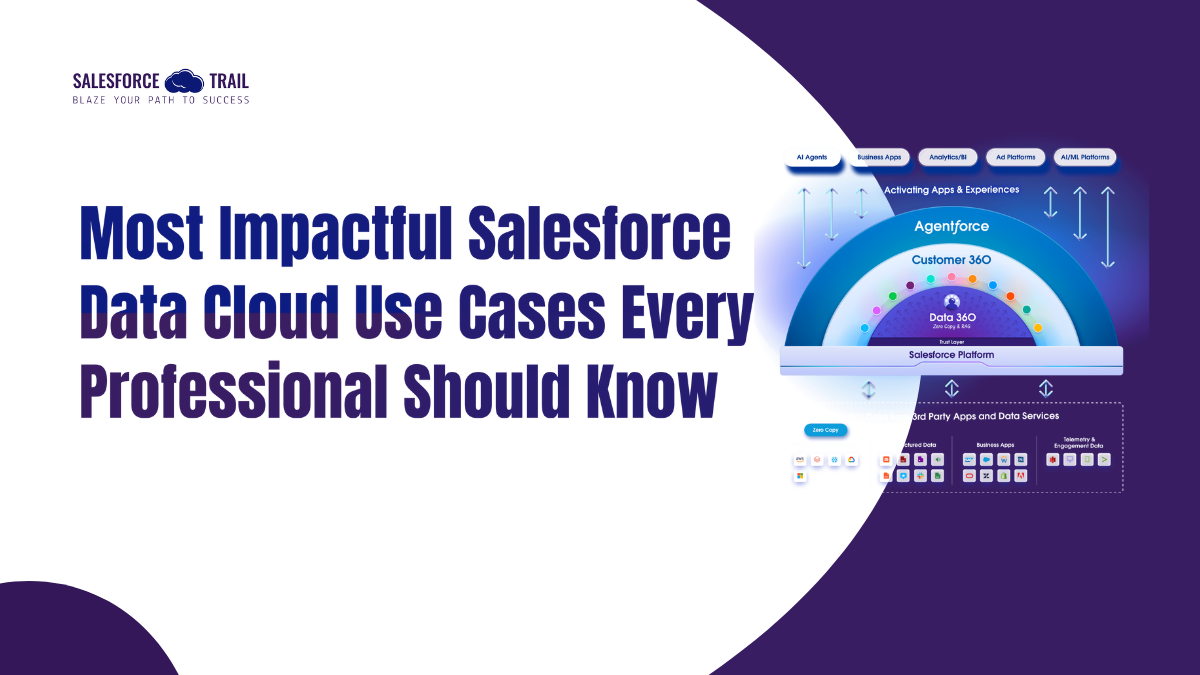
In today’s digital-first world, data has become the backbone of every successful customer experience. Salesforce Data Cloud, formerly known as Customer Data Platform (CDP), is at the center of this transformation. It unifies data from multiple systems, builds a real-time customer profile, and activates insights across Salesforce applications. For Salesforce professionals, understanding practical Salesforce Data Cloud Use Cases is essential to unlocking the full potential of this platform.
Below, we’ll explore the top 7 use cases where Data Cloud is making the biggest impact across industries.
Table of Contents
Building a Real-Time Customer 360
One of the most powerful Salesforce Data Cloud Use Cases is creating a unified, real-time view of each customer. Businesses often struggle with fragmented data stored across CRM, marketing, service, and commerce systems. Data Cloud consolidates these records, resolves identities, and generates a single “golden record.”
For Salesforce professionals, this means better accuracy in segmentation, improved analytics, and cleaner data for activation across all clouds. Whether you’re a marketer trying to personalize outreach or a service agent looking for the latest interactions, a real-time 360 ensures everyone is working from the same source of truth.
Key benefit: Faster decision-making and reduced duplication across Salesforce applications.
Personalized Marketing Journeys
Marketing personalization is no longer optional—it’s expected. With Data Cloud, professionals can create segments that update in real time based on customer behaviors, preferences, and past interactions. These segments can then be activated in Marketing Cloud, delivering personalized emails, SMS, push notifications, or even web experiences.
For example, if a retail customer abandons their cart, Data Cloud can instantly trigger a tailored offer. Or, in financial services, a high-value customer can be placed in a loyalty-focused campaign.
Key benefit: Dynamic personalization that drives higher engagement and conversion rates.
AI-Powered Next Best Action
Another impactful Salesforce Data Cloud Use Case is enabling AI-driven recommendations. By combining unified data with Einstein AI, Salesforce professionals can deploy predictive models that suggest the “next best action” for each customer.
For instance, a telecom company can proactively recommend an upgraded plan to a customer whose data usage consistently exceeds the standard plan. A healthcare provider can recommend relevant wellness programs based on a patient’s medical history.
These AI-driven insights can be delivered across Service Cloud, Sales Cloud, or Marketing Cloud, ensuring every interaction feels intelligent and timely.
Key benefit: Smarter recommendations that boost customer satisfaction and long-term value.
Omnichannel Engagement Orchestration
Customers today interact across multiple touchpoints—email, mobile, in-store, chatbots, and social media. A critical Data Cloud capability is orchestrating seamless omnichannel engagement.
By connecting customer data to all engagement channels, Salesforce professionals can ensure consistency. For example, if a customer interacts with a chatbot about a product, the next email they receive can reflect that context, and a service agent will also see it in their console.
Key benefit: Consistent, personalized experiences across every channel.
Predictive Sales and Lead Scoring
Sales teams often struggle with prioritizing leads. With Salesforce Data Cloud, predictive models can analyze intent signals, behavioral data, and historical patterns to assign lead scores.
For example, a B2B company can identify accounts most likely to convert based on engagement history, event participation, or product usage. This empowers sales reps to focus their time on high-value opportunities.
Key benefit: Shorter sales cycles and improved conversion rates through data-driven prioritization.
Proactive Customer Support
Support is often reactive, but with Data Cloud, it can become proactive. By unifying data from products, IoT devices, and past support tickets, companies can detect issues before customers even report them.
For instance, a software company can notify users of a potential problem and provide troubleshooting steps before it escalates into a major support case. Service agents equipped with a 360-degree view can resolve issues faster and with more context.
Key benefit: Increased customer trust and reduced churn through proactive support.
Data-Driven Compliance and Privacy Management
In industries like healthcare, banking, and retail, compliance is non-negotiable. Another important Salesforce Data Cloud Use Case is managing consent and privacy at scale. Data Cloud enables businesses to track consent preferences, deletion requests, and ensure customer data is used responsibly.
For Salesforce professionals, this means building customer trust while reducing the risk of regulatory penalties. With built-in governance and audit capabilities, teams can demonstrate compliance without slowing down personalization efforts.
Key benefit: Confidence in managing customer data securely and responsibly.
Why These Salesforce Data Cloud Use Cases Matter
The above Salesforce Data Cloud use cases highlight how unifying and activating data goes beyond simple integration. It’s about transforming how organizations operate—making customer interactions smarter, faster, and more personalized.
For professionals working across Salesforce Sales Cloud, Service Cloud, Marketing Cloud, and Commerce Cloud, Data Cloud becomes the connective tissue that unlocks the full value of these platforms. From real-time 360 profiles to AI-driven insights and omnichannel engagement, these use cases demonstrate why Data Cloud is a cornerstone for the future of customer experience.
Final Thoughts
As customer expectations rise, businesses can no longer rely on siloed systems and outdated batch processes. Salesforce Data Cloud enables real-time intelligence, powering use cases that drive measurable results in marketing, sales, service, and beyond.
By focusing on high-impact scenarios like personalization, AI-driven recommendations, predictive insights, proactive support, and compliance, Salesforce professionals can help their organizations unlock the full potential of customer data.


Most Reads:
- How to Become a Salesforce Consultant: A Complete Guide to Success
- How to Become a Salesforce Solution Architect: A Complete Guide to Success
- Best Tips and Tricks to Ace Your Salesforce Interviews in 2025
- Dreamforce 2025 Registration is Open Now: Everything You Need to Know
- How to Crack the Salesforce Interview: Real Questions and Tips from Experts
Resources
- [Salesforce Developer]- (Join Now)
- [Salesforce Success Community] (https://success.salesforce.com/)
For more insights, trends, and news related to Salesforce, stay tuned with Salesforce Trail
- Akanksha Shukla
- Akanksha Shukla