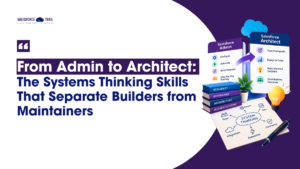



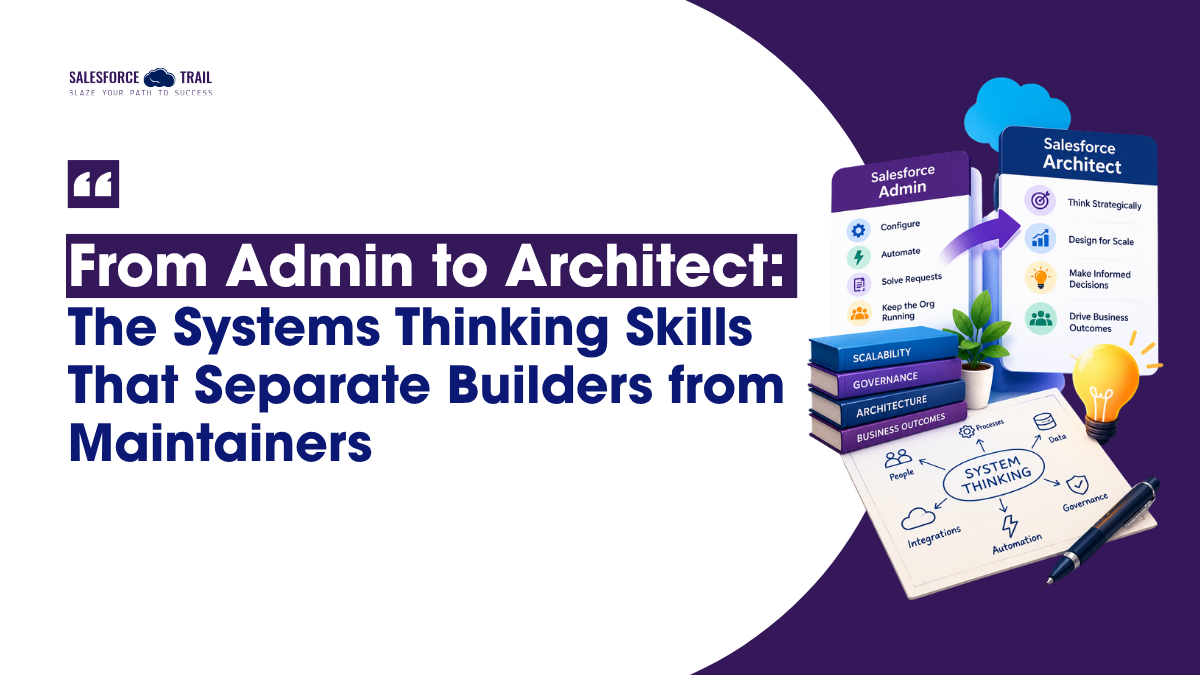
I spent years as the admin who could configure, automate, and build whatever the business needed. A field request on Monday, a validation rule by lunch, a Flow nobody even asked for by Friday because I’d discovered a simpler way to do it. I had the certs. I was fast. And for a long time, I couldn’t understand why I kept getting passed over while people who shipped less than me landed the architect titles.
The gap wasn’t skill. Nobody told me the thing holding me back was a way of thinking, not a missing credential. The admins who break through stop asking “how do I build this?” and start asking “should this be built at all, and what breaks if I do?”
This article is about that shift. Four habits that move you from someone who executes requests to an individual trusted with responsibility for results.
Table of Contents
Admin vs Architect: The Career Ceiling No One Warns You About
There are mostly three modes of working in an org, and they’re not just seniority levels. The maintainer keeps the system running. The builder ships what’s asked, cleanly and fast. The architect determines what actually needs to be built in the first place. Plenty of people spend years as expert builders and never cross into that third mode, because nobody ever told them it was a different job.
And it pays like a different job. According to 10K’s 2025 Salesforce Talent Ecosystem Report, demand for Technical Architects climbed roughly 27% while developer demand actually fell 12% — the only role on their list to drop. Architects remain a sliver of the available talent pool. Salary guides from recruiters like Mason Frank tell the same story from the money side: architect pay lands at roughly double a senior admin’s, depending on specialism and region.
If you want the clearest signal of all, it came from Salesforce itself. Writing on the official Salesforce Admins blog in early 2026, the Admin Relations team put it clearly: the real value of the role “has never been about which buttons to click. It has always been about the decision-making behind those clicks.”
When the vendor is telling admins this directly, that’s your cue.
Builder vs Architect: the tell isn’t the tool
Give a builder and an architect the same ticket: “Add a validation rule so reps can’t close a deal without a close reason.” The builder adds the validation rule. Done, next.
The architect pauses. Why are deals closing without a reason today? Is there an existing automation that already touches close? Will this block the integration that syncs opportunities to the finance system at 2 a.m.? Is a validation rule even the right fix, or is the real problem a missing required field upstream? Same ticket, completely different set of questions. The clicks are identical. The thinking isn’t.
Why This Skill Just Got More Valuable
You can’t talk about Salesforce careers in 2026 without talking about AI, so let’s be straight about it. Marc Benioff told CNBC that AI is already doing “30% to 50% of the work at Salesforce.” Take that for what it is: a CEO making a point about his own product. But the direction of travel is real. As Agentforce and AI assistants absorb the mechanical building, the value doesn’t disappear. It moves.
It moves toward the stuff a model can’t do for you. A Salesforce CTA made this argument on the company’s own Architecture blog: large language models run on “pattern recognition, not comprehension,” which is why “the Salesforce Architect should be accountable for every key architectural decision made, regardless of AI’s involvement.” The AI can draft the Flow. It can’t own the consequences.
So, if you have ever felt that you are ‘slow’ because you pause to think before building something, while a colleague might complete three tasks in the same amount of time it takes you to understand the dependencies — I would suggest looking at it from a different perspective. The act of pausing to think is not ‘slowness.’ In fact, it is precisely the quality that, over time, leads you to a senior role, whereas rushing to build things remains nothing more than a routine, run-of-the-mill task.
The 4 System-Thinking Skills That Separate Builders from Architects
None of these require a new certification. They’re things you can start doing on your very next ticket. The hard part isn’t learning them. It’s the discipline to slow down enough to use them when you’re busy, which is always.
Trace the consequences before you act
A builder reads “add a picklist value to the Stage field” and adds it. An architect reads the same request and pauses to ask what’s downstream. Which reports filter on that field? Which record-triggered flow has an entry condition watching for a specific stage? Is there an integration pushing that field to an external system that’s never heard of your shiny new value?
I learned this the embarrassing way. Added a value to help the sales team, felt good about the quick turnaround, and quietly broke a flow that only fired on the old options. Nobody noticed for three weeks. By then, the reporting was a mess.
Tracing consequences is really dependency awareness, and it maps straight to the “Adaptable” pillar of Salesforce’s Well-Architected framework: design so that one change doesn’t cascade into ten. This is also the habit AI helps with least, because it depends on knowing your specific org, not orgs in general.
Weigh every change against Technical Debt
Every field you add and every automation you spin up is something a human has to maintain later. Say yes too easily, and you’re borrowing against the org’s future, usually at a bad interest rate.
You’ve seen the symptom. An Account object carrying hundreds of custom fields, half of them unused, nobody quite sure which ones are safe to remove. The DevOps vendor Gearset has written about orgs dragging around hundreds of dead fields with live dependencies tangled behind them. That didn’t arrive overnight. It’s the sum of a hundred reasonable-sounding yeses.
Architects treat “can you just add…” as a request with a cost, not a favor to grant. And there’s a sharp AI angle: agents are only as good as the data they can read. An org drowning in redundant fields and conflicting automations can’t trust Agentforce to do anything useful. Cleaning that up stopped being janitorial work the moment AI showed up. It’s some of the most strategic work in the building now.
Choose the simpler org over the cleverer one
I’ll admit it. There’s a real pleasure in building something slick in Flow, the kind of thing that makes another admin go “wait, how did you do that?” I built plenty of those. Most of them became somebody’s debugging nightmare eighteen months later.
The architect instinct runs the other way. Boring and legible beats clever and fragile, because the next person has to understand it. And the next person might be you, with no memory of what past-you was thinking.
Salesforce builds this into its own guidance. The Record-Triggered Automation decision guide on the Architecture Center recommends choosing between Flow and Apex based on “automation density” (how much is happening on the object, the record volumes, how tangled the dependencies get) and keeping to one primary automation entry point per object. That’s a systems question, not a matter of personal taste. The simplest design that meets the requirement usually wins.
Say no, with a good reason
This habit scares people, and it marks you as senior faster than anything else.
Saying no feels unhelpful. It isn’t. It’s governance. Salesforce’s own admin guidance now describes good governance as including “the ability to pause, escalate, or veto architectural choices that introduce risk.” You have official cover to push back.
The whole trick is the reason attached to it. “No” on its own is obstruction. “No, because” is architecture. Here’s roughly how that sounds in real life:
Stakeholder: Can you add a new field to track this?
You: I can, but we’ve already got two fields capturing something close to this. Add a third and our reports split across all three, and then nobody trusts the numbers. Give me ten minutes, and I think we can reuse what’s already there.
Same outcome for them, less debt for the org, and you just did the architect’s job out loud. People remember whoever protected them from their own rushed request.
How to Start Thinking Like an Architect This Week
You don’t need a title or anyone’s permission to practice this.
Start a decision log. A plain document where you record every significant request, what you decided, and why, including the ones you talked someone out of. Two minutes per entry. Six months from now, it’s both your reasoning trail and the strongest evidence you’ll have for a promotion conversation.
Run one honest review of your org against the three Well-Architected pillars (Trusted, Easy, Adaptable). Salesforce relaunched this program in October 2025 as the Salesforce Architecture Program, and the Architecture Center is free to read. Pick a single object and see what you actually find.
Read the relevant decision guide before your next build, not after you’ve already clicked Save. Even ten minutes reframes how you approach the problem.
And get closer to the “why.” When a request comes in, ask what the person is really trying to achieve before you open Setup. Half the time, the best solution isn’t what they typed in the ticket.
The Real Promotion Is a Mindset
The certifications still matter. Learning Apex still matters. But those are baseline requirements now, the stuff AI and a few thousand other admins can also do. What’s scarce is the person trusted with consequences, the one who sees the whole system instead of the single ticket in front of them.
Here’s the reframe I wish someone had handed me years earlier. That caution you feel, the instinct to slow down and check what a change touches, the reluctance to build the clever thing- you might have read all that as being slow. It’s the opposite. It’s the exact habit that compounds into seniority.
You don’t become an architect the day you pass the architect certification exam. You become one the first time you talk somebody out of building the wrong thing.
Frequently Asked Questions
An admin builds and configures what the business asks for. An architect decides what to build, how the pieces fit together, and the long-term consequences. The admin owns the solution; the architect owns the decision behind it.
It helps, and the architect credential path includes a developer cert. But knowing Apex isn’t the dividing line. Knowing when Apex is the wrong choice and a simpler Flow will do — that’s the architect skill.
There’s no fixed timeline. It depends far more on the range of problems you’ve solved than on years served. Someone who’s handled integrations, data model redesigns, and messy migrations will get there faster than someone who’s built the same request type for five years.
Safer than most. AI is absorbing the mechanical building, which pushes value toward judgment, governance, and accountability — the parts of architecture a model can’t own. Most working architects treat AI as leverage, not a threat.
Yes. Plenty of people work in architect roles without the Certified Technical Architect credential. Hands-on experience across varied, complex problems carries real weight. The CTA is a strong signal, not a mandatory gate.
Start a decision log, map dependencies before you build, and practice declining one request a sprint with the trade-offs attached. You’re building the habit on the org you already have.

Arun Kumar
Arun Kumar is a 4x Salesforce Certified professional. He designs and implements scalable solutions that improve customer engagement, streamline business processes, and drive measurable results. Passionate about exploring the latest Salesforce innovations, Arun enjoys sharing practical insights and best practices to help businesses build smarter, data-driven strategies.
- Arun Kumar