

For years, using Salesforce meant opening a browser. Clicking a console. Navigating a UI. That era ends now. Salesforce just announced Headless 360 at TDX 2026, and now the platform development will look the same again.
Let’s be clear about what’s happening: Salesforce isn’t just releasing new features. It’s announcing a full architectural rethink, the company says, that began quietly two and a half years ago when its leadership made a single bet: rebuild the entire platform for AI agents.
The result is Salesforce Headless 360, unveiled at TrailblazerDX 2026 in San Francisco. The idea is simple: every capability Salesforce has built over a quarter-century is now accessible as an API, an MCP (Model Context Protocol) tool, or a CLI command. No GUI required. No human clicking through menus. Your agents can now reach into the heart of Salesforce the same way a developer calls an endpoint.
- 60+ new MCP tools released
- 30+ preconfigured coding skills
- 300% growth in custom AI agents on Slack since Jan
- $50M Builders Fund for the ecosystem
The Three Pillars of Headless 360
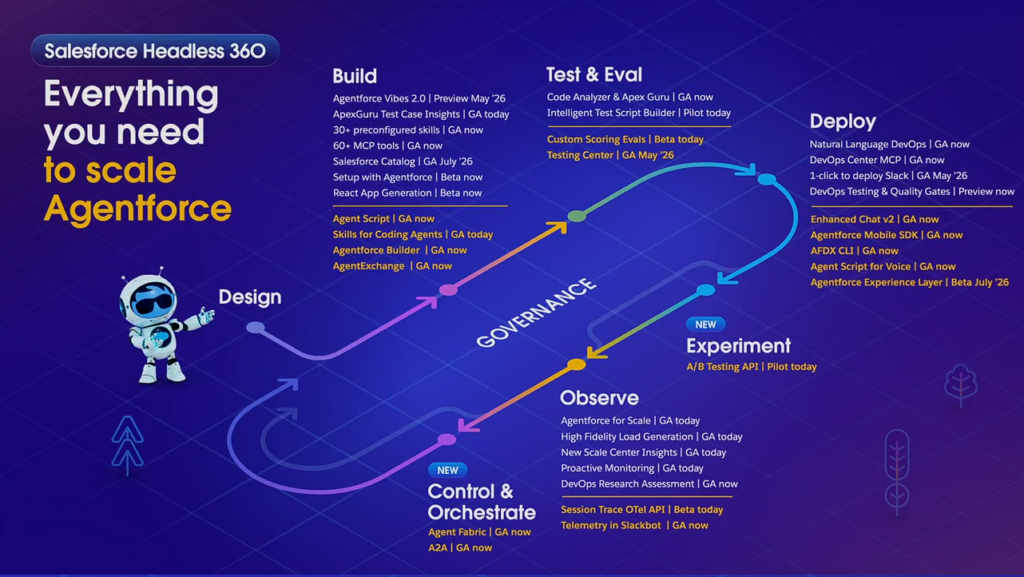
The announcement packages three major capability areas. Here’s how to think about each one:
Build Any Way You Want
Over 60 new MCP tools and 30+ preconfigured coding skills give your coding agent complete, live access to your entire Salesforce org data, workflows, and business logic directly from Claude Code, Cursor, Codex, Windsurf, and VS Code, no Setup tab. No clicking. Just your agent and the platform.
The Conversation Is the Interface
The new Agentforce Experience Layer separates what an agent does from how it appears, delivering rich interactive components (approval cards, decision tiles, flight rebooking flows) natively across Slack, Mobile, Teams, ChatGPT, Claude, and Gemini. Build once, render everywhere.
Build Agents You Can Trust at Scale
A full new toolset for agent lifecycle control, Testing Center for pre-launch gap analysis, Custom Scoring Evals to grade decision quality (not just execution), Agent Script for locking down critical business logic, plus post-launch Observability, Session Tracing, and A/B Testing across real traffic.
Agentforce Vibes 2.0 and the Dev Experience Leap
Alongside Headless 360, Salesforce is shipping Agentforce Vibes 2.0, its browser-based, cloud-hosted VS Code IDE that now ships with full org awareness, multi-model support including Claude Sonnet and GPT-5, and is available at no cost in every Developer Edition org.
This is significant. The free Developer Edition now includes Agentforce Vibes with Claude Sonnet 4.5 as the default coding model, plus Salesforce Hosted MCP Servers, all without writing a check. The message to the vibe-coding generation of builders is explicit: come build on Salesforce. The bar to entry just dropped to zero.
For CI/CD pipelines, the DevOps Center MCP brings programmatic access into deployment workflows. Natural language DevOps means you describe what you want deployed; the agent handles execution. Cycle times reportedly cut by up to 40%. And if you want total visual control, Native React Support is now live for any design language, any interaction model, full platform power underneath.
Agent Trust: The Problem Nobody Else Is Solving
This is where Salesforce makes its most interesting argument. Shipping an agent is easy. Knowing whether it will behave correctly six weeks after launch, across every edge case, under conditions you never anticipated, that’s where most enterprise AI deployments quietly fall apart.
Salesforce’s answer is a set of tools designed around one uncomfortable truth about agents: they are probabilistic, not deterministic. They don’t execute the same way every time. They reason their way to unexpected outcomes. There is no bug to fix; there is behavior to observe, evaluate, and tune.
The Agent Script language (now open source) lets you define exactly which parts of an agent’s behavior must follow explicit business logic and which parts can reason freely. The Testing Center surfaces policy violations before launch. Custom Scoring Evals don’t just check whether something ran; they score whether the agent made the right decision, against criteria you define. And post-launch Session Tracing shows not just what happened, but the why behind every decision path.
This is the enterprise-grade trust infrastructure that vibe-coding alone can’t provide. And it’s baked into the platform.
AgentExchange: One Marketplace to Rule Them All
TDX 2026 also saw the launch of AgentExchange, a unified marketplace consolidating 10,000 Salesforce apps, 2,600+ Slack apps, and 1,000+ Agentforce agents, tools, and MCP servers into a single AI-searchable, one-click-activated destination. Partners include Google, DocuSign, Notion, and more.
The early results shared by Salesforce are striking: Notion cut its average sales cycle from four months to three weeks after listing. DocuSign processed 200+ private offers in Q4 2025 with 60% faster time to signature. MeshMesh closed its first Fortune 500 customer six weeks post-listing.
A $50M Builders Fund provides investment, engineering support, and go-to-market support for Agentblazers ready to scale. This is the distribution engine Headless 360 needed.
Our Take: What Salesforce Professionals Should Watch
For Admins: Headless 360 is primarily a developer story for now, but the Experience Layer changes what users expect from the tools you build and deploy. Richer Slack-native workflows, voice interactions, and cross-surface components will become table stakes. Start learning how the Experience Layer works.
For Developers: The MCP ecosystem is where the action is. Sixty-plus new tools, native React, multi-model Vibes 2.0, and a free dev org with Claude Sonnet built in, this is the most powerful Salesforce development environment that has ever existed. Get into a sandbox and start exploring before your clients ask you why you aren’t using it.
For Architects: Agent Script and the trust tooling deserve your full attention. Governing agent behavior at enterprise scale is the design challenge of the next three years. The companies that figure out how to define, evaluate, and tune agent behavior against business rules will separate from those that can’t.
For ISVs and Partners: AgentExchange is the distribution play you’ve been waiting for. The $50M Builders Fund is real money with real go-to-market support attached. The window to plant your flag in an AI-guided, one-click marketplace is open now.
Frequently Asked Questions (FAQ)
Salesforce Headless 360 is an API-first architecture that exposes the entire Salesforce platform data, workflows, business logic, and compliance controls as APIs, MCP tools, and CLI commands. It allows AI agents and developers to build and act on the platform without using a browser or graphical UI.
It was officially announced on April 15, 2026, at TrailblazerDX 2026 (TDX 2026) in San Francisco. Salesforce states the underlying rebuild began approximately two and a half years prior.
The Agentforce Experience Layer is a UI service that separates what an agent does from how it appears on screen. It lets developers build interactive components, approval cards, decision tiles, and data layouts that render natively across Slack, Teams, Mobile, ChatGPT, Claude, Gemini, and any MCP-compatible client.
Agent Script is a Salesforce-specific definition language (now open source) that lets you control agent behavior before it goes into production. You define which parts of the agent must follow explicit business logic and which parts can reason freely. It’s designed to address the probabilistic nature of AI agents in enterprise settings.
Yes. Every Salesforce Developer Edition org now includes Agentforce Vibes (the browser-based IDE) with Claude Sonnet 4.5 as the default model, and Salesforce Hosted MCP Servers all at no cost as of TDX 2026.
AgentExchange is a unified marketplace announced at TDX 2026 that brings together 10,000 Salesforce apps, 2,600+ Slack apps, and 1,000+ Agentforce agents and MCP servers. It includes a $50M Builders Fund for partners and ISVs building in the ecosystem.

Priya Rastogi
Priya is a 3x Salesforce Certified who believes in the power of continuous learning and collaboration. She’s passionate about exploring how Salesforce can simplify work, boost productivity, and create better user experiences. When she’s not experimenting with new features or automating processes, Priya enjoys connecting with fellow Trailblazers and sharing insights to help others grow in their Salesforce journey.
- Priya Rastogi
- Priya Rastogi
- Priya Rastogi

- Priya Rastogi