
Close Menu

    Subscribe to Updates

    Get the latest creative news from FooBar about art, design and business.

    What's Hot

    How to Handle High-Volume API Integrations in Salesforce Without Hitting Limits

    December 19, 2025

    How to Think Like a Salesforce Architect: Mindset Shifts Every Pro Should Learn

    December 17, 2025

    Salesforce Business Rules Engine (BRE) Explained: Smarter Decisioning Beyond Apex & Custom Metadata

    December 15, 2025
    Facebook X (Twitter) Instagram
    Facebook Instagram LinkedIn WhatsApp Telegram
    Salesforce TrailSalesforce Trail
    • Home
    • Insights & Trends
    • Salesforce News
    • Specialized Career Content
      • Salesforce
      • Administrator
      • Salesforce AI
      • Developer
      • Consultant
      • Architect
      • Designer
    • Certifications Help
    • About Us
    • Contact Us
    Salesforce TrailSalesforce Trail
    Home - Administrator - Understanding the Sales Module Life Cycle: A Complete Guide for Salesforce & CRM Professionals
    Administrator

    Understanding the Sales Module Life Cycle: A Complete Guide for Salesforce & CRM Professionals

    Ganesh EgaBy Ganesh EgaDecember 12, 20254 Mins Read
    Facebook LinkedIn Telegram WhatsApp
    Understanding the Sales Module Life Cycle
    Share
    Facebook LinkedIn Email Telegram WhatsApp Copy Link Twitter

    Managing a modern sales process requires more than spreadsheets and scattered notes—it demands a structured system that helps sales teams track prospects, qualify real opportunities, and close deals with confidence. That’s exactly where a Sales Module within a CRM (like Salesforce or Dynamics 365) becomes essential.

    The Sales Module acts as the digital backbone of your sales operations. It centralizes customer information, automates manual tasks, and ensures every lead moves through the pipeline with clarity and accountability. Whether you’re a Salesforce professional or new to CRM concepts, understanding this life cycle is key to optimizing your end-to-end sales workflow.

    In this guide, we’ll break down each stage in the Sales Module life cycle using simple, practical language—so you can easily connect these concepts to Salesforce objects and real-world processes.

    What is the Sales Module?

    The Sales Module is a core component of Dynamics 365 CRM (or any CRM system) that helps businesses manage everything related to selling products or services. It streamlines the entire customer journey from the first interaction to the final payment, ensuring that every step is organized, tracked, and easy for sales teams to manage.

    In simple terms, it’s like having a digital assistant for your sales process, making sure no lead is missed, every opportunity is tracked, and every deal is closed efficiently.

    Sales Module Life Cycle

    Think of the sales process like a story:
    A person becomes interested → Company starts talking → Customer decides to buy → Company delivers.

    Here’s the simplified cycle:
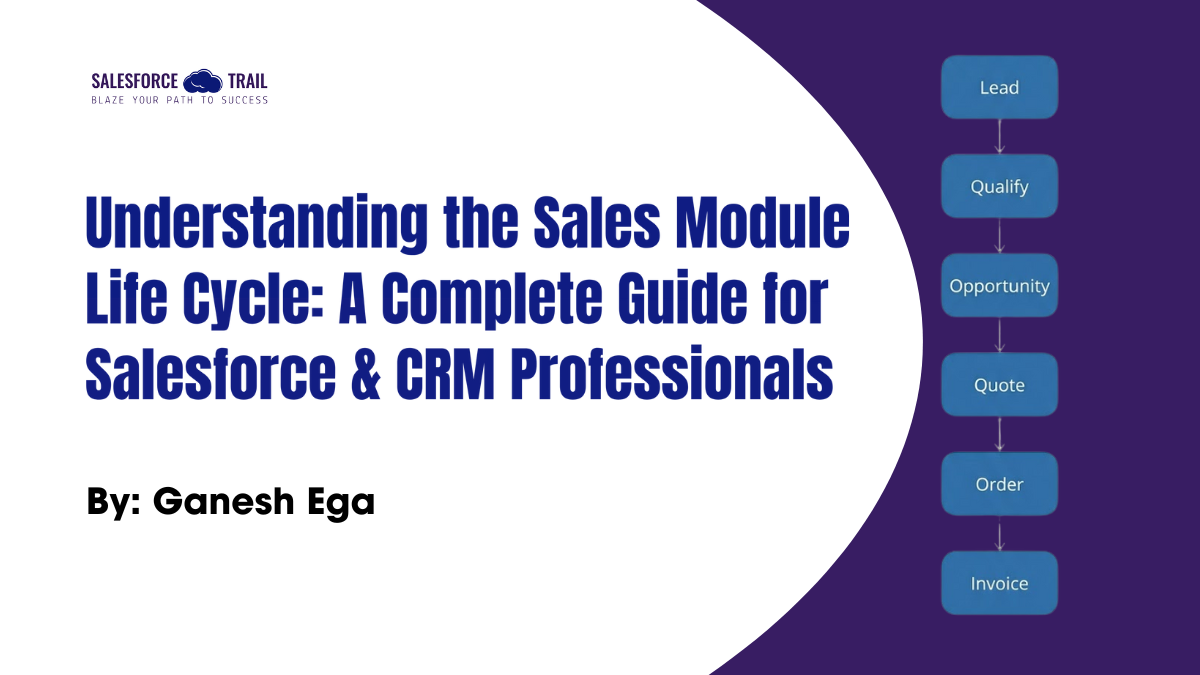
    Lead → Qualify → Opportunity → Quote → Order → Invoice

    Sales Module lifecycle

    Step 1: Lead

    A Lead is someone who shows initial interest in your product or service.
    This interest can come from:

    • Marketing campaigns
    • Website forms
    • Calls
    • Social media
    • Referrals

    At this stage, the person is just a possibility — not yet a confirmed customer.

    Example:
    A visitor fills out a form on your website requesting a demo of your CRM software.

    • Source: Website form
    • Details: Name, Email, Company, Interest in CRM solution

    Step 2: Qualify / Disqualify

    The sales team evaluates the lead to decide if it’s worth pursuing.

    • If the lead is a good match (budget, need, interest), you qualify it.
    • If not suitable, you disqualify it (reasons: no interest, no budget, duplicate, etc.).

    When a lead is qualified, Dynamics 365 automatically creates:
    ✔ Account
    ✔ Contact
    ✔ Opportunity

    Example:
    Your sales rep calls the lead and finds:

    • Budget: $10,000
    • Need: CRM for 50 users
    • Timeline: Next 3 months
      ✅ Qualified: System creates Account, Contact, Opportunity
      ❌ Disqualified: Reason: No budget or duplicate lead
    🔍 Read More: TDX 2026 Call for Participation Is Live: Everything you Need to know

    Step 3: Opportunity

    An Opportunity represents a potential deal.
    At this stage, the salesperson:

    • Understands customer requirements
    • Estimates revenue
    • Tracks timeline and competition
      All follow-ups, activities, and interactions are recorded here.

    Example:
    Opportunity created for ABC Corp:

    • Estimated Revenue: $12,000
    • Close Date: 30 days
    • Activities: Email follow-up, product demo scheduled
    • Competitors: XYZ CRM

    Step 4: Quote

    A Quote is a formal document shared with the customer.
    It includes:

    • Products / Services
    • Pricing
    • Discounts
    • Terms & Conditions

    Quotes can be edited, revised, and re-sent until the customer approves.

    Example:
    Quote sent to ABC Corp:

    • Products: CRM License (50 users)
    • Price: $12,000
    • Discount: 10%
    • Terms: Payment within 30 days

    Step 5: Order

    When the customer accepts the quote, it becomes an Order.
    This means the customer has agreed to purchase, and the deal is confirmed.

    Example:
    ABC Corp accepts the quote → Order created:

    • Order Number: ORD-12345
    • Status: Confirmed
    • Delivery: Immediate activation of CRM licenses

    Step 6: Invoice

    An Invoice is generated from the order for payment.
    Once the invoice is issued, the sales process is officially complete.

    Example:
    Invoice generated:

    • Invoice Number: INV-98765
    • Amount: $10,800 (after discount)
    • Due Date: 30 days
    • Payment Method: Bank Transfer

    Full Process in One Line

    👉 Lead → Qualify → Opportunity → Quote → Order → Invoice

    🔍 Read More: Write Better Salesforce Apex Code with Layered Architecture: A Developer’s Guide

    Why This Process Matters

    When businesses follow a structured Sales Module process, they benefit from:

    • Better sales forecasting

    Opportunities show revenue potential and pipeline health.

    • Stronger customer experience

    Every interaction is recorded, ensuring personalized and timely communication.

    • Reduced manual work

    Automation removes repetitive tasks and prevents errors.

    • Data-driven decisions

    You can track what’s working (and what’s not) across your sales funnel.

    For Salesforce professionals, understanding these concepts enables them to design efficient sales processes, optimize automation, and create more effective sales dashboards and reports.

    Salesforce Trail

    Final Thoughts

    The Sales Module is more than a feature; it’s a framework that keeps your entire sales pipeline structured and predictable. From capturing a lead to issuing an invoice, every stage plays an important role in driving revenue and building customer trust.

    When implemented effectively, a Sales Module becomes the core engine powering business growth. Whether you’re mapping processes in Salesforce or supporting a CRM rollout, mastering this life cycle helps you create stronger, scalable sales operations.

    Ganesh Ega
    Ganesh Ega
    CRMA Developer

    Ganesh brings over 4+ years of expertise in CRM Analytics, with a strong background in Salesforce development. As a seasoned software developer, he has created numerous dashboards and solutions using Salesforce CRM Analytics. His passion for staying up-to-date with the latest enhancements and features drives him to continuously master new skills. Ganesh is dedicated to sharing his knowledge and expertise with others, empowering them to unlock the full potential of CRM Analytics

    • Ganesh Ega
      #molongui-disabled-link
      Preparing Data for Einstein Discovery with CRM Analytics
      August 25, 2025
      Preparing Data for Einstein Discovery with CRM Analytics: A Practical Guide
    • Ganesh Ega
      #molongui-disabled-link
      Salesforce Acquisition
      June 2, 2025
      Salesforce Acquires Informatica for $8 Billion: A Strategic Move for AI Dominance
    • Ganesh Ega
      #molongui-disabled-link
      CRM Analytics Summer '25
      May 27, 2025
      CRM Analytics Summer ’25 Release Updates
    • Ganesh Ega
      #molongui-disabled-link
      Salesforce CRM Analytics
      May 12, 2025
      Exploring Salesforce CRM Analytics: A Complete Guide to Unlocking Business
    CRM CRM Sales Process Dynamics 365 Sales Module Sales Module Life Cycle salesforce
    Share. Facebook LinkedIn Email Telegram WhatsApp Copy Link

    Related Posts

    How to Handle High-Volume API Integrations in Salesforce Without Hitting Limits

    December 19, 2025

    How to Think Like a Salesforce Architect: Mindset Shifts Every Pro Should Learn

    December 17, 2025

    Salesforce Business Rules Engine (BRE) Explained: Smarter Decisioning Beyond Apex & Custom Metadata

    December 15, 2025
    Add A Comment
    Leave A Reply Cancel Reply

    Advertise with Salesforce Trail
    Connect with Salesforce Trail Community
    Latest Post

    6 Proven Principles to Drive Faster Salesforce CRM Adoption

    November 3, 2025

    Driving Revenue Efficiency with Sales Cloud in Product Companies

    October 30, 2025

    How to Become a Salesforce Consultant: A Complete Guide to Success

    August 15, 2025

    5 Expert Tips for Salesforce Consultants and Architects to Improve Collaboration

    April 9, 2025
    Top Review
    Designer

    Customizing Salesforce: Tailor the CRM to Fit Your Business Needs

    By adminAugust 6, 20240

    Salesforce is an adaptable, powerful customer relationship management (CRM) software that businesses can customize, and…

    Sales Professional

    Unlock 10 Powerful Sales Pitches to Boost Your Revenue by 30X

    By Mayank SahuJuly 4, 20240

    Sales is a very competitive arena, and it is followed by one must have a…

    Salesforce Trail
    Facebook X (Twitter) Instagram LinkedIn WhatsApp Telegram
    • Home
    • About Us
    • Write For Us
    • Privacy Policy
    • Advertise With Us
    • Contact Us
    © 2025 SalesforceTrail.com All Right Reserved by SalesforceTrail

    Type above and press Enter to search. Press Esc to cancel.