
When people think of Sales Cloud, they often picture a simple CRM for tracking leads and opportunities. However, for product-based companies where sales cycles are complex, deal sizes are large, and compliance requirements are strict, Sales Cloud can offer much more.
When implemented with scalability and automation in mind, it becomes the engine that drives revenue efficiency across the organization — connecting Sales, Legal, Finance, and Operations into a unified, insight-driven workflow.
The Hidden Complexity in Product Sales
Unlike service-based businesses, product companies deal with multiple moving parts — from configurable deal structures and pricing to contracts that span multiple regions or regulatory conditions.
Sales teams are often slowed down by:
- Manual contract generation and review cycles
- Siloed data between sales and legal teams
- Delays in deal approvals and revenue booking
- Limited visibility into renewals or amendments
That’s where Sales Cloud, designed with automation and compliance at its core, can dramatically transform outcomes.
Real-World Experience: Varian Medical Systems
In one of my key Sales Cloud implementation projects for Varian Medical Systems, a North America–focused product company, the challenge was clear — contract creation and revenue booking were manual, inconsistent, and prone to delays.
The sales team needed a configurable and compliant contract automation framework that could streamline the journey from “Closed Won” to “Contract Signed.”
What We Built
- Configurable Agreement Framework: Designed to handle multiple contract types — MSA, NDA, and SOW — within one scalable model.
- Automated Contract Lifecycle Tracking: Enabled automated status updates across each approval stage and renewal event, ensuring no opportunity fell through the cracks.
- Audit and Compliance Controls: Built custom validation and field-level visibility to align with industry regulations, particularly in the healthcare sector.
- Cross-Functional Data Visibility: Integrated Sales, Legal, and Operations teams through shared dashboards and automated notifications.
The Result
- Faster contract execution times
- Reduction in manual errors
- Improved visibility for Legal and Finance
- Streamlined revenue recognition process
In short, automation didn’t just make sales faster — it made revenue recognition more reliable and cross-team collaboration smoother.
🔍 Read More: Top 5 Salesforce Tools Developers Use Every Day
Designing the Agreement Data Model for Scalability
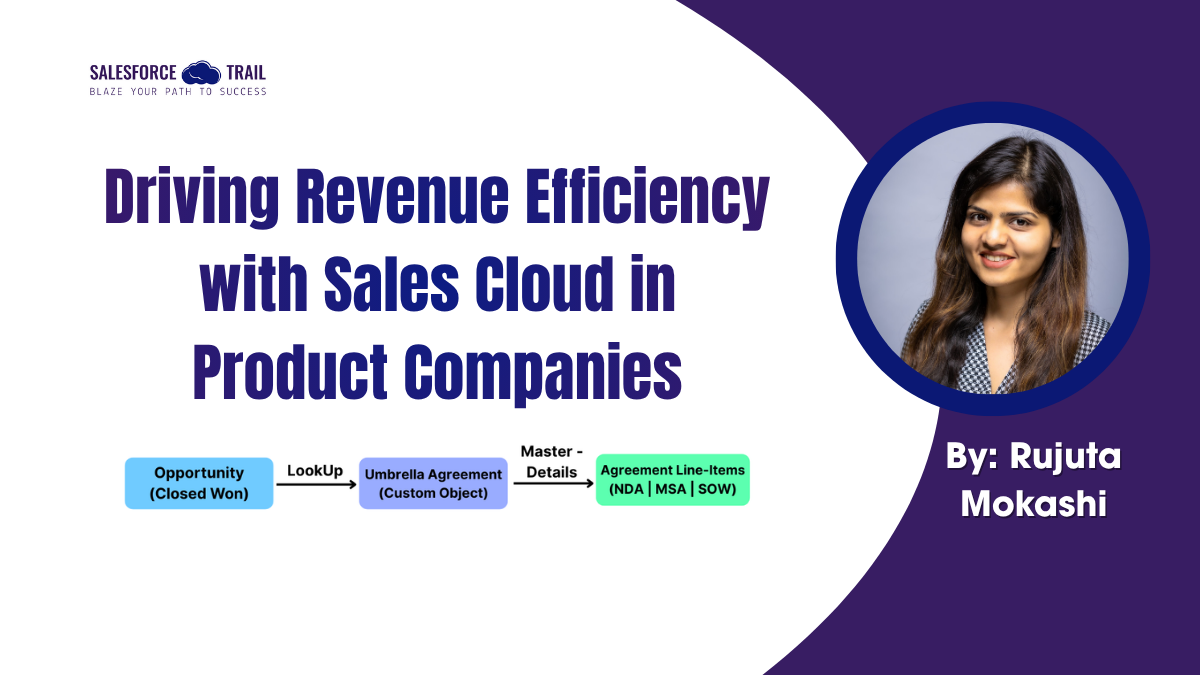
To support growth and compliance, we implemented a flexible agreement data model that works closely with Sales Cloud’s standard objects while adding necessary custom layers.
Here’s how it was structured conceptually:
Each Agreement record is directly connected to its Opportunity, enabling teams to handle various deal types and renewal paths within the same system.
This design empowered:
- Legal teams to track approval stages automatically
- Finance teams to verify deal values before booking
- Sales teams to initiate renewals with a single click
- Management to forecast revenue accurately through unified reporting
By creating relationships that mimic real-world business dependencies, Sales Cloud became the single source of truth for revenue integrity.

Why This Matters for Product Companies
Product companies often struggle to balance sales agility and compliance discipline with Sales Cloud; automation helps close that gap.
Scalable Global Selling
A flexible contract framework enables the inclusion of new regions, currencies, or regulatory requirements without requiring reengineering of the system.
Frictionless Renewals and Upsells
Automated workflows help sales representatives spot renewal opportunities early, while ensuring the approval process facilitates a smooth transition between teams
Foundation for CPQ and Subscription Transitions
Once agreement governance is standardized, integrating Salesforce CPQ or Revenue Cloud becomes straightforward, creating a natural upgrade path for maturing product companies.
Improved Forecast Accuracy
With consistent contract data tied to opportunities, sales leaders gain a more predictable view of future revenue and potential risks.
Best Practices for Implementing Sales Cloud in Product Environments
Based on multiple implementations across industries like healthcare, manufacturing, and telecommunications, here are a few key takeaways:
Start with Data Modeling Before Automation
Don’t rush to build flows or triggers. First, define how objects (Opportunities, Agreements, Contracts) will relate and scale.Prioritize Compliance-First Automation
In regulated industries, automation must serve compliance, not bypass it. Build validation rules and approval hierarchies early.Enable Cross-Departmental Visibility
Utilize shared dashboards and Chatter feeds to ensure the Legal and Operations teams stay in sync in real time.Adopt Iterative Rollouts
Deploy automation in phases, start with one deal type (e.g., SOW) before expanding to others. This helps ensure adoption and governance.Plan for Future Revenue Cloud Integration
Lay a foundation that can later accommodate CPQ, billing, and subscription management modules.
The Bottom Line
For product-based businesses, the key to success lies not just in selling efficiently but in doing so with compliance, visibility, and repeatability.
When implemented thoughtfully, Sales Cloud enables companies to:
✔ Standardize complexity
✔ Automate compliance
✔ Connect Sales → Legal → Operations seamlessly
That’s when Sales Cloud evolves from being just a CRM into a strategic revenue operations platform that fuels growth and builds trust across teams.
Most Reads:
- 5 Agentic Lessons Learned from the Rise of the Agentic Enterprise Era
- What is Agentic Analytics? Your Guide to the Future of AI-Driven Insights
- Top 3 Takeaways from the Dreamforce 2025 Keynote: The Era of the Agentic Enterprise
- Dreamforce 2025 Main Keynote Top Announcements You Can’t Miss
- Your First 90 Days as a Salesforce Admin: A Step-by-Step Checklist
Resources
- [Salesforce Developer]- (Join Now)
- [Salesforce Success Community] (https://success.salesforce.com/)
For more insights, trends, and news related to Salesforce, stay tuned with Salesforce Trail

Rujuta Mokashi
A technology passionate Salesforce Consultant with 7.5 years of experience in implementing Salesforce Sales and Service Cloud solutions. I have worked on the Public Sector, Finance, Healthcare, and Telecommunication domains, gaining exposure to both functional and technical aspects of the Salesforce ecosystem. Skilled at Salesforce programming implementations and effective stakeholder engagement to support successful project outcomes. I have demonstrated a strong commitment to delivering quality solutions tailored to client requirements. With a focus on fostering collaboration and building lasting relationships, I have contributed to impactful projects across diverse industries.
- This author does not have any more posts.