

If you’re a Salesforce Architect and haven’t started planning your TDX 2026 schedule yet, now’s the time. This year’s conference isn’t just another set of product updates; it reflects a genuine shift in how Salesforce expects architects to think, build, and lead.
Agentforce has moved from preview buzz to production reality. Data 360 is no longer a “future-state” conversation. And the Well-Architected Framework is being rewritten to meet the demands of AI-powered systems. Architects who stay current with these changes will design better solutions.
This guide breaks down the 10 sessions most relevant to architects and a few can’t-miss moments beyond the main track.
Table of Contents
What is TrailblazerDX 2026?
TrailblazerDX (TDX) is Salesforce’s annual developer conference, where Salesforce previews platform direction, shares new tooling, and brings the ecosystem together for hands-on learning. TDX 2026 centers on what Salesforce calls the “Agentic Enterprise,” a model in which AI agents and humans work side by side, powered by Data 360 and governed by architecture principles.
For architects specifically, TDX isn’t just a learning event. It’s where you calibrate your understanding of what Salesforce considers production-ready, scalable, and secure.
Why Salesforce Architects Should Attend TDX 2026
The straightforward answer: The platform is changing faster than the documentation can keep up. Sessions at TDX give you direct access to the product teams building these systems, the people who can tell you what actually works in production, not just what the help article says.
Beyond that, three things make TDX 2026 particularly worth your time as an architect:
- The Well-Architected Framework is being updated. Not a minor revision, it’s being extended to account for Agentforce, autonomous agents, and the trust questions that come with them.
- Data readiness is now a first-class architectural concern. If your data layer isn’t designed for AI consumption, your Agentforce implementations will underperform.
- Security models are evolving. AI agents operating at runtime introduce threat surfaces that traditional Salesforce security wasn’t built to address.
These aren’t topics you can pick up from release notes alone.
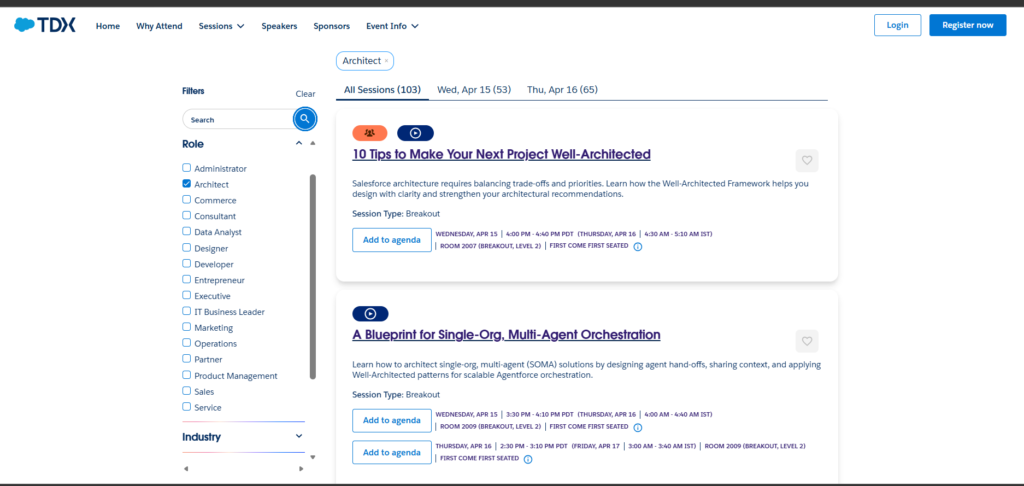
10 Tips to Make Your Next Project Well-Architected
This session is a good anchor for the week. It focuses on practical trade-offs, performance vs. cost, flexibility vs. maintainability, and how to communicate those choices to business stakeholders. If you’ve ever had a technical recommendation overruled because you couldn’t frame it in business terms, this session addresses exactly that.
The Next Chapter of the Well-Architected Framework
Salesforce is evolving the framework to support AI-native design. This session gives architects an early look at how the five pillars are being extended to account for agent autonomy, trust boundaries, and intelligent automation. Attending this one is less optional than it might sound. The updated framework will shape how projects are evaluated going forward.
Workshop: Architect Securely with the Well-Architected Framework
Security has always been part of good architecture, but this workshop treats it as a design constraint, not a post-build checklist. You’ll work through real scenarios under realistic constraints, which is a different skill from reading about the Secure pillar in documentation.
🔍 Also Read: TDX 2026 Must-Attend Sessions for Salesforce Admins
Build an AI-Ready Security Architecture
This session digs into the specifics: Shield, Security Center, and security patterns applied to Agentforce deployments. The core question it addresses is how to detect and respond to threats when AI agents make decisions at runtime, often without direct human oversight. Architects building any agentic solution need a clear answer to this before they go to production.
Achieve Data Readiness for Agentforce Deployment
Bad data doesn’t just produce bad AI outputs; it produces confidently wrong AI outputs. This session covers Data 360 strategies, including data modeling, quality frameworks, and governance structures, that provide agents with reliable inputs. For architects, this is as foundational as schema design. Skipping data readiness on an Agentforce project is the same mistake as skipping data modeling on a standard implementation.
Build a Trusted, Well-Architected Data Layer
Going a level deeper than data readiness, this session focuses on the architectural patterns behind a scalable data layer that can support analytics, automation, and marketing use cases simultaneously. If you’re working in multi-org or high-volume environments, the consistency and trust patterns covered here will be directly applicable to your current work.
A Blueprint for Single-Org, Multi-Agent Orchestration
SOMA (Single-Org, Multi-Agent) architecture is new enough that most architects don’t yet have a mental model for it. This session provides one. It covers how agents interact, how context is shared across agents, and how hand-offs are designed. Think of it as the integration design patterns session, updated for an era where some of your “integrations” are autonomous agents.
Build a Scalable Agentforce Center of Excellence
Architecture decisions don’t stay well-designed if nobody governs them. This session is about building the operational infrastructure that keeps Agentforce implementations healthy after launch: CoE governance models, change management, scaling strategies. Large org architects in particular will find this useful, as it addresses the gap between “we built a good thing” and “the organization can actually maintain and evolve it.”
Think Like an Architect: Scaling for the Big Game
This session takes a different approach; it focuses on an architectural mindset rather than specific tools. Using the What-How-Why framework, it walks through how experienced architects handle extreme scale scenarios (large traffic spikes, high-volume data events). It’s the kind of session that changes how you approach a problem, not just what tools you reach for.
Explore the Updated Salesforce Architecture Center
This one gets underestimated because it sounds like a product tour. It isn’t. The Architecture Center is being reorganized, and knowing where to find authoritative guidance quickly has real-world value. If you’ve ever spent 40 minutes hunting for the right reference document on a deadline, this session will save you future time.
Beyond the Sessions: Don’t Miss These TDX Moments
- TDX 2026 Main Keynote — This sets the strategic direction for the year. Salesforce will lay out its vision for the Agentic Enterprise and what that means for platform investment going forward. Architects should watch this with an eye on which capabilities are now productized vs. still in preview.
Add to your Agenda - TDX Hackathon Showdown — Watch teams build real Agentforce solutions under time pressure. The patterns that emerge from these builds often reveal architectural shortcuts and creative approaches you won’t find in official documentation.
Add to your Agenda - True to the Core TDX 2026 — A direct conversation with Parker Harris and Salesforce product leadership. If there are features you’ve been waiting on, or patterns you’ve seen break at scale, this session is where the community gets to raise those questions. The roadmap context alone makes it worth attending.
Add to your Agenda
A Final Note
TDX 2026 reflects where Salesforce is genuinely investing and where the market will expect architects to be competent within the next 12-18 months. The sessions above aren’t about getting ahead of the curve. They’re about staying current as the platform evolves under your feet.
Pick the ones most relevant to your current work, build in time to talk to the product teams, and come back with a clearer picture of what “well-architected” means in an AI-driven Salesforce environment.

- Akanksha Shukla

- Akanksha Shukla