


Enterprise integrations rarely fail due to Salesforce being unavailable. Failures often become critical when monitoring is incomplete, retry mechanisms are poorly designed, responsibilities are unclear, or recovery processes are absent.
After supporting Salesforce integrations in telecom operations, I learned that the hardest incidents are not always the most complex from a technical perspective. Often, the real challenge is understanding what failed, which business process was affected, and how to recover without creating a second problem.
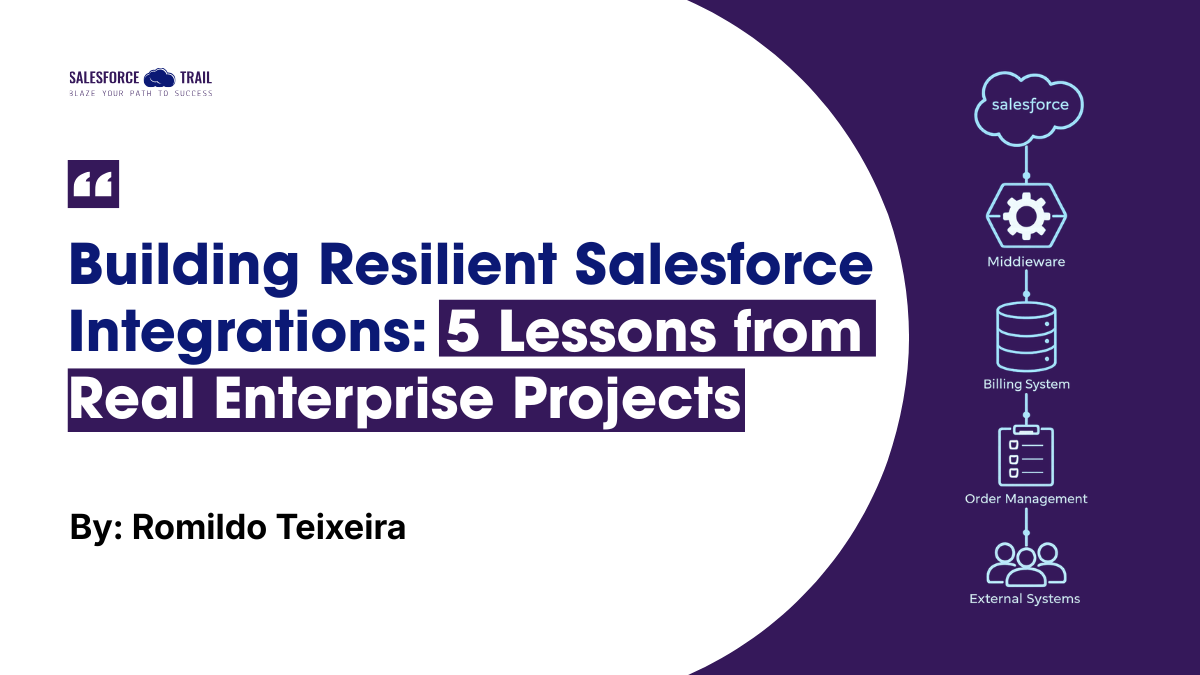
Salesforce often connects sales, service, order management, billing, provisioning, and external channels. In telecom environments, a single customer order may cross several platforms before it is completed.
In high-volume enterprise environments, these integrations may involve dozens of connected systems, thousands of business transactions, and multiple operational teams. The exact numbers vary by organization, but the pattern is consistent: a small integration issue can quickly become a business-impacting incident.
Key Takeaways
- Integration failures are inevitable in enterprise environments.
- Monitoring and observability are just as important as the integration itself.
- Retry strategies must be carefully designed to prevent duplicate transactions.
- Error handling should focus on business impact, not only technical issues.
- Strong governance improves scalability, supportability, and long-term success.
Over the years, I have seen recurring challenges related to monitoring, error handling, retries, and operational ownership. These lessons shaped the way I look at Salesforce integrations today.
The reality is simple: every integration will fail at some point. What differentiates a reliable enterprise integration from a fragile one is not the absence of failure, but the ability to detect, explain, and recover from failure with minimal business impact.
In this article, I will share five practical lessons and best practices that can help Salesforce administrators, developers, and architects improve integration reliability, reduce operational risk, and streamline support activities within the complex Salesforce ecosystem.
Lesson 1: Design for Failure, Not Just for Success
A common mistake in integration projects is focusing almost entirely on smooth operation. During development and testing, teams typically verify that data is being transferred from one system to another. This is essential, but not sufficient for production operations.
In real environments, failures are expected: API timeouts, temporary network disruptions, authentication failures, third-party outages, and unexpected payload changes.
I like to change the question from Will this integration fail? to What will happen when this integration fails? That simple change improves the quality of the design discussion.
A good failure path preserves business context, records what happened, and supports the team with a safe recovery option. Without that, even a small technical issue can become a long operational investigation.
Lesson 2: Monitoring Is Not Optional
One of the most useful lessons I learned in support operations is that alerts do not detect many incidents. They are discovered by users, business teams, or through downstream impacts. That is usually too late.
When production issues occur, support teams need answers quickly: Is the integration working now? When did the issue start? How many transactions were impacted? Which business process is affected?
Without clear observability, troubleshooting becomes slow and reactive. Effective monitoring should provide visibility into success and failure rates, processing times, API consumption, integration queues, pending transactions, and system availability.
Depending on the architecture, monitoring may involve Salesforce Event Monitoring, Platform Events, middleware logs, Splunk, Datadog, New Relic, Grafana, CloudWatch, or other observability platforms. The tool matters, but the operating model matters even more.
In one production scenario, the integration flow was technically running, but failed transactions were not detected quickly enough due to limited monitoring. The hardest part was not fixing the error. The hardest part was identifying which business processes had been impacted.
A practical principle I often use is simple: if you cannot monitor it, you cannot effectively support it.
Lesson 3: Retries Can Save an Integration or Create a Bigger Problem
Retry mechanisms are essential for temporary failures. At the same time, retries can be dangerous when teams treat them as a simple automatic fix.
In one production scenario, a temporary API outage triggered repeated retry attempts and duplicate downstream transactions. The original technical issue was short-lived, but the recovery required manual analysis, business validation, and coordination across multiple teams.
That experience reinforced an important lesson for me: a retry strategy must be controlled, visible, and safe. A good retry model should include exponential backoff, retry limits, clear logging, and idempotency.
A practical approach is to associate each retry with a unique business identifier, such as an order number, external transaction ID, or idempotency key. This helps prevent duplicate order creation and allows the system to recognize that the request has already been processed.
Without idempotency, retries can quickly become a source of incidents rather than a solution.
Lesson 4: Error Handling Must Focus on Business Impact
Error messages, stack traces, and logs are important. But during an incident, the business question is usually much simpler: was the customer or business process impacted?
That is why error handling should not stop at identifying technical failures. It should help the team understand the business consequence of the failure.
Lower-impact issues may include temporary API timeouts or short-lived connectivity problems. Higher-impact issues may include lost customer orders, failed service provisioning, incorrect billing transactions, or missing customer updates.
When support teams can connect the technical error to the impacted process, prioritization becomes clearer and communication with stakeholders becomes more effective.
Lesson 5: Governance Is the Foundation of Sustainable Integrations
As enterprise landscapes grow, integration knowledge often starts to live in the heads of a few experienced people. That may work for a while, but it does not scale.
Common signs of weak governance include duplicated integrations, inconsistent patterns, limited documentation, unclear ownership, and high dependency on specific individuals.
Every critical integration should have a technical owner, a business owner, and a defined support process. In mature organizations, integration governance may include Architecture Review Boards, API and integration standards, ownership matrices, and reusable design patterns. These practices help teams scale without relying only on individual memory.
Documentation should include an architecture overview, system dependencies, error-handling procedures, and escalation paths. In practice, this documentation becomes extremely valuable during incidents, audits, and future changes.
Real-World Perspective from Telecom Operations
Telecommunications companies operate highly interconnected environments. A single customer order can involve Salesforce, Order Management systems, billing platforms, provisioning systems, and customer communication channels.
Because of this complexity, even a minor integration issue can affect multiple business processes. In complex operations, the first question during an incident is rarely only what failed. The more important questions are: what business process was affected, how many transactions are involved, and what recovery path is safe?
From my experience, the most difficult incidents were rarely caused by Salesforce limitations alone. They were usually connected to missing monitoring, insufficient error handling, unclear recovery procedures, or incomplete operational ownership.
In real operations, resilience is what helps the support team understand what failed, who was impacted, and how to recover without creating another incident.
Best Practices for Building Resilient Salesforce Integrations
The following practices have consistently improved the reliability and maintainability of Salesforce integrations in enterprise environments:
| Best Practice | Why It Matters |
|---|---|
| Design integrations with failure in mind | Plan for API timeouts, network disruptions, authentication issues, and downstream system outages. A resilient integration should recover gracefully rather than assume every transaction will succeed. |
| Implement comprehensive monitoring and alerting. | Monitor transaction status, API consumption, error rates, queue backlogs, and processing times. Where appropriate, use Salesforce Event Monitoring alongside middleware or observability platforms to improve visibility across the integration landscape. |
| Separate technical failures from business-impact incidents | Not every technical error requires the same response. Prioritize incidents based on their effect on business processes, customers, and downstream systems rather than technical severity alone. |
| Build controlled retry mechanisms. | Use retry limits, exponential backoff, detailed logging, and idempotency to prevent duplicate transactions and simplify recovery after temporary failures. |
| Establish clear ownership and governance. | Every critical integration should have defined technical and business owners, documented support processes, and agreed escalation paths to reduce operational uncertainty during incidents. |
| Maintain accurate documentation | Keep architecture diagrams, system dependencies, integration flows, error-handling procedures, and recovery steps up to date, so support teams can respond efficiently when issues occur. |
| Regularly validate recovery procedures. | Test failover, retry logic, and disaster recovery scenarios periodically to confirm they work as expected before a real production incident occurs. |
Final Thoughts
As enterprise ecosystems become increasingly connected, integration resilience is no longer optional. Successful Salesforce integrations are not the ones that never fail.
They are the ones that detect issues quickly, explain business impact clearly, and recover safely. Every enterprise integration will eventually fail. The real question is not whether failure will happen, but whether the architecture and operating model are prepared to recover.
For Salesforce professionals, the opportunity is clear: design integrations not only to connect systems, but also to support real operations when something goes wrong.

Romildo Teixiera de Paula
- This author does not have any more posts.