

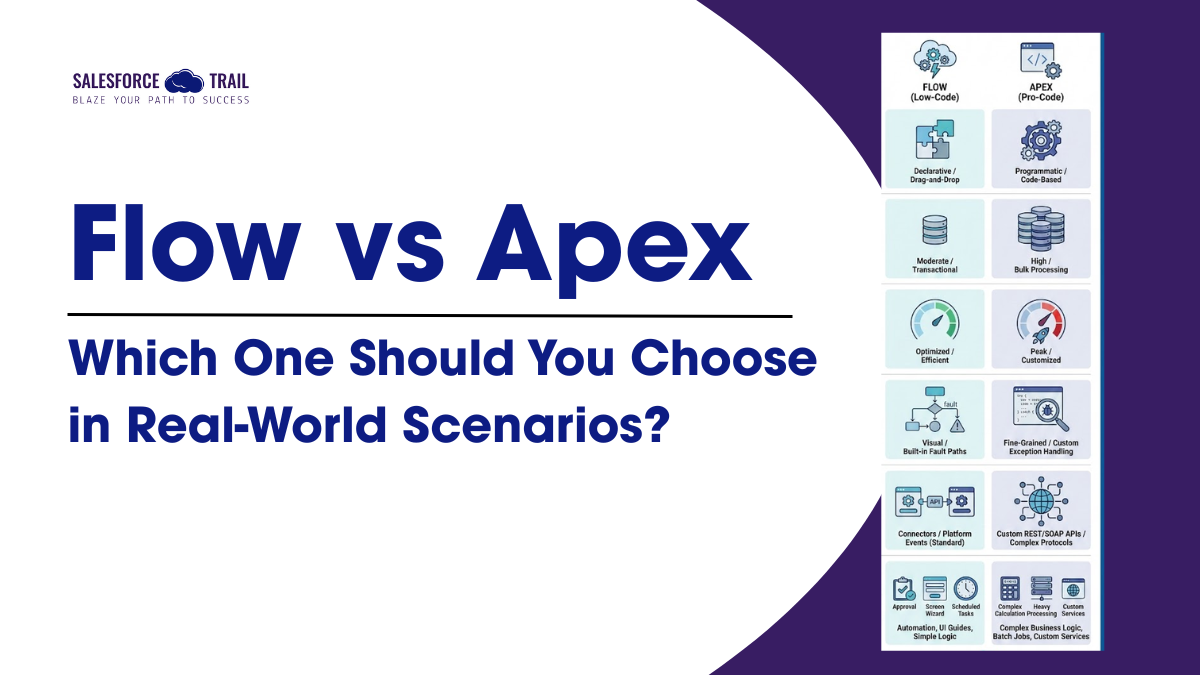
Automations are the backbone of Salesforce implementations, whether it is to optimize the sales process, enhance service implementations, or when there is a need to create a robust, enterprise-grade application. In 2025, the Salesforce Flow capability and the scaling capability of Salesforce Apex have created numerous choices for Salesforce implementers regarding when to use which technology that will be the best fit.
One of the most common questions for Salesforce implementers that comes to their mind when they have to implement any scenario is:
“Should I use Flow or Apex for this requirement?”
Table of Contents
The Evolution of Automation: What’s New in 2025?
Before choosing which tool to use, here are a few major updates from recent Salesforce releases that may affect the decision-making whether to choose Flow vs Apex:
Latest Flow Enhancements:
- Real-time field updates are now available with more Flow screens with Reactive Components; you can update a field in the Flow without having to click “Next.”
- New enhancements to Flow Orchestration enable faster step execution, better retry control, and improved administrative view of Flow Orchestration.
- Flow Error Diagnostics now provide step-level logs along with AI-driven suggestions for correcting errors in Flow.
- Flow now supports dynamic headers on HTTP callouts, Multi-Step Authentication, and Platform Events.
- Lookup Screen Component version 2.0 has added support for filters, Multi-Select capability, and Conditional Visibility.
Latest Apex Enhancements:
- Apex Trigger Performance Optimizer is more advanced; it now gives real-time warnings inside the setup on non-bulkified coding operations
- New Async Job Chaining allows scheduled, queueable, and batch sequences without governor conflicts.
- Enhanced Apex Unit Testing Framework with mock orchestrations, callout virtualization, and performance reports.
- Native Large Data API Support: Apex can now run optimized operations on datasets exceeding millions of records without custom batch structures.
Flow vs Apex: The Real Comparison
Choosing between Flow and Apex is not about preference; it’s about fit. Let’s break this down across the areas that matter most in real projects.
Complexity of Business Logic
Flow is known for its structured and visual logic
Flow works exceptionally well when:
- It follows a step-by-step logical business process.
- Decisions are based on rules, not on heavy calculations
- One needs to have proper visibility on how automation works.
Examples:
- Lead assignment based on country, industry, or source
- Updating case priority based on SLA status
- Creation of a child record on parent creation.
- Flow allows admins and consultants to see and understand the logic without writing any code.
Apex is best known for Complex and Dynamic Logic implementation.
Apex is designed for:
- They are best used where advanced calculations are needed.
- They are mostly preferred where multi-object operations need to be performed.
- They can work dynamically where the conditional logic changes frequently.
Example:
- Revenue needs to be divided across multiple stakeholders
- Lead scoring based on historical data
- Custom validations that depend on multiple objects
- Apex gives full control over logic execution and error handling.
Data Volume & Governor Limits
Flow performs best when automation runs on individual records and small datasets.
- Flow works best with Low to Medium Data Volume
- Flows work well when processing single records
- It works well when running a small batch update
- It helps in executing near-real-time automation
Example:
- Record-triggered updates are needed
- When there is a need to perform screen-based user actions
- When Approval automation is needed, related automations
Apex is used when building for high-volume data processing
- It can handle thousands to millions of records in one go
- They are best used for bulk processing tasks
- They can perform scheduled and batch operations
Examples:
- It is mostly used for performing monthly data clean-up jobs
- It is the best fit for doing mass updates during integrations
- It can easily perform large data migrations
With Batch Apex, Queueable Apex, and Scheduled Apex, developers can safely handle massive data loads.
Performance & Execution Speed
Flow Performance is considered faster to build, and it is suitable for real-time updates. Recent releases have improved its performance drastically.
Flow performs best when:
- Automation runs in real time on record creation or update
- Logic is straightforward and event-driven
- Speed of delivery matters more than deep optimization
Examples:
- Updating fields instantly when a record is saved
- Showing dynamic screens based on user input
- Triggering follow-up actions after approvals
Apex runs as compiled code, giving developers precise control over how and when logic executes
Apex excels when:
- Automation must be highly optimized
- SOQL and DML operations need fine-grained control
- CPU time and memory usage must be managed carefully
Examples:
- Complex calculations during data processing
- Performance-critical integrations
- Automations handling large datasets without impacting users
Error Handling & Debugging
Flows help in error handling and also help in debugging the process. Flows
Flow provides:
- When an error occurs, fault paths reroute the Flow automatically so that you can perform other actions, such as logging the problem or informing an administrator.
- When a Flow fails, e-mail alerts immediately notify the administrator, allowing for a much quicker response time.
- The basic error messages indicate the location of the failure, but they typically do not contain extensive technical information.
Examples:
- Sending an email to admins when record creation fails
- Logging failed Flow executions into a custom object
- Skipping a failed step and continuing user-driven automation
Apex offers full control over how errors are handled, logged, and recovered from during execution.
Apex Error Handling:
- Apex allows you to use try/catch blocks to gracefully manage any run-time errors that occur while executing the process without stopping the entire execution flow.
- Custom Exception Handling allows developers to create custom exceptions that provide meaningful business context for the error, allowing for easier identification and resolution.
- With comprehensive debug logs, you can view detailed execution information, enabling you to trace and resolve problems quickly.
Example:
- Continuing bulk processing even if some records fail
- Retrying failed integration callouts
- Logging detailed error information for audit and troubleshooting
Maintainability & Team Collaboration
Flow is designed for quick changes and clear visibility, making it ideal for admin-led teams.
Flow works best when:
- Flow is considered admin-friendly and transparent
- Admins can update logic directly in Flow Builder without writing or deploying code.
- The visual design of the flow makes it easy for non-technical stakeholders to understand the process.
- Many changes in flow can be made without complex release or deployment steps.
Example:
- Updating lead routing rules after business expansion
- Modifying approval conditions based on new policies
- Tweaking case escalation logic without developer involvement
Apex is built for structured development, governance, and long-term scalability.
Apex excels when:
- Apex is considered developer-friendly and Scalable
- Using a source control system, Apex code can be tracked, reviewed, and rolled back.
- Enables automated testing and deployments across environments.
- Multiple developers can work on the same codebase without any conflict.
- Structured reviews help maintain code quality and prevent production issues.
- Better suited for large teams and long-term projects because it supports governance, scalability, and structured development.
Example:
- Large enterprise automation projects
- Multi-team development environments
- Long-term systems requiring strict change control
Integrations & External Systems
Flow supports basic integrations without requiring custom code.
Flow Integration Capabilities
- Flows can perform HTTP callouts, allowing flows to send or receive data from external systems.
- Flows can perform platform events, enabling event-driven communication between Salesforce and other platforms.
- Flows trigger outbound messages that send real-time notifications to third-party applications.
Examples:
- Sending data to a webhook
- Triggering events for downstream systems
- Notifying third-party tools of record changes
Apex is required for secure, complex, and large-scale integrations.
Apex Integration Power
- OAuth authentication is necessary for Apex to manage secure, token-based authentication processes.
- Apex supports JWT-based integrations, which help in securing server-to-server communication without user interaction.
- Apex used complex JSON parsing, which helps in providing full control over transforming request and response data.
- Apex ensures integration reliability during failures or network delays.
Example:
- ERP or payment gateway integrations
- Secure system-to-system data synchronization
- High-volume or mission-critical integrations
Flow vs Apex: Real-Life Scenarios & What to Choose
As a Salesforce professional, it’s a rare question that is asked: “Can this be done by flow or Apex?”
But the question that is asked is, “Which is the safest, fastest, and most maintainable way to do this in production, whether it is to use Apex or Flow?”
Let’s walk through real situations admins and developers face—and the right choice for each.
Scenario 1: Auto-Assign Cases Based on Priority and Product
Business Requirement
When a Case is created:
- High-priority cases should go to a Priority Queue
- Product-specific cases should route to specialized teams
Flow is the best Choice
Why Flow Works
- The logic is rule-based and easy to visualize
- Admins can update routing rules as business needs change
- No complex calculations or large data volume involved
Scenario 2: Monthly Forecast Recalculation for 50,000 Opportunities
Business Requirement
At month-end task to be done:
- Recalculate forecast values
- Update multiple related objects
- Ensure the job runs overnight without hitting limits
Apex (Batch Apex) is the best fit for this scenario
Why Apex Is Required
- Flow might hit the execution limits with high-volume data
- Apex can control the chunk processes that are needed
- Needs predictable performance and scheduling
Scenario 3: Employee Onboarding Wizard
Business Requirement
HR needs a guided process to:
- Collect employee details
- Upload documents
- Assign training programs
Screen Flow is the best fit
Why Flow Works
- Requires a user-friendly UI
- Step-by-step data collection can be easily done
- Can easily update onboarding rules and changes
Scenario 4: Revenue Allocation Across Sales Hierarchies
Business Requirement
Revenue must be split:
- Across the parent and child opportunities
- Between multiple sales reps
- Based on dynamic percentages
Apex is the best choice.
Why is Apex Is Needed?
- Complex calculations and nested logic can easily be implemented
- Multiple object relationships can be managed and handled
- The flow would become hard to maintain
Scenario 5: Notify Manager When Deal Value Exceeds ₹10,00,000
Business Requirement
When an Opportunity crosses a value threshold:
- Notify the Sales Manager instantly
Flow is the best choice
Why Flow Works?
- A simple condition check needs to be implemented
- A single record update is needed
- No performance or volume concerns.
Scenario 6: Real-Time Payment Gateway Integration
Business Requirement
When payment is initiated:
- Authenticating using OAuth is needed
- Call multiple APIs
- Handle failures and retries
Apex is the best choice.
Why Apex Is Mandatory?
- Complex authentication flows
- Multi-endpoint communication
- Detailed error handling is required

Final Thoughts
Choosing between Flow and Apex should never be about job roles. It should always be about scalability, safety, performance, and maintainability.
- Use Flow for visual, rule-based, and user-friendly automation.
- Use Apex for complex logic, high data volumes, and enterprise-grade integrations.
- Use both together—Flow for orchestration and Apex for processing.
The strongest Salesforce architectures embrace this balance. When automation is designed with the future in mind, Salesforce doesn’t just work; it scales.




Most Reads:
- Salesforce Business Rules Engine (BRE) Explained: Smarter Decisioning Beyond Apex & Custom Metadata
- TDX 2026 Call for Participation Is Live: Everything you Need to know
- Build a Dynamic, Reusable Lightning Datatable in Salesforce LWC (With Metadata-Driven Columns, Search & Pagination)
- Salesforce Marketing Cloud to Agentforce: The Future of Marketing Automation
Resources
- [Salesforce Developer]- (Join Now)
- [Salesforce Success Community] (https://success.salesforce.com/)
For more insights, trends, and news related to Salesforce, stay tuned with Salesforce Trail

- Akanksha Shukla#molongui-disabled-link

- Akanksha Shukla#molongui-disabled-link
- Akanksha Shukla#molongui-disabled-link
- Akanksha Shukla#molongui-disabled-link