

For years, technology vendors promised a single source of truth, a unified view of customers that would connect sales, service, marketing, and every digital touchpoint. In reality, most organisations continued to operate with fragmented systems, incomplete customer insights, and missed revenue opportunities.
That narrative is now changing.
Salesforce Data 360 is no longer just another data initiative. It is becoming a foundational layer for generating revenue, delivering AI-driven experiences, and making smart decisions in 2026 and beyond. This change marks a significant turning point in how Salesforce professionals and businesses approach data.
Table of Contents
The Real Problem Salesforce Set Out to Solve
Modern enterprises generate massive volumes of customer data. However, that data is often scattered across:
- Sales and service platforms
- Marketing tools
- Websites and mobile apps
- Support systems and finance software
- External and on-premise systems
Each team sees only a fragment of the customer story. Salespeople may pursue leads without understanding what has happened recently. Old profiles may be used by marketing in campaigns. Support teams typically fix problems without knowing everything that happened with the consumer.
The issue is not a lack of tools. It is disconnected data.
When people don’t share a unified vision, they make decisions based on only part of the picture, leading to slow growth, poor customer experiences, and lost revenue.
What Makes Data 360 Different
Data 360 isn’t about getting more information. It is about making sure that all of the company’s consumer data can be used, trusted, and acted on.
Salesforce knew that AI-powered interactions, personalisation, and automation wouldn’t work until customer data could be accessed and connected in real time. Businesses need:
- A single place to get customer data
- A single platform to act on it
- A single, reliable source of truth for all teams
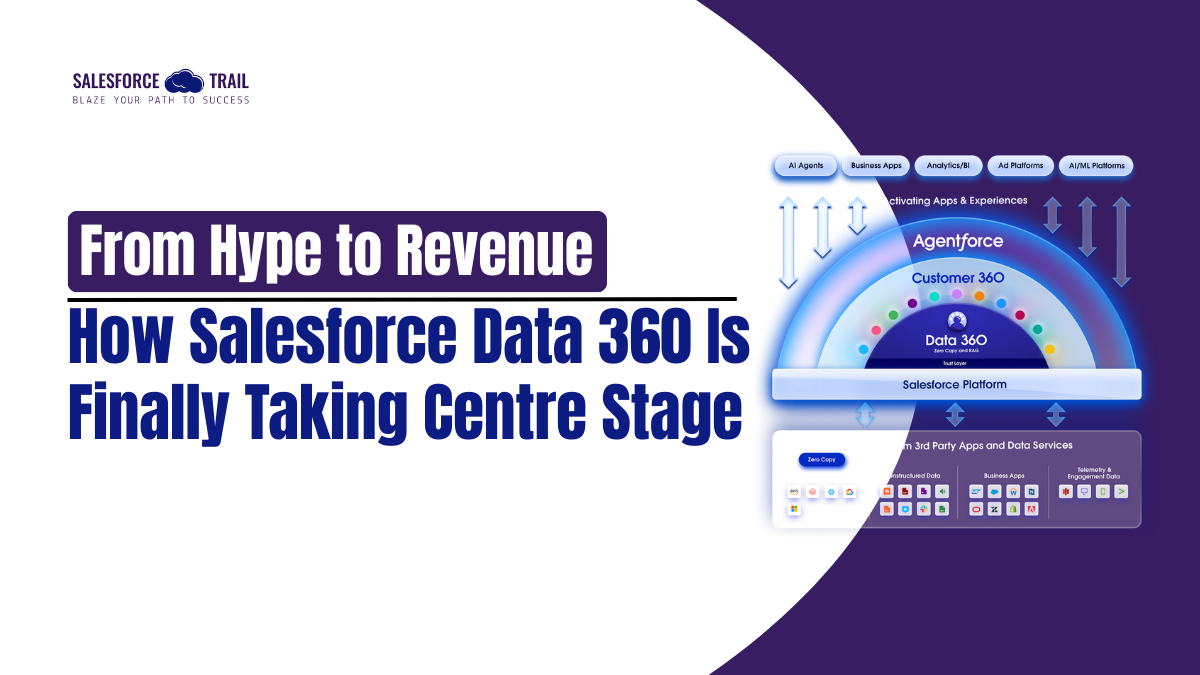
Data 360 links customer behavior and activity from any source and converts it into insights that help businesses reach their goals.
This shift becomes far more tangible when you look at how unified customer data is already being applied across real Salesforce implementations, from intelligent lead prioritisation to personalised engagement and proactive service experiences.
🔍 Read More: TDX 2026 Must-Attend Sessions for Salesforce Admins
Why Data 360 Matters for Salesforce Professionals
This shift is not only transforming organisations; it is reshaping Salesforce careers.
Clearer Business Context
With Data 360, Salesforce professionals gain a complete understanding of how customer data flows across sales, service, marketing, and external systems. This enables admins and developers to design solutions that support real business goals, not just technical requirements.
Stronger, More Confident Decisions
A unified and trusted data foundation reduces guesswork. Professionals can build automated systems, reports, and AI-driven features with confidence that the data is accurate and up to date. This leads to smarter implementations and fewer issues after deployment.
Faster and Cleaner Implementations
By reducing data silos, Data 360 simplifies integrations and eliminates much of the time spent fixing inconsistencies. Teams can shift focus from maintenance to optimisation and innovation.
Career Growth in the AI Era
Understanding Data 360 prepares professionals for future-focused roles such as AI administrators, data architects, and automation specialists. As AI adoption accelerates, this knowledge becomes a long-term career advantage.
How Data 360 Turns Insight Into Revenue
People used to think that customer data platforms were only useful for marketing and reporting, not necessary. More and more businesses are realising that many of their money problems are actually data problems.
It’s not that there aren’t enough tools; it’s that information is often disconnected. This can lead to missed opportunities, poor leads, irrelevant campaigns, and service delays.
Data 360 addresses this issue by generating revenue continuously for the entire duration of a customer’s relationship with your business:
- Sales teams can see how customers interact with them in real time, helping them focus on the right leads and close deals faster.
- Marketing teams analyze consumer behavior and purchasing patterns to better segment their target market, run more relevant campaigns, and increase sales.
- Service teams can see the whole customer journey, which helps them fix problems faster, build better relationships, and keep more customers.
This method doesn’t just help with revenue; it makes it.
A New Role for Data in Salesforce Strategy
Salesforce Data 360 represents a fundamental shift. Data is no longer only a backdrop asset for reports and dashboards. It is now the basis for modern consumer experiences, smart automation, and measurable growth. When data is not connected, neither are judgments. And decisions that aren’t connected to the business slow it down.
By unifying customer information and making it actionable in real time, Agentforce 360 and Data 360 enable businesses to operate with clarity, speed, and confidence at every touchpoint.

Looking Ahead: Data as the Engine of Growth
Unified data is no longer an option in a world where AI, personalisation, and automation are what set businesses apart. It is what makes every smart move a firm makes possible.
Data 360 is now at the heart of Salesforce’s growth, turning what they know about customers into better business. Companies get more involvement and better financial results. Salesforce pros can now have an impact on strategy and systems.
Managing relationships is no longer the only thing that matters for Salesforce’s future. It is about using data to promote real, measurable growth, and that future has already begun.
Frequently Asked Questions (FAQ)
Salesforce Data 360 is a unified data layer that connects customer information across sales, service, marketing, and external systems. It allows organizations to create a single, trusted view of each customer in real time, enabling teams to make better decisions, personalize experiences, and drive revenue through data-driven insights.
Modern businesses generate data across multiple platforms, but that data often lives in silos. Salesforce Data 360 brings this information together, helping teams understand the full customer journey. With unified data, organizations can improve decision-making, deliver more relevant customer experiences, and identify new revenue opportunities.
Salesforce Data 360 helps businesses act on real-time customer insights. Sales teams can identify high-intent prospects faster, marketing teams can build more targeted campaigns, and service teams can resolve issues with full customer context. These improvements lead to higher conversion rates, stronger customer relationships, and increased lifetime value.
Salesforce Data 360 addresses the challenge of disconnected customer data across different systems. Without unified data, teams often work with incomplete information. Data 360 solves this by integrating data from multiple sources, ensuring that sales, marketing, and service teams operate with consistent and accurate customer insights.
AI systems rely on accurate and connected data to produce reliable results. Salesforce Data 360 provides that foundation by creating a unified customer profile that AI tools can use for predictions, personalization, and automation. This allows businesses to deliver smarter recommendations, automated workflows, and more personalized customer experiences.
Traditional customer data platforms were often used mainly for analytics or marketing insights. Salesforce Data 360 goes further by acting as an operational data foundation across the Salesforce ecosystem. It connects data across teams and systems so organizations can take action on insights, not just analyze them.
Yes. By providing a unified view of customer interactions across all touchpoints, Salesforce Data 360 allows teams to deliver more consistent and personalized experiences. Sales, marketing, and service teams can understand a customer’s full history and respond with more relevant communication and faster support.

- Akanksha Shukla#molongui-disabled-link

- Akanksha Shukla#molongui-disabled-link
- Akanksha Shukla#molongui-disabled-link
- Akanksha Shukla#molongui-disabled-link