

Stepping into the role of a Salesforce Business Analyst is both exciting and challenging. Business Analysts (BAs) serve as the bridge between business stakeholders and technical teams, translating needs into actionable Salesforce solutions. While the role is rewarding, many new BAs—and even those with some experience—fall into common traps that can derail projects, cause miscommunication, and slow down delivery.
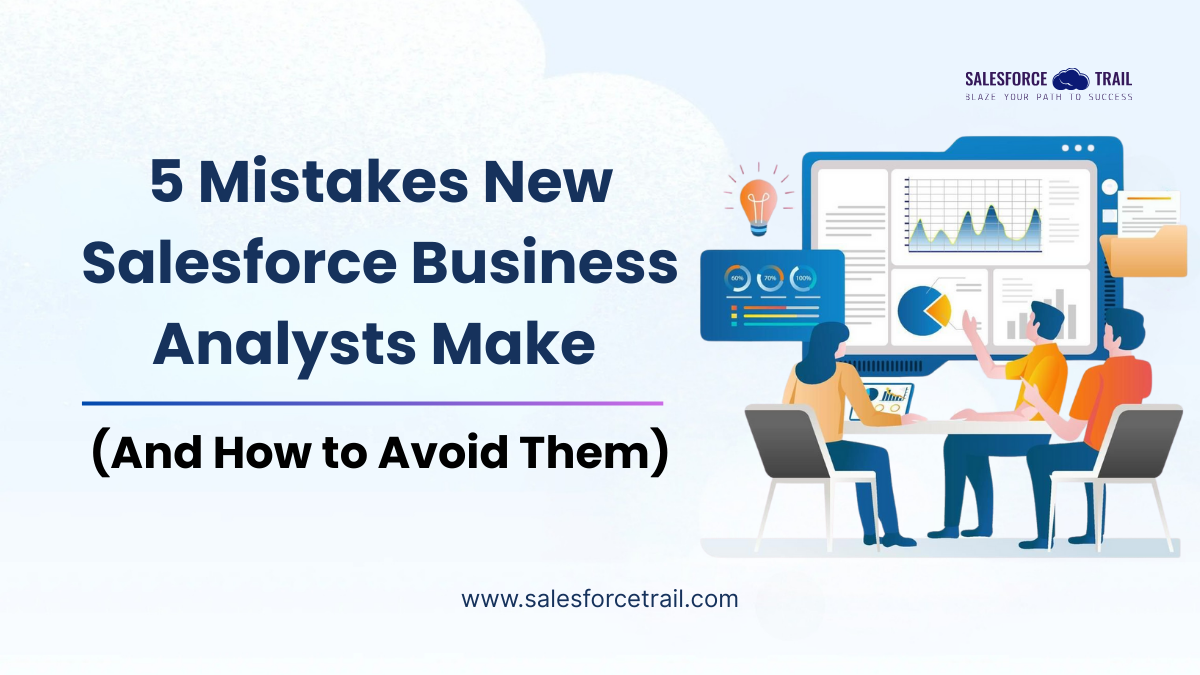
In this article, we’ll explore five common mistakes Salesforce Business Analysts make and share practical ways to avoid them. Whether you’re just starting or refining your approach, these lessons can help you grow into a trusted, high-performing BA.
Table of Contents
Diving Straight into Technical Solutions
One of the most frequent mistakes is diving into Salesforce features before fully understanding the business problem. Many new BAs feel pressure to showcase their technical knowledge by suggesting objects, fields, or automation as soon as requirements are mentioned.
The issue? This often leads to solutions that miss the mark because they weren’t aligned with the bigger picture.
How to Avoid It:
- Start by asking “why” behind every requirement. For example, if a sales manager asks for a new custom field, dig deeper: what process does it support? What decision will this data drive?
- Focus first on documenting the business needs, pain points, and goals before mapping them to Salesforce capabilities.
- Collaborate with stakeholders to validate understanding before proposing any solution.
If you avoid rushing into Salesforce features right away, you’ll create solutions that fix real business needs instead of just quick requests.
Not Engaging with Stakeholders Effectively
A Salesforce Business Analyst acts as a bridge between business and technical teams. But many new BAs underestimate how critical stakeholder engagement is. They may conduct one or two requirement sessions and assume they’ve gathered everything — only to realize later that important voices were left out.
How to Avoid It:
- Identify all stakeholders early, including end users, managers, and cross-functional teams. Salesforce often impacts departments beyond the obvious ones.
- Use a mix of discovery methods: workshops, interviews, surveys, and shadowing. Different stakeholders prefer different communication styles.
- Keep communication ongoing. Requirements aren’t static; they evolve.
Remember: Success in Salesforce projects isn’t just about technical configuration — it’s about ensuring all business voices are heard and represented.
Overlooking Documentation and User Stories
Documentation can feel uninteresting, especially for new BAs eager to prove themselves in solution design. But skipping detailed documentation leads to confusion later.
Inadequate user stories, unclear acceptance criteria, or missing process flows make it harder for admins, developers, and testers to deliver what’s truly needed.
How to Avoid It:
- Write clear, concise user stories that include acceptance criteria. For example:
“As a sales rep, I want to track competitor information on opportunities so I can prepare better proposals.” - Use visuals like process diagrams or mockups to clarify complex workflows.
- Keep documentation updated. Salesforce projects often evolve rapidly, so your documentation should too.
Well-structured documentation saves time, prevents rework, and ensures alignment across the team.
Ignoring Change Management and User Adoption
Many new Salesforce Business Analysts believe that once a solution is built, the job is done. In reality, a solution’s success depends heavily on how well users adopt it. Failing to prepare for change management can result in underutilized features or frustrated end users who revert to outdated workarounds.
How to Avoid It:
- Always consider the end-user perspective. Will this change make their job easier or more complicated?
- Partner with training teams to create concise guides, walkthroughs, or brief demonstrations.
- Identify potential resistance early and address it by involving users in the design process.
A technically perfect Salesforce solution that no one uses is ultimately a failure. Adoption is just as important as configuration.
Read More: Top 10 Salesforce Job Boards You Must Know
Underestimating the Importance of Data
Data is at the heart of Salesforce. Yet many new Business Analysts overlook its importance during requirement gathering and solution design. They may focus solely on functionality without considering data quality, integration, or reporting needs.
How to Avoid It:
- Ask questions about data sources, accuracy, and ownership early in the project.
- Ensure requirements address not just what data is captured but also how it will be maintained and used.
- Consider the reporting and analytics needs upfront. If executives want dashboards, the right data must be captured consistently.
Strong data practices elevate Salesforce from being a transactional system to a powerful decision-making tool.

Final Thoughts
Being a Salesforce Business Analyst means wearing multiple hats: listener, translator, problem-solver, and strategist. Avoiding these common mistakes can accelerate your growth and make you a trusted partner in every Salesforce project.
By focusing on business value, engaging stakeholders, documenting clearly, supporting adoption, and addressing data early, you’ll set yourself apart as a skilled and reliable professional in the Salesforce ecosystem.


Most Reads:
- How to Become a Salesforce Consultant: A Complete Guide to Success
- How to Become a Salesforce Solution Architect: A Complete Guide to Success
- Best Tips and Tricks to Ace Your Salesforce Interviews in 2025
- Dreamforce 2025 Registration is Open Now: Everything You Need to Know
- How to Crack the Salesforce Interview: Real Questions and Tips from Experts
Resources
- [Salesforce Developer]- (Join Now)
- [Salesforce Success Community] (https://success.salesforce.com/)
For more insights, trends, and news related to Salesforce, stay tuned with Salesforce Trail

Mark Jacobes is a seasoned Salesforce expert, passionate about empowering businesses through innovative CRM solutions. With over 6 years of experience in the Salesforce ecosystem, Mark specializes in Salesforce development, integrations, and digital transformation strategies.
- Mark Jacobeshttps://salesforcetrail.com/author/markjacobes/
 September 8, 2025
 - Mark Jacobeshttps://salesforcetrail.com/author/markjacobes/
- Mark Jacobeshttps://salesforcetrail.com/author/markjacobes/
- Mark Jacobeshttps://salesforcetrail.com/author/markjacobes/June 16, 2025