

A few weeks ago, I sat down to update my LinkedIn profile but got stuck on the very first line. Should I still list “Data Cloud,” or is it now called “Data 360”? Would a recruiter today even search for the “Sales Cloud” project listed on my resume? I spent a full minute thinking about it, as I wasn’t entirely sure if the two names appearing on the screen referred to the same product.
If this has happened to you too, you aren’t alone. The community has even given it a name: ‘Renameforce.’ It is half-joke and half-coping mechanism. Someone has even created a website called renameforce.com, where you can enter the name of an old product and view its convoluted history. When a parody site like this exists, you know that people’s frustration is real and that they are all going through the same thing.
So, this isn’t a complaint or a rant. It’s a sort of ‘translation layer.’ By the end, you’ll understand what has actually changed versus what is just the same old product with a new label; you’ll also grasp why Salesforce does this repeatedly.
Table of Contents
What actually changed in the 2025 rebrand?
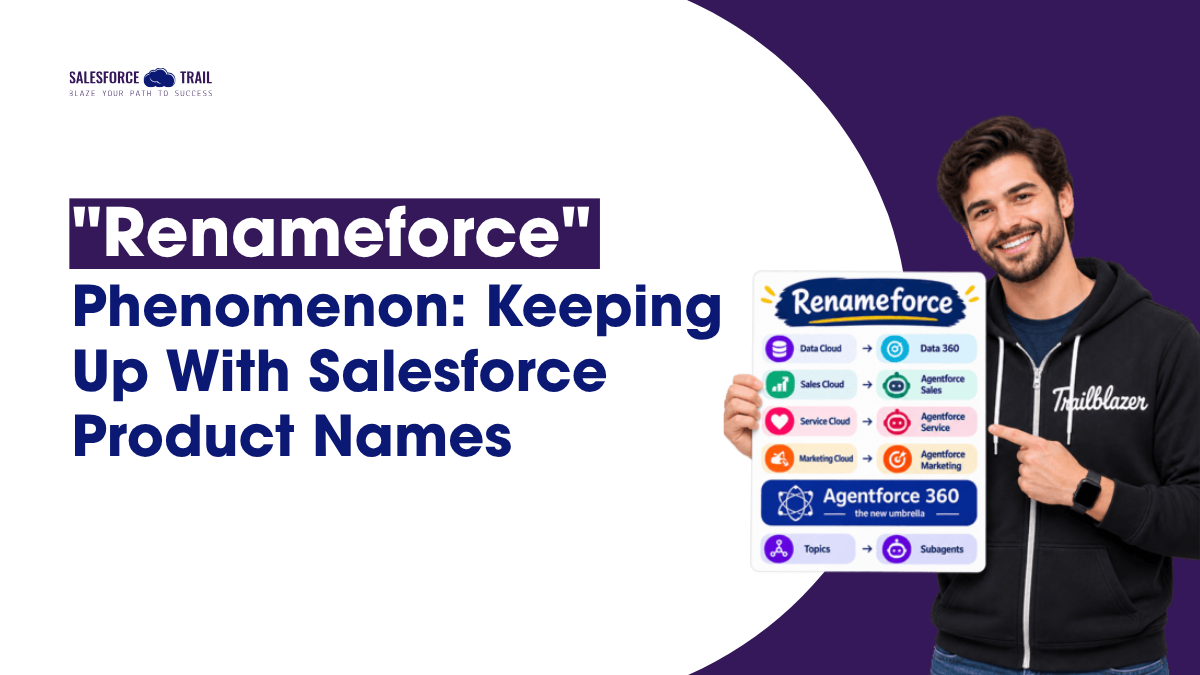
At Dreamforce 2025, Salesforce put its whole portfolio under an “Agentforce 360” umbrella. Data Cloud became Data 360, Sales Cloud became Agentforce Sales, Service Cloud became Agentforce Service, and Marketing Cloud became Agentforce Marketing. In most cases, the underlying product, data, and pricing didn’t change – only the label did.
Wait – is “Renameforce” actually a thing?
Yes, this nickname may be spot on. We aren’t talking about minor tweaks here; renaming is simply part of how this platform operates. Salesforce maintains a list of products that have undergone name changes, a count that exceeds 30 and counting. Read this as a carefully tracked estimate, not an official Salesforce number, but nobody seriously argues the trend.
Keep this in mind: even though it all seems chaotic, there is a logic behind most of these changes. This article aims to do two things: first, provide a “decoder ring” so you can search and communicate using current terminology; and second, explain the “why” because once you grasp the underlying strategy, the situation won’t seem quite so frustrating.
The 2025–2026 Rebrand Wave: Your Translation Layer
Start here. This table is the part worth bookmarking; it answers the only question most of us actually have: “Is this a new thing I need to learn, or the same thing I already know?”
| Old name | New name (2025–26) | Same product? | What actually changed |
|---|---|---|---|
| Data Cloud | Data 360 | Yes (its 6th name) | Added Intelligent Context + Tableau Semantics |
| Sales Cloud | Agentforce Sales | Yes | Naming; agentic features now available |
| Service Cloud | Agentforce Service | Yes | Naming only |
| Marketing Cloud | Agentforce Marketing | Umbrella term | Sub-products keep their own names |
| Einstein 1 Platform (positioning) | Agentforce 360 | Repositioned | New umbrella, four pillars |
| Topics | Subagents | Yes | No changes to functionality |
Now the short walk-throughs.
Data Cloud → Data 360
Same customer data platform. Same ingestion, harmonization, unified profiles, and zero-copy links out to Snowflake and Databricks. Salesforce renamed it around Dreamforce 2025, and its own product page now literally reads “Data 360 (Formerly Data Cloud).”
What’s genuinely new is worth knowing, because this one isn’t pure relabeling. Salesforce added Intelligent Context, which blends structured CRM records with unstructured stuff like PDFs, emails, and call transcripts, plus Tableau Semantics for consistent metrics across clouds. So, there has been both a rebranding and the addition of genuine new capabilities. Don’t dismiss this as just marketing, but also don’t assume that a new name automatically brings new features.
One more thing that tells you everything about the pattern — this is the platform’s sixth name. It’s gone from Customer 360 Audiences to Salesforce CDP to a Marketing Cloud CDP to Genie to Data Cloud to Data 360, all inside about six years.
Sales Cloud → Agentforce Sales, and Service Cloud → Agentforce Service
This is the reassurance section, and I mean that. There is no migration. Your Opportunities, Accounts, Contacts, cases, omni-channel routing, Flows, and Apex all work the same. Pricing on the existing capabilities didn’t jump because the name did.
If you don’t believe me, believe Salesforce’s own docs. Open a Sales Cloud help article right now, and you’ll see a banner along the lines of “Sales Cloud is now Agentforce Sales. You may see references to Sales Cloud in Salesforce applications and documentation.” The rename got formalized with the Spring ’26 release. Practically, “Agentforce Sales” means “the Sales Cloud you already run, with agentic features available to switch on.”
Marketing Cloud → Agentforce Marketing
This is the genuinely confusing one, so I won’t pretend otherwise. “Agentforce Marketing” is an umbrella label. Underneath it, the actual products still carry their own names — Marketing Cloud Engagement, Marketing Cloud Account Engagement (the artist formerly known as Pardot), and Marketing Cloud Next. Salesforce’s own materials use “Marketing Cloud” and “Agentforce Marketing” more or less interchangeably right now.
The takeaway for anyone buying or configuring: always confirm the specific SKU. The umbrella name won’t tell you which product you’re actually getting.
Agentforce 360 — the new umbrella
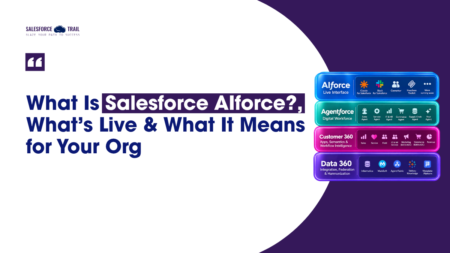
Agentforce 360 went GA on October 13, 2025 (Salesforce’s own announcement calls it a platform that connects humans and AI agents in one system). It succeeds the “Einstein 1 Platform” introduced in 2023 and comprises four key components: the Agentforce 360 platform, Data 360, Customer 360 apps, and Slack.
The pace of its evolution is evident from the fact that this is the fourth version of Agentforce released within twelve months. Agentforce debuted at Dreamforce 2024, followed by Agentforce 2, then 2dx, then 3, and now 360. If you feel like you have fallen behind, it is because the name has literally changed four times in a single year.
Topics → Subagents
Small one, but it’ll trip up anyone building agents. Starting April 2026, what were called “Topics” in Agentforce are now “Subagents,” and the “Topic Selector” is now the “Agent Router.” Salesforce states plainly there are no changes to functionality — it’s vocabulary. If you follow an older build tutorial that says “add a Topic,” it means Subagent.
This isn’t a new two-minute history of Salesforce renaming
If the talk about the 2025 ‘Wave’ seems excessive, it is worth noting that this pattern has been going on for over a decade. A few examples make this clear.
The story of their analytics offerings is the best example. Salesforce acquired EdgeSpring in 2013, launched it as ‘Wave’ in 2014, rebranded it as Einstein Analytics in 2017, renamed it Tableau CRM after acquiring Tableau, and finally rebranded it as CRM Analytics in 2022. One product line, four names.
Then there was the 2022 marketing cleanup, when Pardot became Marketing Cloud Account Engagement – a change people mocked openly for turning a crisp, memorable name into a mouthful. Datorama, Interaction Studio, and ExactTarget all got folded into “Marketing Cloud [Something]” in the same stretch.
And the AI-related naming trend continues to this day: Einstein, followed by Einstein GPT, then Einstein Copilot, then Agentforce, and now Agentforce 360. The pattern is always the same regardless of the current strategy; the names are altered to align with it.
Why does Salesforce keep doing this?
This is not just some corporate fad. There are three perfectly valid reasons behind it, even if going through the process is frustrating.
Signaling AI direction to Wall Street and Buyers
Salesforce wants the AI story to be impossible to miss, and product names are free advertising for it. Marc Benioff has stopped using the term “cloud” because customers in focus groups wanted to discuss AI agents rather than cloud software. The numbers give the rename a spine: in the Q3 FY26 earnings release, Salesforce reported Agentforce and Data 360 reaching roughly $1.4 billion in combined ARR, up 114% year over year. When a product line is your growth headline for investors, you make sure its name says “AI” out loud.
(Benioff was even asked in December 2025 whether Salesforce itself might get renamed and said it wouldn’t shock him — though a company spokesperson quickly called that “theoretical.” File under speculation, not fact.)
Unifying Acquired Products under One Brand
Years of acquisitions: Tableau, Slack, Pardot, Datorama, and more have created a confusing mix of names that feel disconnected. The “360” architecture is an attempt to impose order on that. Constellation Research analyst Holger Mueller framed the Agentforce 360 rollout as competitive positioning: a whole suite under the 360 brand while competitors ship single products. Whether or not you buy the lead he claims, the unifying instinct is clearly deliberate.
Keeping “Agentforce” and “360” Front and Center
Once Agentforce became the core platform story, “Sales Cloud” began to feel like a siloed legacy product. Renaming it “Agentforce Sales” makes its architecture appear as part of a unified system. However, there is also an important and candid point to be made here. During the “True to the Core” session at Dreamforce ’25, co-founder Parker Harris admitted that the company had somewhat “lost its way”—a realization prompted by an architect in the audience who remarked that, for the past two years, they had heard nothing but “Agentforce.” Harris’s response was clear: go all in or go obsolete.
Final Thoughts
The renaming isn’t going to stop. The next Dreamforce will almost certainly relabel something you rely on. So the winning move was never memorizing names — it’s building the habit of translating them. Keep a two-column note for your own org: old name on the left, current name on the right, and one line on whether anything actually changed.
The next step, which will take just ten minutes, is this: open your LinkedIn profile and resume today, relabel all the Salesforce products and certifications listed there, and add their current names in parentheses next to the old ones. Doing this alone will make it easier for recruiters to find you, boost client confidence in you during periods of transition, and ensure you remain unaffected by any sudden changes.
Frequently Asked Questions (FAQ)
Yes, Data 360 is the renamed Data Cloud, the same customer data platform. Salesforce added new capabilities like Intelligent Context and Tableau Semantics around the rename, but the core product, your data, and your integrations carry over.
Yes, Sales Cloud is now Agentforce Sales, formalized with the Spring ’26 release. It’s a naming change, not a new platform. Your Opportunities, Flows, Apex, and pricing stay the same; agentic features are available to enable.
Agentforce 360 is the umbrella brand Salesforce launched in October 2025 for its whole platform. It bundles the Agentforce 360 Platform, Data 360, the Customer 360 apps, and Slack. It replaces the positioning that “Einstein 1 Platform” used to hold rather than being a brand-new product.
Mainly to signal its AI-agent strategy to customers and investors, to unify acquired products under one brand, and to keep “Agentforce” and “360” front and center. It’s been a repeating pattern for over a decade.
Some are. Salesforce is renaming a batch of certifications and retiring others as part of the Agentforce shift — for instance, Sales Cloud Consultant becomes Agentforce Sales Consultant. Check Salesforce’s official certification pages for the current name and dates on your specific credential.
Agentforce Marketing is the new umbrella term, but the products underneath (Marketing Cloud Engagement, Account Engagement, Marketing Cloud Next) keep their own names. Salesforce uses both labels right now, so confirm the exact SKU when buying or configuring.

Priya Rastogi
Priya is a 3x Salesforce Certified who believes in the power of continuous learning and collaboration. She’s passionate about exploring how Salesforce can simplify work, boost productivity, and create better user experiences. When she’s not experimenting with new features or automating processes, Priya enjoys connecting with fellow Trailblazers and sharing insights to help others grow in their Salesforce journey.
- Priya Rastogi
- Priya Rastogi
- Priya Rastogi
 September 16, 2026
 - Priya Rastogi