

Leaving ‘Dreamforce’ this year, ‘AIforce’ was the main topic on everyone’s lips. It anchored the keynote, and Marc Benioff spent a good chunk of his stage time on the idea that AI is changing how we interact with software itself, not just what the software can do.
The pitch is big. Salesforce believes that the app you log into every day is about to matter a lot less, and that most of your work with it will happen somewhere else entirely. Bold claim. Whether it holds up is a different question, and that’s what this article is really about.
So let’s walk through what AIforce is, what you can touch today versus what’s still on the roadmap, and the things worth checking before you get excited.
Table of Contents
What Is Salesforce AIforce?
Salesforce AIforce is an interface layer that brings Salesforce data, workflows, permissions, and governance into outside AI tools like Claude, Slack, and Lightning. Instead of opening the app, you ask a question or update a record from wherever you already work. It launched at Dreamforce 2026 alongside Claudeforce, Slackforce, and Agentforce Coworker.
For years, your company’s information remained locked within the Salesforce UI. If you needed a figure, you would open a dashboard. If you needed a figure, you’d open a dashboard. To update a record, you’d log in, find the record, and edit the fields by hand.
AIforce changes this. It exposes every element of the Salesforce platform to AI tools running elsewhere, so the answer comes to you instead of you going to fetch it. Salesforce frames it as “Salesforce comes to you.”
Why AIforce Matters: From “Open the App” to “Just Ask”
The people who benefit most here aren’t the power users. Admins and RevOps folks already know their way around a report builder. The real audience is everyone who never touches one.
Think of the account exec who wants to know which deals went quiet this week, or the support lead who needs the history on an escalating case. Under AIforce, they can ask in plain language and get a grounded answer pulled from live Salesforce data, without learning the object model or waiting on someone to build them a view. That’s the practical shift.
Where AIforce Fits in the Agentic Enterprise Stack
AIforce is not a standalone product; rather, it acts as a new layer on top of Salesforce’s existing products.
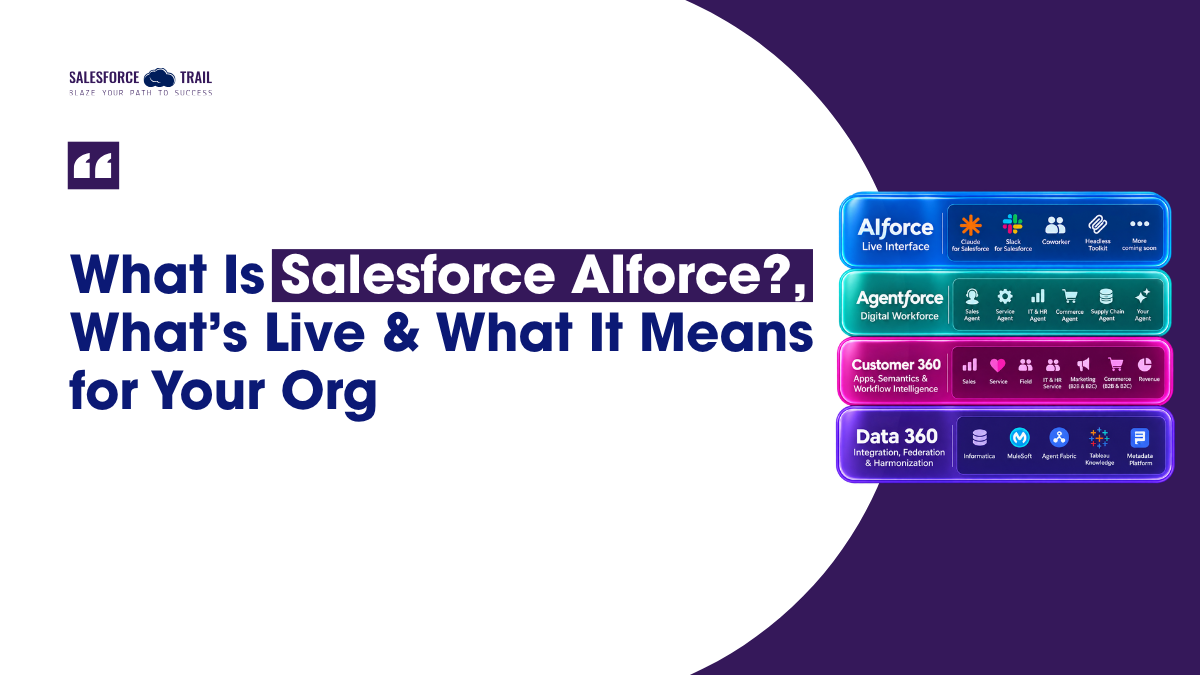
According to Salesforce, the stack works as follows: Data 360 handles unified data and context. Customer 360 supplies the business logic and semantics. Agentforce provides the digital workforce. AIforce is the delivery layer that pushes all of it out to any AI interface.
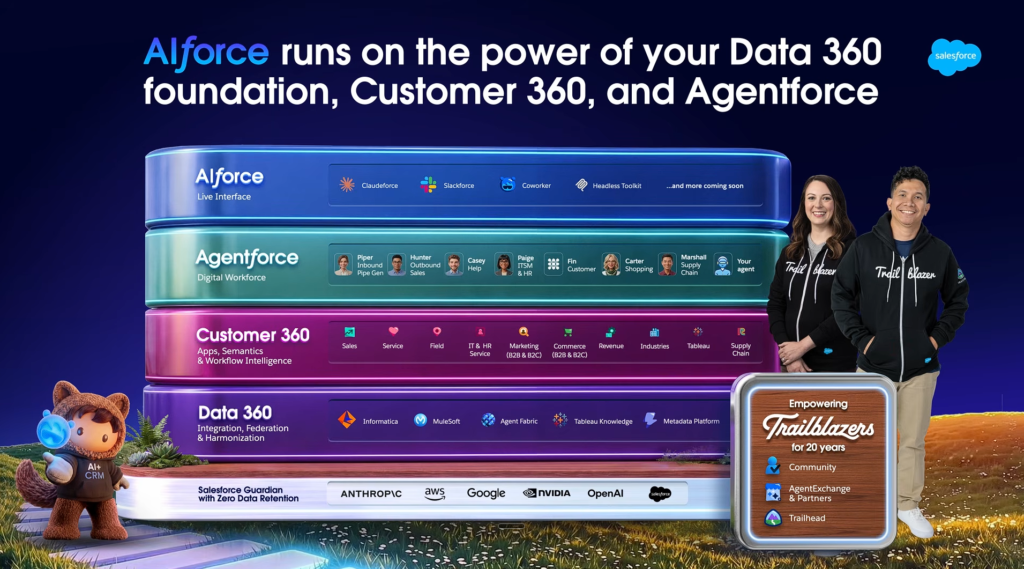
Read that again, and you’ll notice something. Most of the foundation existed before this keynote. What’s genuinely new is the access layer and the branding that ties it together. Repackaging scattered capabilities into one coherent story has real value. But if someone tells you AIforce is entirely net-new technology, they haven’t read closely.
The Three Launch Products
AIforce arrived with three surfaces. Each targets a different place people already do their work.
Claudeforce and “Salesforce in Claude”
This is the part drawing the most attention, and it deepens the existing Salesforce- Anthropic partnership. Claudeforce delivers something called Salesforce in Claude, which packs Salesforce’s intelligence into a prebuilt MCP server that runs directly inside Claude.
The MCP part matters. Normally, wiring an AI tool into Salesforce means manual setup, authentication headaches, and custom skill-mapping. A prebuilt server skips most of that friction. Salesforce launches with 37 prebuilt sales skills covering everything from prospecting to pipeline hygiene, and developers get a separate Salesforce Development plug-in for Claude Code with more than 40 skills.
According to Salesforce, Deloitte, GitLab, and Legora have conducted pilot tests of the tool. Two points: it is currently in the beta stage and not yet available to the general public. Analytics through Tableau and skills for service, marketing, and commerce are described as coming soon.
Slackforce
Most teams already live in Slack, so extending Salesforce into it is a natural move. Slackforce is really four things stitched together: Slackforce Surfaces, a smarter Slackbot, Slack CRM, and Slack Code. One detail that explains a lot: Claude is now the default model behind Slack. That’s the reason Slackbot suddenly feels like it actually understands what’s going on across your channels instead of just matching keywords.
Slackforce Surfaces is the one I’d keep an eye on. It pulls live data from Salesforce and Slack into an interface your team can filter, comment on, and act on together – all without leaving the thread you’re already in. Slack CRM handles the other direction, tying Slack activity back to your Salesforce records. Spin up a new account, log notes from a call you just wrapped, update a record, all from a prompt in Slack. No separate tab, no context-switch.
Availability across these sub-features looks mixed, and the announcement doesn’t spell out what’s live versus staged. I’d treat the specifics as “confirm before you promise anything to stakeholders.”
Agentforce Coworker
Of the three, this is the one you can actually use today. Agentforce Coworker is an AI teammate built right into the Lightning interface. It reasons across accounts, activity, and history, and it calls the specialized Agentforce agents you’ve already deployed, so it grows as your agent setup grows.
Salesforce reports that 100,000 users activated Coworker within its first 35 days, and it shared a customer quote from Fulton Bank citing more than 20 use cases in production and roughly 3,000 users in a matter of weeks. Those are vendor-reported figures, so read them as adoption signals rather than independent benchmarks. Still, the fact that it activates with a button and no migration is a legitimately low barrier to try.
The Headless Toolkit: The Part Developers Should Care About
If you build on the platform, this is your section. Underneath all three surfaces sits the Headless Toolkit, the open architecture that exposes the Salesforce platform through MCPs, APIs, plug-ins, skills, and developer tools.
This is the real engineering story. AIforce is the brand; the Headless Toolkit is the mechanism. It’s also what makes the AgentExchange ecosystem possible, where partners build interfaces and agents on top of Salesforce and list them in a marketplace. Salesforce names Anthropic, AWS, Google, and Microsoft among the interface partners, plus builders like Lovable and Vercel. For developers, that is more interesting than any single product launch, because it is something you can build upon.
What Admins, Developers, and Architects Should Actually Check
Salesforce leans hard on “connect once, no new permissions model, teams get access on day one.” That’s a strong claim. Before you flip anything on for your org, here’s my checklist.
- Permissions and Sharing: Salesforce says every request runs on existing permissions, so an agent sees only what the person asking can see. Test this against your real sharing rules and record-level security before you trust it in production. Edge cases live in the gaps.
- Zero Data Retention: Salesforce states that business data answers the question at hand and isn’t retained by the model provider. Confirm what that covers for your specific tools and whether it satisfies your compliance team. “Not retained by the model provider” is a narrower promise than “never leaves your boundary.”
- Beta vs GA Status: Don’t assume a demo means it’s live. Claudeforce is in beta today.
- Pricing: The announcement carries the standard note that pricing and packaging are subject to change, with no figures attached. If budget matters, treat cost as an open question and confirm with your account team.
- Data Readiness: These tools are only as good as the data underneath. Messy objects and stale records will produce confident, wrong answers.
Beta vs GA: What’s Really Available Today
This is the table nobody else will bother to make, so here it is.
| Product | Status | Notes |
|---|---|---|
| Agentforce Coworker | Generally available | Activates with a button, runs inside Lightning |
| Salesforce in Claude (Claudeforce) | Beta | Open to all customers; more skills coming |
| Salesforce Development plug-in for Claude Code | Available | 40+ skills for builders |
| Slackforce (Surfaces, Slackbot, Slack CRM, Slack Code) | Mixed / rolling out | Confirm individual feature availability |
Status reflects Salesforce’s September 15, 2026 announcement and may change.
Final Thoughts
AIforce is worth your attention, but not your blind trust. If you want to get hands-on, the lowest-risk option is activating Agentforce Coworker in a sandbox, since it’s GA and reversible, then trying the Salesforce in Claude beta if your team already uses Claude.
Before any of that, do the work: audit your permissions and clean up your data, because these tools will happily surface whatever mess is underneath. Get that right, and AIforce will stop being a keynote demo and start being something your team actually uses.
Frequently Asked Questions
It’s an interface layer that brings Salesforce data, logic, permissions, and governance into outside AI tools like Claude, Slack, and Lightning, so you can work with Salesforce without opening the app.
Salesforce hasn’t published pricing. The announcement says pricing and packaging are subject to change, so confirm cost with your team before planning a rollout.
Agentforce is the digital workforce of AI agents. AIforce is the layer that delivers Salesforce, including those agents, into other interfaces. Agentforce is what acts; AIforce is where you reach it.
Salesforce says requests run on your existing permissions and that data isn’t retained by the model provider (Zero Data Retention). Validate that against your own compliance requirements before enabling it.
Salesforce says no new permissions model is required and admins connect once. Test it against your actual sharing rules before trusting that in production.
- Akanksha Shukla