



External integrations are one of the most common requirements in Salesforce applications. In this article, we will build a Weather Information Viewer using Salesforce technologies such as Visualforce, Apex, Named Credentials, Custom Metadata, and Wrapper Classes.

This project demonstrates how Salesforce can interact with external APIs and display real-time data inside a Salesforce UI. By the end of this guide, you will have a responsive Visualforce weather dashboard where a user can enter a city name and retrieve current weather information.

Table of Contents

What We Are Building

We will build a weather lookup application that allows users to:

  • Enter a city name
  • Click the Get Weather button
  • Fetch real-time weather data from an external API
  • Display weather details in a clean Visualforce interface

The weather data is fetched from:

https://api.weatherapi.com/v1/current.json

Example API request: 

				
					https://api.weatherapi.com/v1/current.json?key=API_KEY&q=Chennai&aqi=no


Architecture Overview

Our solution follows Salesforce integration best practices by avoiding hardcoded values and separating logic properly. The key components are:

ComponentTechnologyPurpose
FrontendVisualforce PageUser interface for city search and weather display
ControllerApex ClassHTTP callout logic and data binding
API ConfigNamed CredentialsSecure external endpoint management
API KeyCustom MetadataConfigurable key storage outside code
Data ModelWrapper ClassJSON response deserialization

Named Credentials

Instead of hardcoding the API endpoint in Apex, we configure a Named Credential for security and maintainability.

Navigate to: Setup → Named Credentials, then configure:

  • Name: weather_Api
  • URL: http://api.weatherapi.com

This allows our Apex callout to reference the endpoint safely:

				
					callout:weather_Api


Custom Metadata for API Key

We store the API key in Custom Metadata instead of hardcoding it in Apex. This allows us to update the configuration without changing any code.

Custom Metadata Type:

				
					Weather_Config__mdt


Field:

				
					ApiKey__c


Record:

				
					DeveloperName: weather_Api_Key


What is a Wrapper Class in Salesforce?

A Wrapper Class is an Apex class used to represent complex data structures, especially when dealing with JSON responses from external APIs. When Salesforce receives a JSON response, it may contain nested objects such as location, current, and condition.

Instead of manually parsing JSON using maps, we create a wrapper class that mirrors the JSON structure, enabling automatic deserialization via JSON.deserialize().

Benefits of using Wrapper Classes:

  • Cleaner, more readable code
  • Automatic JSON deserialization
  • Easy property access on nested objects
  • Better maintainability over time

Weather API JSON Structure

The weather API returns a response structured as follows:

				
					{
 "location":{
    "name":"Chennai",
    "country":"India",
    "localtime":"2026-03-13 16:32"
 },
 "current":{
    "temp_c":31.2,
    "humidity":71,
    "condition":{
       "text":"Sunny",
       "icon":"//cdn.weatherapi.com/weather/64x64/day/113.png"
    }
 }
}


Wrapper Class Implementation

Using this wrapper class allows Salesforce to convert the JSON response automatically using JSON.deserialize()

				
					public class WeatherResponseWrapper {
    
    public Location location {get; set;}
    public Current current {get; set;}
    
    public class Location{
        public String name {get; set;}
        public String region {get; set;}
        public String country {get; set;}
        public String localtime {get; set;}
    }
    
    public class Current {
        public Decimal temp_c {get; set;}
        public Decimal temp_f {get; set;}
        public Integer humidity {get; set;}
        public Decimal wind_kph {get; set;}
        public Condition condition {get; set;}
    }
    
    public class Condition{
        public String text {get; set;}
        public String icon {get; set;}
    }
}


Apex Controller

The WeatherVFController handles the complete workflow:

  • Retrieves the API key from Custom Metadata
  • Builds the API request using Named Credentials
  • Sends an HTTP callout to the weather service
  • Parses the JSON response into the wrapper class
  • Handles errors with user-friendly ApexPages messages
				
					public with sharing class WeatherVFController {
    
    public String cityName {get; set;}
    public WeatherResponseWrapper weatherData {get; set;}
    
    public void getWeather() {
        
        try{
            
            Weather_Config__mdt wcQuery = [
                SELECT Id, Label, ApiKey__c 
                FROM Weather_Config__mdt 
                WHERE DeveloperName = 'weather_Api_Key' 
                LIMIT 1
            ];
            
            String apiKey = wcQuery.ApiKey__c;
            
            String endpoint = 'callout:weather_Api/v1/current.json?key='
                + apiKey + '&q=' + cityName + '&aqi=no';
            
            HttpRequest req = new HttpRequest();
            req.setEndpoint(endpoint);
            req.setMethod('GET');
            
            Http http = new Http();
            HttpResponse res = http.send(req);
            
            if(res.getStatusCode()==200){
                
                weatherData = (WeatherResponseWrapper)
                    JSON.deserialize(res.getBody(), WeatherResponseWrapper.class);
                    
            } else {
                
                ApexPages.addMessage(
                    new ApexPages.Message(
                        ApexPages.Severity.ERROR,
                        'Weather API Error'
                    )
                );
            }
            
        } catch(Exception e){
            
            ApexPages.addMessage(
                new ApexPages.Message(
                    ApexPages.Severity.ERROR,
                    e.getMessage()
                )
            );
        }
    }
}


Visualforce Page

The Visualforce page provides a clean, responsive UI for users to search for weather information. It features:

  • Gradient blue background with card-based layout
  • City name input field with placeholder text
  • Partial page refresh via reRender (no full page reload)
  • Dynamic weather icon fetched from the API response
  • Responsive grid displaying: City, Country, Local Time, Temperature, and Humidity

Visualforce Code


🌦 Weather Information

Your UI looks like this:
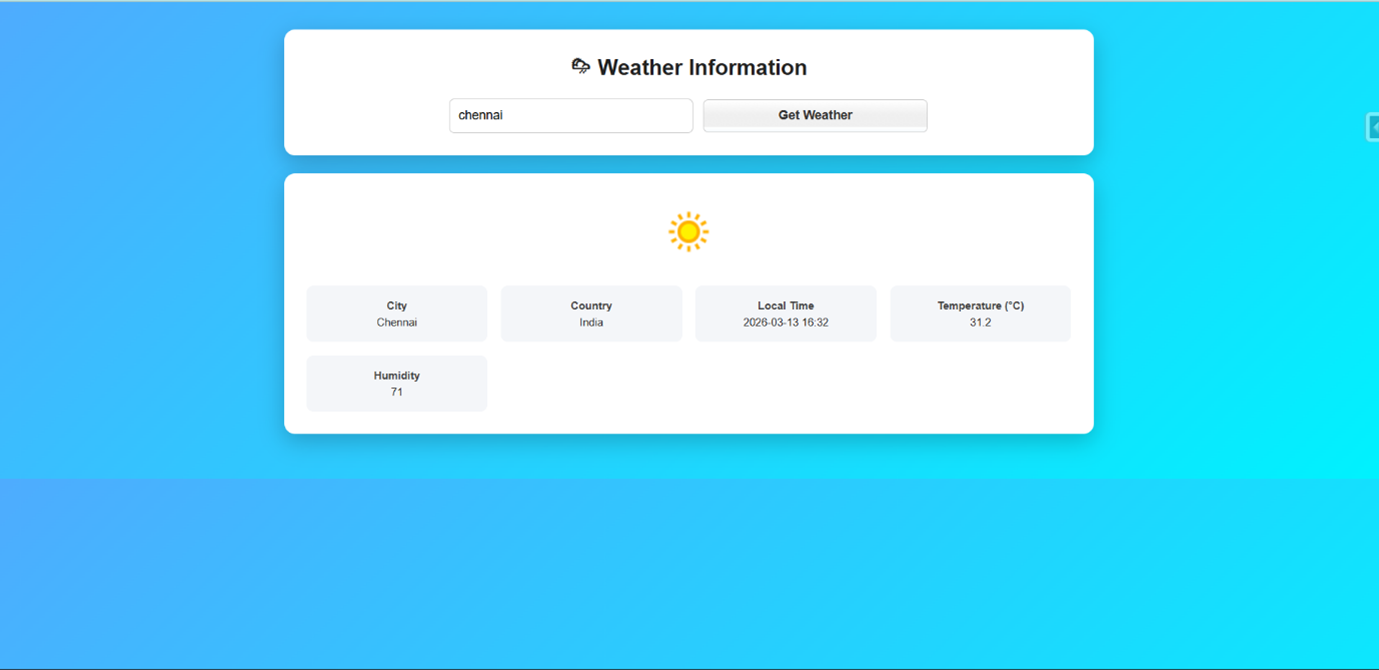
Visualforce Weather Dashboard

The page dynamically displays:

  • City
  • Country
  • Local Time
  • Temperature
  • Humidity
  • Weather Icon

Example Output

Example result for Chennai:

FieldValue
CityChennai
CountryIndia
Local Time2026-03-13 16:32
Temperature31.2 °C
Humidity71%
ConditionSunny

Best Practices Demonstrated

Named CredentialsAvoid hardcoded endpoints and manage external services securely
Custom MetadataStore configuration values like API keys outside of code
Wrapper ClassesHandle JSON responses cleanly and efficiently
Error HandlingProvide user-friendly error messages via ApexPages
Clean UI DesignUse CSS styling to enhance Visualforce pages

Final Thoughts

This project is a great example of how Salesforce can integrate with external systems while maintaining a secure and scalable architecture. Even though modern Salesforce development focuses heavily on Lightning Web Components, Visualforce remains valuable for learning Apex integrations and callout patterns.

Understanding these patterns helps developers build enterprise-grade integrations in Salesforce.

Kiran Sreeram Prathi
Sr. Salesforce Developer  kiransreeram8@live.com

I’m Kiran Sreeram Prathi, a Salesforce Developer dedicated to building scalable, intelligent, and user-focused CRM solutions. Over the past five years, I’ve delivered Salesforce implementations across healthcare, finance, and service industries—focusing on both technical precision and user experience. My expertise spans Lightning Web Components (LWC), Apex, OmniStudio, and Experience Cloud, along with CI/CD automation using GitHub Actions and integrations with platforms such as DocuSign, Conga, and Zpaper. I take pride in transforming complex workflows into seamless digital journeys and implementing clean DevOps strategies that reduce downtime and accelerate delivery. Recognized by organizations like Novartis, WILCO, and Deloitte, I enjoy solving problems that make Salesforce work smarter and scale better. I’m always open to connecting with professionals who are passionate about process transformation, architecture design, and continuous innovation in the Salesforce ecosystem.


Share.
Leave A Reply

Exit mobile version