

You’ve passed the Admin exam, or you’re very close to it. You can create fields, set up flows, and write validation rules without having to Google every single step. Then, someone from the sales team comes to your desk and says, “Our entire process is broken; can you fix it?” and you have absolutely no idea where to start.
I’ve been in that situation too. That moment of uncertainty is where many beginners quietly get stuck, and it has nothing to do with your technical skills. You know *how* to build; you haven’t yet figured out *what* to build. That skill has a name, and learning it early on is the closest thing to a shortcut I’ve found in the Salesforce ecosystem.
It’s called business analysis. Here’s why you should start picking it up now, even on day one.
The short answer
Business analysis is the skill of turning vague business problems into clear, buildable requirements. For a Salesforce beginner, it matters because most failed or bloated orgs aren’t caused by bad code – they’re caused by building the wrong thing. Learn to ask the right questions before you build, and you become the person teams actually trust.
Table of Contents
What business analysis actually means on Salesforce
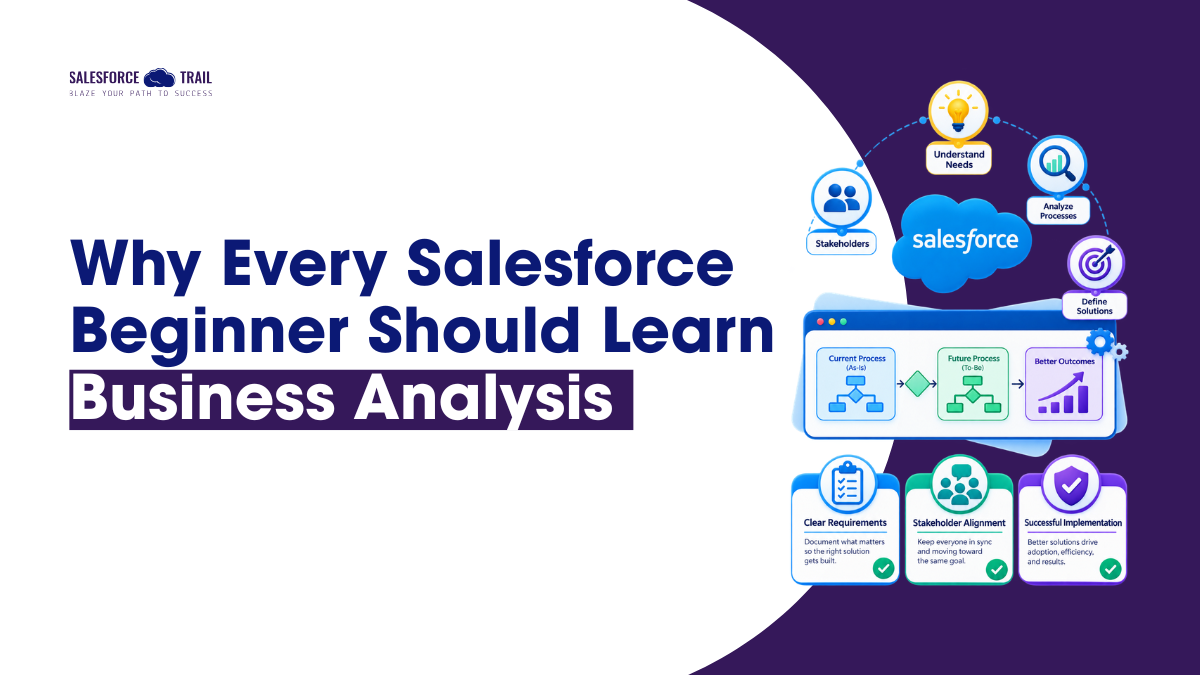
Business analysis sounds like a specialized career path one pursues only after years of experience. In reality, that isn’t the case. It involves habits you can adopt immediately: understanding what stakeholders truly need, grasping how a process currently functions, clearly documenting requirements, and establishing a consensus on the definition of “done” before implementation begins.
Making changes in Salesforce is incredibly easy. That ease, however, carries a risk. You can create a new field or automation in a single afternoon, which means you can just as easily build the wrong solution fast and call it progress. Salesforce’s own Business Process Mapping module on Trailhead makes this clear: analysis comes before architecture, and architecture comes before the build.
You’re probably already doing it (a little)
Whenever you asked, “Wait, why is this field actually needed?” that was business analysis. Whenever you questioned a request because it didn’t seem right, that too was the same thing. The goal is not to impose an external element or methodology; rather, to utilize the understanding you already possess more deliberately and effectively.
The Gap that stalls Beginners isn’t Technical.
Most beginners get stuck at a certain stage not because they lack the ability to build, but because they fail to grasp the true meaning of things. A stakeholder might describe a complex situation in their own terms, without there being a clear field or workflow to map it to. Before considering a solution, you must understand the ambiguity, ask the right questions, and clearly define the problem.
Data on this subject may be dated, but the trend has remained consistent. The Project Management Institute’s Pulse of the Profession research found that inaccurate requirements management was the primary cause of failure in nearly half of unsuccessful projects. The long-running Standish Group CHAOS studies have said much the same for decades: clear requirements and real user involvement are among the strongest predictors of whether a project succeeds or dies.
Translate that to Salesforce. When you see an org drowning in unused fields, abandoned automations, and reports nobody opens, that’s rarely a coding failure. It’s a requirements failure. Someone built exactly what was asked, and what was asked was wrong.
Why BA skills make you more employable
Let’s talk about what you’re actually here for: does this benefit your career and your earnings?
The Market Backdrop
The Salesforce ecosystem is still enormous. A 2023 IDC study commissioned by Salesforce projected the Salesforce economy would create a net gain of 11.6 million jobs and $2.02 trillion in worldwide business revenue between 2022 and 2028. That’s a projection, not a guarantee, and the job market softened noticeably through 2024 into 2025. Entry-level roles are crowded right now. This is exactly why a skill that sets you apart is worth more than another line-item certification.
What it does for your earnings
Business analysis skills don’t lock you into a single title. That’s the quiet advantage. Whether you stay an admin, move toward consulting, or eventually specialize, the ability to run discovery and write solid requirements travels with you.
For a rough external benchmark, the U.S. Bureau of Labor Statistics lists a median annual wage of $101,190 (May 2024) for management analysts — the closest standard classification to a business analyst — and projects the field to grow about 9% through 2034, faster than the average occupation. Inside the Salesforce world specifically, BA compensation tends to track at or slightly above admin pay, and it climbs as you take on bigger, messier problems.
It’s a multiplier, not a detour.
This is the reframe I wish someone had handed me earlier. Learning business analysis doesn’t pull you away from your technical growth. It makes everything you build land better. Better requirements mean fewer rebuilds, higher adoption, and stakeholders who come back to you first. It compounds.
The AI Angle: Why this Matters More in 2026, not less
If you’re worried that AI will take away entry-level Salesforce jobs, I wouldn’t say that fear is unfounded. Agentforce and AI-assisted tooling are already automating much of the configuration and are starting to chip away at coding as well. The routine build work is getting cheaper by the month.
But look closely at what AI can’t do. It can’t sit in a room and sense that two departments are describing the same problem in incompatible language. It can’t tell that the picklist someone requested is really a symptom of a broken handoff three steps upstream. It can’t build trust with a nervous stakeholder or make a judgment call about which requirement actually matters.
That’s business analysis. As the mechanical aspects of work become automated, the human elements such as discovering new things, making the right decisions, and understanding the purpose behind what you are creating are what truly make the critical difference. Beginners who focus on these aspects now are essentially betting on the part of the work that is hardest to change or replace.
How to Start Learning Business Analysis – Free, Today
You don’t need $200 or two years of experience to begin. Here’s the path I’d point a beginner to.
Start on Trailhead
Salesforce has made this available for free. Complete the “Get Started as a Salesforce Business Analyst ” content and the “Business Process Mapping” module. These cover how the BA role differs from that of an admin, how to write user stories, and how to map processes using clear notation.
Next, do the work that actually builds skills: choose a real-world process such as lead handoff, case escalation, or something similar and map it from start to finish. Create an “as-is” map first, followed by a “to-be” map. Actually doing it is far better than just reading about it.
Build the underlying muscles.
Some of the most valuable BA skills aren’t Salesforce-specific at all:
- Requirements elicitation – learning to ask questions that surface what people mean, not just what they say.
- Stakeholder interviews and gap analysis – spotting the distance between where a process is and where it needs to be.
- Documentation discipline – consistent naming, clean templates, notes someone else can actually follow.
For the theory, the BABOK Guide from the IIBA is the recognized standard. You don’t need to memorize it. Skimming its knowledge areas gives you a vocabulary and a framework that make the Salesforce-specific stuff click faster.
Should you get the BA certification yet?
Honestly? Not on day one. The Salesforce Certified Business Analyst exam costs $200; it is heavily based on real-world scenarios and assumes you have about two years of experience. Simply memorizing the material at the start won’t teach you much.
The good news for planners is that this is a safe bet for the long term. When Salesforce announced the certifications being retired in 2027, the Business Analyst credential was not on that list. It remains a core role-based certification. So, learn the skills now, combine them with your Administrator certification, and take the BA exam once you have gained experience on a few projects.
The mindset shift that changes your whole career
Strip away the certifications and salary figures, and here’s what actually changes. You stop being the person who waits for instructions and start being the person who asks the question everyone else in the room missed. “Why do we do it this way?” “What happens if this step fails?” “Who else is affected by this?”
That shift is what earns trust. Trust earns you bigger projects. Bigger projects are how careers accelerate. Business analysis is what turns someone who knows Salesforce into someone who makes Salesforce deliver value for the business — and that second person is the one who gets promoted.
Final Thoughts
Don’t try to absorb all of this at once. This week, do one thing: open Trailhead, start the Business Process Mapping module, and map a single real process you already understand. That’s it. One process, mapped as-is and to-be.
You’ll feel the difference the next time a stakeholder hands you a vague, tangled problem. Instead of freezing, you’ll know exactly where to start.
Frequently Asked Questions (FAQ)
You can pass the Admin exam without them, but you’ll struggle in the real job without them. Most of an admin’s day is spent on quiet business analysis — figuring out what people need and translating it into a solution. Deliberately building this skill makes you far more effective.
An admin configures and maintains the platform. A business analyst focuses on understanding the business problem, gathering requirements, and mapping processes so the right thing gets built. In many teams, especially smaller ones, the same person wears both hats.
Compensation varies widely by country and experience. As a benchmark, the U.S. Bureau of Labor Statistics reports a median wage of $101,190 (May 2024) for management analysts, the closest standard role. Within Salesforce, BA pay generally tracks at or slightly above admin pay and rises with seniority.
Yes. Trailhead has free trials and modules on process mapping, user stories, and the BA role. Pair those with the freely available BABOK framework from the IIBA, then practice by mapping real processes. You can build genuine skill without spending anything.
Not immediately. The exam assumes real project experience and rewards practical judgment over memorization. Learn the skills first, get your Administrator cert, and sit the BA exam once you’ve worked on actual implementations. It’s a solid mid-term goal rather than a starting point.
Unlikely. AI is automating the routine build and configuration work, but the core of business analysis, discovery, judgment, stakeholder trust, and knowing what to build and why is exactly what AI handles poorly. If anything, those human skills are becoming more valuable as the mechanical parts get automated.

Priya Rastogi
Priya is a 3x Salesforce Certified who believes in the power of continuous learning and collaboration. She’s passionate about exploring how Salesforce can simplify work, boost productivity, and create better user experiences. When she’s not experimenting with new features or automating processes, Priya enjoys connecting with fellow Trailblazers and sharing insights to help others grow in their Salesforce journey.
- Priya Rastogi
- Priya Rastogi
- Priya Rastogi
 September 16, 2026
 - Priya Rastogi