

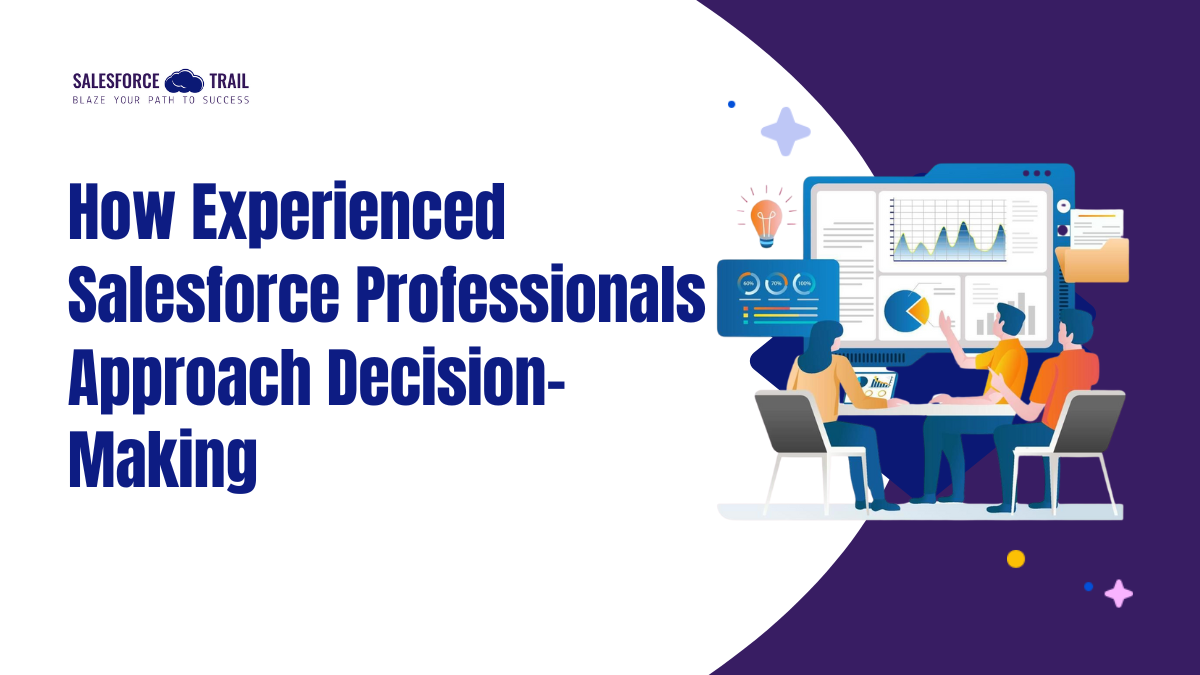
In the Salesforce ecosystem, decision-making is what separates beginners from truly Experienced Salesforce Professionals. It’s not just about knowing features or passing certifications. It’s about making the right choice in the right context, often under constraints like time, budget, data quality, and long-term scalability.
Whether you’re an Admin deciding between Flow and Validation Rules, a Developer choosing Apex vs declarative automation, or an Architect defining a data model, your decisions directly shape system health and business outcomes. This article explains how experienced professionals think, evaluate, and make decisions in real-world Salesforce environments.
Table of Contents
Experience Changes How You See Problems
Early in a Salesforce career, decisions are often feature-driven:
- “Can Salesforce do this?”
- “What tool should I use?”
With experience, the question shifts to:
- “Should we do this?”
- “What are the long-term consequences?”
Experienced professionals recognize that most Salesforce challenges don’t have a single “correct” answer. Instead, there are trade-offs. The goal of Salesforce professional decision-making is to choose the option that best aligns with business needs, scale, and maintainability, not just technical elegance.
Start With the Business Problem, Not the Tool
One common mistake less-experienced professionals make is jumping straight to solutions:
“Let’s build a Flow.”
“We need Apex.”
“This should be a custom object.”
Seasoned Salesforce practitioners pause first.
They ask:
- What problem is the business actually trying to solve?
- Who is impacted—end users, admins, customers, leadership?
- Is this a one-time requirement or an evolving process?
Only after clarifying the why do they think about the how. This discipline prevents overengineering and ensures Salesforce remains a business enabler rather than a technical maze.
Evaluating Trade-Offs, Not Just Capabilities
Every Salesforce option comes with strengths and limitations.
For example:
- Flow vs Apex
Flow is faster to build and easier to maintain, but complex logic and performance constraints may favor Apex. - Standard vs Custom Objects
Standard objects offer built-in features, but custom objects provide flexibility. - Declarative Automation vs Code
Declarative tools are accessible, but code offers precision and version control.
Experienced Salesforce Professionals evaluate decisions across multiple dimensions:
- Maintainability
- Performance
- Scalability
- Admin friendliness
- Risk of future technical debt
They understand that “works today” is not enough. The solution must still make sense a year from now.
Designing for Scale and Change
One hallmark of experience is designing for growth even when the current requirement seems small.
Experienced professionals ask:
- What happens if data volume increases 10x?
- Will this break with additional automation?
- Can a new admin understand this setup?
For example, instead of hardcoding logic into multiple Flows, they may centralize logic, document assumptions, or design with extension points in mind. This mindset protects organizations from fragile implementations that collapse under change.
Respecting Platform Limits and Realities
Salesforce has limits, governor limits, automation limits, sharing recalculations, and API limits. Beginners often discover these limits after something breaks.
Experienced Salesforce professionals factor platform constraints into decisions upfront:
- Avoiding excessive automation chains
- Preventing recursive logic
- Designing efficient SOQL and data models
- Minimizing user-facing performance impact
This awareness comes from real-world incidents, production failures, and hard-earned lessons, not just documentation.
Balancing “Best Practice” With Context
Salesforce best practices are important, but they’re not absolute rules.
For instance:
- “One trigger per object” is a good guideline, but structure matters more than count.
- “Click not code” is helpful, but not at the cost of clarity or performance.
Experienced professionals know when to follow best practices strictly—and when to adapt them to fit organizational reality. They avoid dogmatic thinking and instead apply principles with context and judgment.
Communicating Decisions Clearly
Decision-making doesn’t stop at implementation. It includes explaining why a decision was made.
Seasoned Salesforce professionals:
- Document assumptions and trade-offs
- Explain risks to stakeholders in plain language
- Set realistic expectations with business users
- Provide options instead of dictating solutions
This builds trust. When something changes later (and it always does), stakeholders understand the reasoning and are more aligned with the next decision.
Learning From Past Mistakes
One underrated aspect of Salesforce professional decision-making is reflection.
Experienced professionals regularly ask:
- What worked well in this implementation?
- What caused rework or confusion?
- Where did we underestimate complexity?
They treat mistakes as feedback loops, not failures. Over time, this reflection sharpens intuition and improves future decisions—often faster than any certification or Trailhead module.
Common Decision-Making Mistakes to Avoid
Even experienced professionals stay alert to these pitfalls:
- Over-customizing when standard features are sufficient
- Solving symptoms instead of root problems
- Ignoring admin usability in favor of technical purity
- Designing for edge cases while neglecting core flows
Awareness of these traps is itself a sign of maturity.
Conclusion: Experience Is About Judgment, Not Just Knowledge
At its core, how Experienced Salesforce Professionals approach decision-making is less about tools and more about judgment. They combine technical knowledge, business understanding, platform awareness, and experience to make thoughtful, balanced choices.
Good Salesforce implementations aren’t defined by complexity. They’re characterized by clarity, resilience, and alignment with real-world needs. As you grow in your Salesforce career, focus not just on what you build—but why you make it, and how it will stand the test of time.
That mindset is what truly defines professional maturity in the Salesforce ecosystem.





Most Reads:
- Salesforce Business Rules Engine (BRE) Explained: Smarter Decisioning Beyond Apex & Custom Metadata
- TDX 2026 Call for Participation Is Live: Everything you Need to know
- Build a Dynamic, Reusable Lightning Datatable in Salesforce LWC (With Metadata-Driven Columns, Search & Pagination)
- Salesforce Marketing Cloud to Agentforce: The Future of Marketing Automation
Resources
- [Salesforce Developer]- (Join Now)
- [Salesforce Success Community] (https://success.salesforce.com/)
For more insights, trends, and news related to Salesforce, stay tuned with Salesforce Trail
- Akanksha Shukla

- Akanksha Shukla