



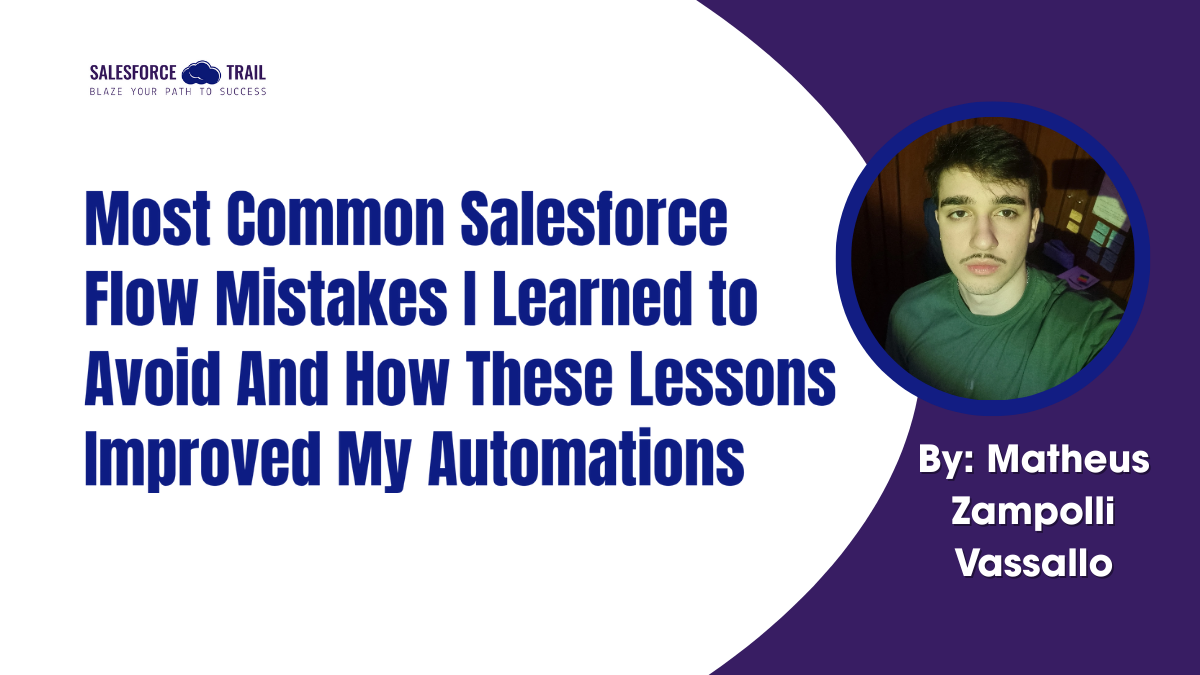


When I first started working with Salesforce Flow, I believed the biggest challenge would be mastering the interface — elements, variables, loops, formulas, decisions. But as I moved into real business projects, I realized something much more important:

Flows don’t break because of missing clicks.
They break because of poor design decisions.

Over time, I understood that the real issues weren’t technical — they were architectural. My mistakes became my training ground, and every failure pushed me to rethink not only how I built flows but why I built them that way.

In this article, I share the most common Salesforce Flow mistakes I made (and see many beginners make), along with the insights that transformed the quality and stability of my automations.

Table of Contents

  1. Ignoring the Salesforce Order of Execution

Understanding the Order of Execution was one of the biggest turning points in my development as a consultant.

In my early flows, I didn’t consider that:

  • Validation rules might fire before my updates
  • Apex triggers could overwrite my changes
  • Other flows could run in sequence
  • Integrations might update fields moments later

Because of that, I faced issues like:

  • updates being overwritten
  • flows triggering twice
  • inconsistent field values
  • “REQUIRED_FIELD_MISSING” errors even when everything seemed correct

Once I started mapping what happens before and after my flow, my automations became far more predictable and easier to maintain.

  1. Using Loops Inefficiently

Loops were one of my biggest sources of trouble.

In one of my early projects, I accidentally triggered 120 individual DML operations inside a loop.
One save attempt.
120 operations.
One failed flow.

After that painful experience, I adopted new principles:

  • Aggregate records before updating
  • Avoid DML inside loops
  • only loop when necessary
  • understand how collections work

This not only improved performance but also made my automations much more scalable.

  1. Poorly Structured Decision Logic

Decision elements are the “thinking core” of a flow, and early in my journey, my flows “thought” in very confusing ways.

I created:

  • redundant conditions
  • overlapping paths
  • vague outcome names
  • decision trees that only made sense on the day I built them

When I revisited those flows months later, I couldn’t understand what I had created.

Now I follow three rules:

  1. Each outcome must be unique and mutually exclusive
  2. Names must clearly express the logic (e.g., IsRenewal, IsNewContract)
  3. Avoid unnecessary nested paths

Clear decision logic = easy maintenance.

  1. Not Designing for Real-Life Scenarios

(Lead → Account → Contact → Opportunity)

This was one of the most important lessons I learned.

At the beginning, I built flows for the perfect scenario — the “happy path.” But real business processes are messy.

My flows broke when:

  • A lead conversion didn’t bring all fields
  • Integrations created accounts with inconsistent data
  • opportunities varied depending on who created them
  • Users edited records multiple times at unexpected moments

Now I always ask:

  • What if the field is blank?
  • What if this comes from an integration?
  • What if the user edits it again later?
  • What if this record originated from a Lead conversion?

Stable flows are designed for real-life situations rather than ideal conditions.

  1. Incorrect Handling of Picklists and Data Types

This mistake caused more silent failures than any other.

I struggled with:

  • comparing picklists without using TEXT()
  • treating numbers as text
  • formulas that behaved correctly “sometimes.”
  • decision branches that never fired

Once I started:

  • normalizing data types
  • avoiding mixed-type comparisons
  • moving complex logic into Formula Resources
  • debugging picklists intentionally

My flows stopped failing mysteriously.

  1. Skipping Fault Paths (Error Handling)

This mistake nearly ruined an entire process.

One of my flows silently failed for weeks because I didn’t configure fault paths.
No error messages.
No emails.
No alerts.
Just data missing, and no one knew why.

Today I always:

  • Configure a fault path
  • Send an automated alert to myself or an admin
  • Provide a clear, understandable error message
  • Log the issue when necessary

Professional flows never fail silently.

  1. Thinking Like a Clicker Instead of a Consultant

This was the biggest mindset shift of my career.

Initially, I immediately opened Flow Builder and started dragging elements into place. Today, I don’t even open the tool until I fully understand the business problem.

Before building anything, I identify:

  • the business requirement
  • user behavior
  • data relationships
  • exceptions
  • impacts on other processes
  • long-term maintenance
  • integrations and dependencies

A flow is not a collection of elements — it is a business solution. Once I adopted this mindset, the quality of my automations improved dramatically.

Conclusion

Building flows taught me far more than automation. It taught me how to think logically, anticipate failures, and design processes that support the business rather than simply functioning technically.

If I could give one piece of advice to anyone beginning their Flow journey, it would be this:

Don’t focus only on learning Flow. Focus on learning how to think.
Flow is just the tool. The real quality comes from your design decisions.

Matheus Zampolli Vassallo
Consultor Salesforce Junior  teteuzampa@gmail.com

Dynamic Salesforce Professional with hands-on experience in implementation and customization projects across diverse clients. Skilled in configuring objects, fields, page layouts, flows, and validation rules, as well as developing tailored reports and dashboards to drive business insights. I have contributed to external system integrations, strengthening my expertise in connectivity and interoperability within the Salesforce ecosystem. My experience also includes working with complex flows and Apex class modifications, enabling advanced automation and customization. Passionate about continuous learning, I collaborate closely with project teams to analyze requirements and transform client needs into effective Salesforce solutions. I am consistently expanding my knowledge in Sales Cloud, Service Cloud, and CRM best practices, with the goal of becoming a well-rounded consultant and Salesforce expert.

Share.
Leave A Reply

Exit mobile version