


Prompt engineering turns business goals into clear, testable instructions that help generative models produce reliable outputs. This guide lists common ways that things go wrong, connects each one to useful ways to fix them, and gives teams a short workflow- Plan, Design, Write, Test, Monitor, Iterate that they can use to make prompts that can be audited and are ready for production. The guidance emphasizes structured outputs, validation, and versioning so that prompts act like software artefacts that can be maintained.

Table of Contents

Why Prompt Engineering Needs a Framework

A prompt is the bridge between human intent and model behavior. The clearer and more structured the prompt, the more predictable the outcome. As organizations embed generative AI into CRM workflows, translating business requirements into concise, verifiable prompts becomes an operational capability. Explicit roles, structured outputs, and decomposed tasks reduce hallucination, making results easier to validate and integrate. This article treats prompt engineering as an engineering discipline: define success criteria first, design the prompt structure second, and iterate with tests and versioning.

Common Prompt Failures (and Why They Happen)

Before designing better prompts, it’s important to understand why prompts fail in practice.

  • Vague intent — Broad or open questions without audience, scope, or format produce generic or irrelevant outputs.

Prompt: “Write something about Salesforce integration.”

Why poor: No audience, scope, format, or success criteria.

  • Missing context — Omitting background (data schema, constraints) forces the model to guess or hallucinate.

Prompt: “Summarize the case into a Knowledge article.”

Why poor: No format, fields, or sorting rules.

  • Overloaded prompts — Combining unrelated tasks in one prompt yields partial or inconsistent results.

Prompt: “Create a training plan, write a slide deck, and produce code samples for Apex triggers.”

Why poor: Multiple unrelated tasks; the model will likely produce shallow results.

  • No output structure — Freeform responses are hard to parse, validate, or integrate.

Prompt: “Give me a report of leads by source.”

Why poor: No audience, level of detail, or format.

  • No validation or acceptance criteria — Without success criteria, outputs cannot be automatically checked or rejected.

Prompt: “List migration risks for Lightning.”

Why poor: No scenario, constraints, or validation rules.

  • Assuming model memory or facts — Treating the model as a database leads to stale or fabricated facts.

Prompt: “What is our current SLA for premium customers?”

Why poor: Forces the model to assume facts from memory.

  • Poor example selection — Bad or missing examples leave the model without a clear target style.

Prompt: “Write a customer apology email.

Example: ‘Sorry about the delay.’”

Why poor: Tone and formality unclear.

Consequences: Vague or inaccurate instructions can produce irrelevant, biased, or unsafe outputs and increase operational risk.

How to Write Effective and Engineer Better Prompts

  • Role — Set perspective

Example: You are an expert Salesforce architect.

  • Context — Provide necessary background and data schema.
  • Task — State a single, measurable objective.
  • Constraints — Specify format, length, tone, and forbidden content.
  • Examples — Include positive and negative examples when helpful.
  • Validation — Define rules the model should use to self-check (assumptions, confidence).

Core Principles of Prompt Engineering Framework

Beyond structure, strong prompts follow a set of design principles.

  • Define intent explicitly. Map each prompt to a single, measurable outcome.
  • Separate concerns. Use modular sections for capability boundaries, instructions, and system actions.
  • Prefer templates. Reusable templates reduce drift and make auditing feasible.
  • Chain small prompts. Use retrieval → synthesis → action to reduce hallucination and isolate failures.

Prompt Engineering Workflow/Lifecycle

Begin by defining what success looks like (Plan). Next, design the prompt by specifying role, context, task, constraints, and examples (Design). Create the minimal prompt that satisfies those criteria (Write) and validate it against a small, representative test set (Test). Monitor performance in production (Monitor) and apply focused, single‑variable edits with version control (Iterate). Change one thing at a time and use automated checks to measure impact.
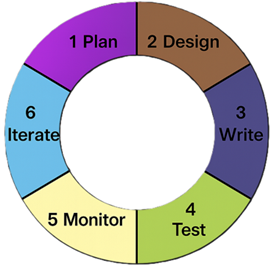
Prompt Engineering Workflow/Lifecycle

  1. Plan — Define success before you write

  • Goal: What must the prompt achieve?
  • Audience: Who consumes the output?
  • Format: Plain text, JSON, table, code, or bullets?
  • Acceptance criteria: Minimum checks (length, fields, no hallucinated facts).
  1. Design — Structure the prompt

  • Use modular sections in this order: Role; Context; Task; Constraints; Examples; Validation.
  • Iterate on prompt structure based on model responses.
  1. Write — Start minimal and be explicit

  • Specify structure, tone, length, and required fields.
  • Add positive and negative examples to reduce ambiguity.
  • Version prompts with short notes for traceability.
  1. Test — Validate with representative inputs

  • Run a small test suite to reveal edge cases.
  • Log actual vs expected outputs and refine only as needed.
  • Version tests alongside prompts.
  1. Monitor — Measure outcomes in production

  • Track business signals (accuracy, relevance, safety), not just token counts.
  • Automate detection of common failure modes and feed results into remediation pipelines.
  1. Iterate — Make focused, measurable changes

  • Change one variable at a time and measure impact.
  • Keep rollbacks simple and maintain before/after examples for auditability.
Best Practices for Production-Ready Prompts

Goal: Make prompts reliable, auditable, and easy to integrate.

  • Set the role and audience: Specify the persona and the intended consumer so tone and detail match expectations.
  • Demand structured outputs: Request JSON, CSV, or clearly labeled sections when downstream systems will parse the result.
  • One task per prompt: Break complex workflows into sequential prompts to isolate failure modes.
  • Define acceptance criteria: List required fields, length limits, and validation rules so outputs can be checked automatically.
  • Include concrete examples: Provide a positive example that shows the desired output and a negative example that shows what to avoid.
  • Surface assumptions: Ask the model to list its assumptions or confidence level before the final answer.
  • Protect sensitive data: Never hard-code secrets or PII; parameterize identifiers and follow approved environments.
  • Automate validation: Use simple schema checks to reject malformed outputs and route low-confidence results for human review.
  • Version templates: Store prompts in a versioned library with changelogs and automated tests.
  • Human in the loop for risk: Require reviewer approval for low‑confidence or high‑impact outputs.
  • Measure meaningful metrics: Track intent accuracy, task success rate, human escalation rate, and latency.

Examples of Good Prompts

Below are concise, production-oriented prompt templates that illustrate the principles above. Each example specifies role, context, task, constraints, and validation rules so you can plug them into a test harness or template library with minimal modification.

Example
Good Prompt
Specifies role, audience, scope, format, and acceptance criteria so the model cannot guess intent.Executive summary for integrations
Role: Experienced Salesforce architect
Context: Org uses Sales Cloud and Service Cloud; integrations must use middleware.
Task: Write a 200–250-word executive summary for nontechnical stakeholders describing three integration patterns: point‑to‑point, middleware, and event‑driven, and one business benefit per pattern.
Constraints: Plain language; no diagrams; exactly three patterns and three benefits.
Validation: Output ≤250 words; contains three pattern names and three benefits.
Provides the record schema, target category, output format, and validation so the model can produce a usable, non‑hallucinated article.Knowledge article from case fields
Role: Knowledge author for Service Cloud
Context: Case fields: Subject, Description, Steps_Taken__c, Resolution__c. Target category: Billing.
Task: Produce a JSON object with keys: title, summary, steps, resolution, tags.
Constraints: Title ≤10 words; summary ≤60 words; tags array length 3–5; exclude PII.
Validation: JSON parses; all keys are present and meet length rules.
Defines a machine‑readable schema and validation rule so the output can be parsed and integrated automatically.Lead source summary for analytics
Role: Data analyst
Context: Dataset fields: LeadId, CreatedDate, Source, Status.
Task: Return a JSON array summarizing lead counts by Source for the last 30 days.
Format: Each object: source, lead_count, percent_of_total.
Constraints: Sort by lead_count descending; round percent_of_total to one decimal place; include total_leads at top level.
Validation: JSON valid; total_leads equals sum of lead_count.
Splits unrelated tasks into sequential, testable prompts so each output is focused and verifiable.Decomposed training content workflow
Prompt A Plan: Create a 6-module outline for a half-day Apex triggers workshop. Each module: title, duration, learning objective. Total duration is 4 hours.
Prompt B Slides: Using the accepted outline from Prompt A, produce 3–5 slide bullets per module.
Prompt C Code Samples: For modules that require code, provide one concise Apex trigger example with comments and a test class skeleton.
Specifies exact output structure, number of items, and validation so results meet acceptance criteria.List migration risks for Lightning
Role: You are a Salesforce migration lead.
Context: Migrating from Classic to Lightning for a mid‑size org with 200 custom objects and Visualforce pages.
Task: Produce a markdown table with columns: Risk, Impact (High/Medium/Low), Mitigation, Estimated Effort (Low/Medium/High). Provide exactly five risks.
Constraints: Each mitigation is one sentence; Estimated Effort must be Low/Medium/High.
Validation: Table must have five rows and four columns; no row may be empty.
Forces the model to request or use explicit data rather than assuming facts from memory.Current SLA for premium customers
Role: You are a Service Cloud analyst.
Context: I will provide the SLA policy text or the Case record ID; do not assume any SLA values.
Task: If I provide a Case ID, fetch the SLA field from the record and summarize it in one sentence. If I provide policy text, extract the SLA terms, and summarize them.
Constraints: If no SLA data is provided, respond with: "No SLA data provided; please supply Case ID or policy text."
Validation: Summary must reference the source (Case ID or policy text) and not invent values.
Provides both positive and negative examples and explicit elements to include, guiding tone, and content quality.Customer apology email with examples
Role: Customer success manager
Context: Shipment delayed by 5 days due to a supplier issue; customer is a small business.
Task: Draft a 120–150-word apology email offering a 10% discount on the next order and a clear next step.
Positive example: “We sincerely apologize for the five-day delay. We value your business and will apply a 10% discount to your next order. Next steps: …”
Negative example: “Sorry about the delay. It’s not our fault.”
Constraints: Empathetic tone; include discount code placeholder; no PII.
Validation: Email contains apology, reason, remedy, next step; length 120–150 words.

Prompt Checklist

  • Goal defined — Is the objective measurable and specific?
  • Audience specified — Who consumes the output, and what level of detail is required?
  • Format specified — Is the output machine-readable (JSON, CSV) or human-facing (email, summary)?
  • Constraints listed — Length, tone, forbidden content, and required fields.
  • Examples included — Positive and negative examples to anchor style and quality.
  • Validation rules present — Parsers, schema checks, or acceptance criteria.
  • Single task or decomposed — Is the prompt focused or part of a controlled chain?
  • Sensitive data excluded — Are identifiers parameterized and secrets removed?

Use this checklist as a preflight gate before saving or deploying any prompt template.

Evaluation and Governance

  • Purpose and scope. Treat prompt performance as a measurable product feature: define which business outcomes the prompt should influence and instrument those signals for ongoing review.
  • Run controlled A/B tests for prompt variants and measure downstream KPIs (for example: handle time, resolution rate, conversion lift). Use statistical significance and practical effect size to prioritize changes.
  • Preproduction checks. Include bias, safety, and privacy reviews before deploying prompts that touch sensitive data or high-impact decisions. Maintain an approval workflow for templates that require a compliance sign-off.
  • Access and change control. Restrict edit rights to a small set of owners, require pull‑request style reviews for template changes, and keep an immutable audit trail of prompt versions and who approved them.
  • Test automation. Maintain a compact test suite of representative inputs and golden outputs; run these tests automatically on template updates and after model upgrades.
  • Human oversight. Define clear routing rules for human review: low‑confidence, high‑risk, or policy-sensitive outputs should surface to reviewers with context and acceptance criteria.
  • Continuous revalidation. Schedule periodic rechecks after model or data changes and when business rules evolve; treat revalidation as part of the release cadence.

Risks and Mitigations

  • Hallucination risk

Mitigation: Require retrieval or citations for factual claims, ask the model to list assumptions, and validate outputs against authoritative sources.

  • Model drift over time risk

Mitigation: Schedule periodic revalidation, maintain a test suite, and re-run key prompts after model or data updates.

  • Privacy leakage risk

Mitigation: Never embed PII or secrets in prompts; parameterize identifiers; restrict prompt execution to approved, encrypted environments, and run privacy tests before deployment.

  • Overconstraining prompts risk

Mitigation: Use A/B testing to balance constraints and creativity; maintain looser variants for ideation and tighter variants for production.

  • Operational regressions risk

Mitigation: Version prompts, run automated tests on template changes, and keep a rollback path to the last stable prompt.

  • Bias and safety issues risk

Mitigation: Include bias checks in preproduction, add guardrails for sensitive content, and route flagged outputs to human reviewers.

Final Thoughts

Prompt engineering is not about clever wording. It is about clarity, structure, and accountability.

When prompts are treated like planned, tested, versioned, and reviewed, they become reliable interfaces between human intent and AI behavior. For Salesforce professionals, this discipline is quickly becoming a core skill as AI becomes increasingly embedded in CRM workflows.

In the next part of this series, we’ll apply this framework directly to Salesforce and Agentforce, exploring practical prompt patterns, real use cases, and platform-specific considerations.

Somenath Dhar
Somenath Dhar
Sr. Salesforce Architect  somnath_dhar@yahoo.com

With over 26 years of experience in the IT industry, I am a seasoned professional specializing in Salesforce architecture, program management, and enterprise solution design. My career spans diverse domains including pre-sales, managed services, fresh implementations, DevOps consulting, and delivery management, where I have consistently driven innovation and operational excellence. For more than 13 years, I have focused on Salesforce solutions, leading the design, development, and architecture of complex enterprise platforms. As a Salesforce Sales Solution Architect (SSA) for nearly a decade, I have successfully delivered scalable solutions across Sales, Service, Experience, Marketing, Financial Services, and Insurance Clouds. My expertise extends to pre-sales estimations, enabling organizations to align technical feasibility with business strategy. I bring nearly 20 years of experience in designing distributed applications and cloud platforms, complemented by hands-on proficiency with Einstein for Sales and Service Clouds, Salesforce Agentforce implementations, and advanced data modeling. My technical acumen includes Apex programming, triggers, and Lightning Web Components (LWC), ensuring robust and future-ready solutions. Beyond solution delivery, I have played a pivotal role in leading Centers of Excellence (COEs), competency building, and mentoring teams to adopt best practices in Salesforce DevOps strategy—an area where I have contributed nine years of consultancy and architectural leadership. Driven by a passion for technology and transformation, I continue to help enterprises harness Salesforce and cloud innovation to achieve sustainable growth and customer success.
Share.
Leave A Reply

Exit mobile version