


Think about the organization you have inherited. It has 40 roles no one understands, three layers of automation that constantly clash, and a sharing model held together by nothing more than hope. You didn’t build it, but now it’s yours. So when you look for a certification to add to your profile, the real question isn’t, “Which one looks the best?” Instead, the question is far deeper and more honest: Will this certification convince a hiring manager that you can effectively manage a sprawling, disorganized organization without breaking anything in the process?
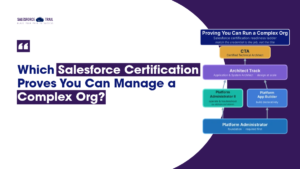
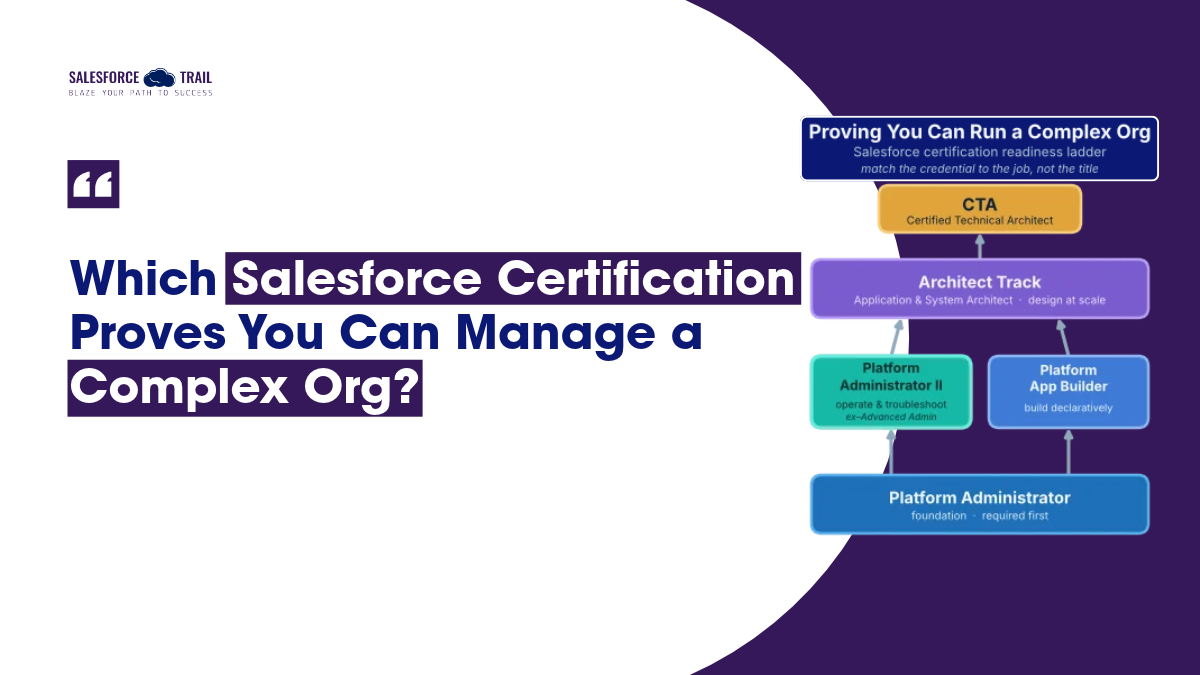
Three certifications usually come up. Platform Administrator II (what we used to call Advanced Admin), Platform App Builder, and the Architect track. And here’s the catch most advice online hasn’t caught up to: Salesforce renamed a big chunk of its certifications in 2025, so half the comparisons you’ll find still use names that no longer exist.
This isn’t a ranking. It’s a straight answer about which one actually proves you can run a complex org.
Table of Contents
The Quick answer
If you want to prove you can run a complex org, Platform Administrator II is the clearest signal, because it’s the only one of the three that tests auditing, monitoring, and troubleshooting live automation. Platform App Builder proves you can build on the platform. The Architect track proves you can make design trade-offs at scale. Pick for the job, not the title.
An honest point before we begin: the cert that maps most directly to org management also happens to have the most dated exam. More on that below.
| Credential | What it proves | Best fit |
|---|---|---|
| Platform Administrator II | You can operate and troubleshoot a mature org | Admins running a live, complex org |
| Platform App Builder | You can design and build declarative apps | BAs, consultants, builders |
| Architect track | You can make system-level design decisions | Senior ICs, solution designers |
First, what does “managing a complex org” actually test?
Before we hand any credential a gold star, we need a yardstick. Over the years, the orgs that keep me up at night all stress the same handful of muscles. Score a cert against these and the fog clears fast.
- Complex security and sharing. Org-wide defaults, role hierarchies, permission set logic, delegated admin, Territory Management. The stuff that quietly leaks data when it’s wrong.
- Automation at scale, and fixing it. Not just building a Flow, but untangling why three of them fire in the wrong order.
- Data at scale. Large data volumes, big objects, external data through Salesforce Connect, and keeping it all clean.
- Auditing and monitoring. Debug logs, the setup audit trail, knowing what changed and who changed it.
- System-level trade-offs and governance. Deciding what not to build, and designing so the next person doesn’t inherit a mess.
Here’s the thing worth sitting with: building an org and keeping a mature one healthy are genuinely different skills. That’s the whole reason “which cert is best?” has no single answer. A credential that proves you can assemble a slick app says little about whether you can diagnose a production slowdown at 4pm on a Friday.
Platform Administrator II: the operator’s proof
This is the one formerly known as Advanced Administrator, and for pure org-management signal, it’s the strongest of the three. One thing to clear up right away: you can’t take it cold. You need to hold the Platform Administrator certification first, so it genuinely reads as a second-tier, “I’ve done this a while” credential.
What it actually proves about running an org
Look at how the exam weights its sections, and you can see it was written for people who maintain orgs rather than spin up new ones:
- Security and Access — 20%
- Process Automation — 20%
- Objects and Applications — 19%
- Data and Analytics Management — 13%
- Cloud Applications — 11%
- Auditing and Monitoring — 10%
- Environment Management and Deployment — 7%
That Auditing and Monitoring slice matters more than its 10% suggests. It’s the only one of our three credentials that tests it at all. The exam pushes into the exact corners that bite you in a mature org: sharing-model implications, comparing profiles against permission sets, delegated admin, debug logs, the setup audit trail, troubleshooting declarative automation and order of execution, and the data-at-scale options like big objects and Salesforce Connect. These are maintenance problems, not greenfield ones.
The catch you won’t read elsewhere
Now, let’s turn to a somewhat concerning aspect. The official exam guide still states that its questions are aligned with the ‘Summer ’22’ release. It even includes ‘Workflow Rules’ among the objectives—even though Salesforce ended support for ‘Workflow Rules’ as of December 31, 2025. So, while the scope is quite comprehensive, the information itself is significantly outdated.
I’d still take it for the skills it validates. I’d just pair it with something current — the Agentforce Specialist certification is the obvious choice — so your profile doesn’t quietly signal that your knowledge stopped three years ago.
I would still recommend taking it, as it validates certain specific skills. Just be sure to pair it with a more recent certification—the ‘Agentforce Specialist’ certification is the best choice here—so that your profile doesn’t give the impression that your knowledge stopped evolving three years ago.
Platform App Builder: the builder’s proof
While ‘Admin II’ focuses on keeping the system up and running, ‘App Builder’ centers on what you add to that system. It validates the entire process of ‘declarative building’ (building without coding), and contrary to some occasional misconceptions, it is not an entry-level certification. According to Salesforce, the target audience for this exam includes experienced administrators and architects.
What it proves
The exam leans hard on data modeling and, above everything, automation. Here’s the current breakdown:
- Salesforce Fundamentals — 18%
- Data Modeling and Management — 20%
- Business Logic and Process Automation — 32%
- User Interface — 17%
- App Deployment — 13%
Nearly a third of the exam sits in Business Logic and Process Automation, and that’s really a Flow exam in disguise — building flows, yes, but also troubleshooting and monitoring them. Agentforce now shows up here too, treated as one more automation tool rather than a separate discipline. Round it out with relationship design, Lightning UI, mobile, and a deployment plan built on sandboxes, change sets, and packages, and you’ve described the full life of a declarative app.
The 2026 refresh made it harder
This is the most current exam of the three, refreshed on August 21, 2026, and aligned to the Summer ’26 release. The refresh came with teeth: the passing score jumped from 63% to 73%, the highest bar of any credential here.
Salesforce’s certification team has focused this change on ‘flow maintenance ‘- that is, can you troubleshoot, monitor, and keep a flow running? Their goal was not to turn everyone into an ‘Agentforce power user.’ They were quite clear on this: there is a separate ‘Agentforce Specialist’ exam for that purpose. Therefore, there is no need to over-prepare for the AI-related components. The exam rewards people who can keep automation healthy, which, not coincidentally, is exactly what a complex org needs.
The Architect track: the trade-offs proof
This is where the question shifts from “can you operate the org?” to “should it have been built this way at all?” The Architect credentials are about judgment at scale, and they work differently from the exams above.
Application Architect vs. System Architect
Neither is a single exam. Each is an umbrella credential you earn automatically once you hold its four component certifications. A lot of older guides list the wrong components, so here’s what’s actually required right now:
Application Architect = Platform App Builder + Platform Data Architect + Platform Developer + Platform Sharing and Visibility Architect.
System Architect = Platform Developer + Platform Development Lifecycle and Deployment + Platform Identity and Access Management Architect + Platform Integration Architect.
For the “can I design a complex org that won’t buckle” question, Application Architect is the stronger signal. The Sharing and Visibility plus Data Architect pairing is about as close as a credential gets to proving you can design for scale, large data volumes, and genuinely complicated access. System Architect earns its keep when integrations, identity, and off-platform systems are your daily reality.
CTA, and what it really costs
At the top is the ‘Certified Technical Architect‘ designation, which is a completely different proposition; it is not a multiple-choice exam, but rather a two-stage review board process. You are required to present your solution before a panel and defend it. To pursue this, one must already hold the ‘Application Architect’ and ‘System Architect’ certifications, and the board fees alone come to $6,000, on top of roughly $2,400 in component exams at list price.
One practical heads-up if you’re aiming here: the CTA credential page still references logging into Webassessor, even though registration moved to Trailhead Academy back in July 2025. Double-check the current registration steps before you book anything.
Head-to-head: which one wins the complex-org test?
Back to the yardstick. Here’s how the three score against the five competencies, honestly, including where each falls short.
| Competency | Admin II | App Builder | Architect |
|---|---|---|---|
| Complex security and sharing | ✓ | Partial | ✓ |
| Automation at scale, and fixing it | ✓ | ✓ | ✓ |
| Data at scale | ✓ | Partial | ✓ |
| Auditing and monitoring | ✓ | ✗ | Partial |
| System-level trade-offs and governance | Partial | ✗ | ✓ |
So there’s no single winner, and anyone who tells you otherwise is selling a course. For operating a mature org day to day, Platform Administrator II is the most direct proof — it’s the only one that covers the full operate-and-audit loop. For designing an org that won’t collapse under its own weight, Application Architect is the strongest overall. App Builder sits in the middle: lighter on governance, but the most current exam and a required stepping stone toward Architect. Match the credential to the job you’re interviewing for, and the “which is best” argument mostly dissolves.
So which should you take?
Strip away the theory, and here’s how I’d actually choose, depending on where you are.
- You’re a mid-career admin keeping a messy org alive. Platform Administrator first, then Platform Administrator II. It’s the clearest proof you can run what you’ve got.
- You’re a BA, consultant, or builder. Go for Platform App Builder. It carries the toughest pass mark of the three and counts toward Application Architect later, so nothing’s wasted.
- You’re a senior IC proving design judgment. Application Architect, and I’d start with Platform Sharing and Visibility Architect plus Platform Data Architect — the two components that most convincingly say “I can design for scale.”
- Any of the above, and you want to look current. Add Agentforce Specialist. It patches the freshness gap on the older exams and signals you’re keeping up.
Notice none of these is “collect them all.” A focused pair that matches your role beats a long list of mismatched badges every time.
Mistakes to avoid
A few traps that catch people out, and the maintenance one is sneaky because it costs you a credential you already earned.
- The maintenance trap. The current rule is one maintenance badge per year, released with each Spring, Summer, or Winter release. Some exam guides still say three times a year — ignore that; it’s outdated. The deadline to flag right now: the Winter ’26 maintenance badges for Platform App Builder, Platform Developer, and all Architect-track holders are due December 4, 2026. Miss it and the credential lapses.
- Taking Admin II for its freshness. You’re taking it for scope, not currency — the exam still aligns to Summer ’22. Great signal, old surface. Plan around that.
- Treating App Builder as easy. The 73% pass mark says otherwise. Study the Flow troubleshooting content properly.
- Chasing CTA too early. Without both domain credentials and real enterprise delivery behind you, the board review is an expensive way to learn you weren’t ready.
- Trusting old cert names. If a study resource still says “Advanced Admin” or “Data Architect” without the Platform prefix, check whether the rest of it is current too.
Your next step
Back to that inherited org, the one with forty profiles and a sharing model nobody understands. No certification fixes it. You do. But the right credential tells a hiring manager which part of that work you can be trusted with: Admin II says you can keep the thing standing, App Builder says you can build on it without making the mess worse, and Architect says you can design the next one so it never gets this bad.
So don’t pick the longest name. Pick the job you want to be doing a year from now, then earn the credential that proves it. If you’re still mapping where your org’s weak points even are, start there — our guide to keeping a Salesforce org healthy is the natural next read before you spend a rupee or a dollar on an exam.
Sources
All certification facts verified against official Salesforce pages.
- Platform Administrator II Exam Guide — Salesforce Help (section weights, Summer ’22 alignment, prerequisite)
- Platform App Builder Exam Guide — Salesforce Help (current weights, Summer ’26 alignment)
- What the Platform Administrator Exam Update Means for Admins — Salesforce Admins blog (Agentforce weighting)
- Application Architect credential and System Architect credential — Trailhead (component certifications)
- Certified Technical Architect credential — Trailhead (board format, fees, prerequisites)
- Certification Maintenance Schedule — Salesforce Help (one badge per year, Winter ’26 deadline)
- Agentforce Specialist Exam Guide — Salesforce Help
Frequently Asked Questions
Yes. Salesforce renamed Advanced Administrator to Platform Administrator II as part of its 2025 certification rename, effective July 21, 2025. Same credential, new name. Anything still calling it Advanced Admin predates the change.
Yes. You must hold the Platform Administrator certification (formerly just Administrator) before you can earn Platform Administrator II. It’s designed as a second-level credential.
By the numbers, App Builder now has the higher bar — its passing score rose to 73% in the August 2026 refresh. Admin II is broader and requires a prerequisite, so “harder” depends on whether you mean the pass mark or the path.
Often yes. Salesforce lists experienced admins among its target audience, the automation and data-modeling content sharpens real build skills, and it counts as a component toward Application Architect if you later go that route.
For operating one, Platform Administrator II. For designing one that scales, Application Architect. There’s no single “best” — it depends on whether your job is running the org or architecting it.
Once a year. Salesforce requires one maintenance badge per certification per year, released alongside each Spring, Summer, or Winter release and due a year later.

Priya Rastogi
Priya is a 3x Salesforce Certified who believes in the power of continuous learning and collaboration. She’s passionate about exploring how Salesforce can simplify work, boost productivity, and create better user experiences. When she’s not experimenting with new features or automating processes, Priya enjoys connecting with fellow Trailblazers and sharing insights to help others grow in their Salesforce journey.
- Priya Rastogi
- Priya Rastogi

- Priya Rastogi
- Priya Rastogi