

When Salesforce teams talk about technical debt, the conversation usually goes straight to Apex, Flows, integrations, custom objects, hardcoded values, or old components nobody wants to touch. That is understandable. Bad implementation choices can make a platform harder to maintain and slower to evolve.
But after supporting large-scale Salesforce environments for several years, I began to notice another kind of ‘debt’ (or burden). It didn’t always show up in the repository. It wasn’t always clear in the architecture diagrams, either. And in some cases, it was more painful than the code itself.
In many cases, the code was doing exactly what it was designed to do. The real problem was somewhere else: nobody had documented the recovery process, ownership was unclear, monitoring did not explain the business impact, or only one person knew how the full process actually worked.
That changed how I think about technical debt. In enterprise Salesforce operations, the most dangerous debt is often not in the code. It is in the operational knowledge the organization failed to document, transfer, and maintain.
Table of Contents
Key Takeaways:
- Technical debt is not always about bad code. In enterprise environments, it is often about missing operational clarity.
- The longest incidents are usually not caused by the original failure. They are caused by the uncertainty that follows it.
- Knowledge silos, unclear ownership, untested recovery steps, and monitoring without business context create hidden risk.
- Architects should evaluate how a solution will be operated, not only how it will be built.
- If a critical Salesforce process depends on a single key expert, that is technical debt too.
The Technical Debt Everyone Sees
Traditional technical debt is easy to recognize. A long Apex class. A Flow with too many branches. A legacy integration nobody wants to modify. A hardcoded value that should have been metadata. A customization that never followed a standard.
These problems matter. They increase maintenance effort, slow delivery, and make changes riskier.
But they have one advantage: teams usually know they exist. Developers complain about them. Architects identify them. Technical leads add them to improvement backlogs. Even when the organization does not fix them immediately, the debt is visible.
The more dangerous debt is the one nobody sees until production fails.
Visible vs Invisible Technical Debt
| Traditional Technical Debt | Operational Technical Debt | Why It Matters |
|---|---|---|
| Complex Apex classes | Undocumented recovery steps | Recovery becomes slow even when the fix is simple |
| Legacy integrations | Unclear ownership | Teams lose time deciding who should act |
| Hardcoded values | Dependency on key individuals | Operations depend on memory instead of process |
| Overengineered Flows | Monitoring without business context | Alerts exist, but impact is unclear |
| Poor standards | Knowledge silos | The same issue is investigated repeatedly |
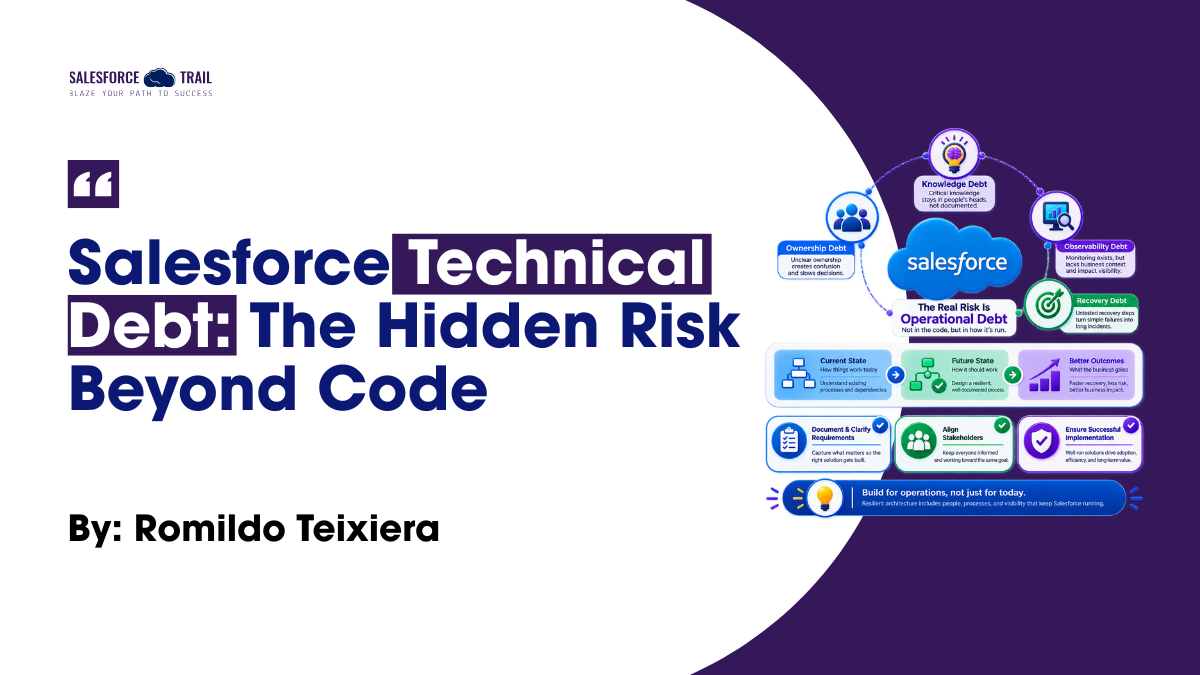
The Four Layers of Invisible Technical Debt
Over time, I noticed a pattern in difficult production incidents. The biggest delay was not always the technical fix. Often, the delay came from missing information, unclear decisions, or lack of a safe recovery path.
I group these risks into four layers: Knowledge Debt, Ownership Debt, Recovery Debt, and Observability Debt.
The important point is that these layers do not look urgent when everything is working. They become urgent when something breaks.
Layer 1: Knowledge Debt
Knowledge debt appears when critical information is kept in people’s heads instead of being documented and shared.
At first, this seems efficient. An expert knows the integration. A support analyst knows the solution. The architect remembers why the design was built that way. Everyone moves faster because nobody stops to document.
Then a real incident happens.
In one enterprise scenario, a critical integration stopped processing transactions after a configuration change. The technical issue was not especially complex. The hard part was that only one specialist understood the full end-to-end process.
That person was unavailable. The investigation took longer than it should have because the team had to reconstruct the process while the incident was already active.
The incident was not difficult because Salesforce was difficult. The incident was difficult because the organization had accumulated knowledge debt.
Layer 2: Ownership Debt
During incidents, one question appears very quickly: who owns this process?
In enterprise environments, the answer is not always simple. A Salesforce process may depend on middleware, order management, billing, external APIs, and business validation. Each team owns a piece, but sometimes nobody owns the end-to-end outcome.
When ownership is unclear, time is lost. Teams discuss responsibility. Escalations slow down. Recovery actions wait for approval. Communication becomes fragmented.
Ownership may sound administrative, but in production it behaves like a technical control. When teams know who decides, recovery becomes faster and cleaner.
Layer 3: Recovery Debt
Many teams test whether a feature works. Fewer teams test how it recovers. That gap creates recovery debt.
In another enterprise scenario, the support team identified the cause of a failed integration fairly quickly. The failure itself was understood. The difficult question came next: how should the failed transactions be recovered?
Could the records be replayed? Would a retry create duplicates? Was business validation needed before reprocessing? Which records were already completed downstream?
The technical fix was not the longest part of the incident. The recovery decision was.
A system is not truly ready for production only because it works. It is ready when teams also know how to recover it safely.
Layer 4: Observability Debt
Monitoring is essential, but not all monitoring is useful during an incident.
A dashboard may show an API timeout. A log may confirm an exception. A middleware alert may show a failed message. That is useful for technical teams.
But business stakeholders usually ask different questions: did an order fail? Was billing impacted? Did customer data stop synchronizing? How many transactions are affected?
When monitoring answers only technical questions, teams still spend valuable time translating the failure into business impact.
That is observability debt: the platform can show that something failed, but the organization cannot quickly explain what it means for the business.
Why Architects Miss This Debt
Architecture reviews often focus on the right topics: limits, security, scalability, integration patterns, automation, data models, and maintainability.
But a design can be technically clean and still be hard to operate.
A diagram may show the systems involved without showing ownership. A solution document may describe the happy path without explaining recovery. A dashboard may show failures without linking them to business outcomes.
That is why operational readiness should be part of architecture, not something handed to support after go-live.
In enterprise environments, architecture is not tested only when the system works. It is tested when the system fails, and people need to recover it under pressure.
Why Managers Should Care
Operational technical debt is a hidden liability. It rarely appears in a backlog. It rarely appears in a KPI. It rarely appears in a project status report.
For a long time, everything may look stable. Then a major incident, audit, personnel change, or business continuity event exposes the real dependency.
This matters to leaders because operational debt affects incident duration, customer impact, team dependency, audit readiness, and business continuity.
Code debt can slow down development. Operational debt can slow down the entire organization during a critical moment.
A Quick Self-Assessment
Self-assessment: The more “No” answers you have, the more operational technical debt may exist in your Salesforce environment.
| Area | Question |
|---|---|
| Knowledge | Could a new team member understand critical integrations without relying on one specific person? |
| Ownership | Is ownership clearly defined for every critical Salesforce process and integration? |
| Recovery | Are recovery procedures documented, tested, and safe to execute? |
| Observability | Does monitoring explain business impact, not only technical failure? |
| Continuity | Could operations continue safely if a key specialist became unavailable? |
The Real Cost of Operational Technical Debt
Traditional debt usually affects systems. Operational debt affects how people respond when systems fail.
The hardest incidents are often driven by uncertainty. What happened? Who owns the decision? Which transactions were impacted? Can the team recover safely? Is the business already affected?
When nobody can answer these questions quickly, the organization starts paying interest on years of undocumented decisions and informal processes.
And unlike code refactoring, operational debt is harder to remove because it requires changes in habits, ownership, documentation, governance, and culture.
Final Thoughts
Technical debt does exist in code. Apex, Flows, integrations, and customizations still need standards, reviews, and continuous improvement.
But the next time your organization evaluates Salesforce technical debt, look beyond the codebase. Ask a more uncomfortable question: if your most critical Salesforce process stopped working tomorrow, could the organization recover without its key experts?
That answer may reveal more about your real technical debt than a code review ever will. The most dangerous Salesforce technical debt is often not in the code. It is in the operational knowledge nobody documented.

Romildo Teixiera de Paula
- This author does not have any more posts.