


Salesforce has grown into the world’s leading CRM platform, and the role of the Salesforce Developer has become one of the most in-demand careers in tech. Organizations need developers who can customize Salesforce, build scalable apps, and integrate systems to deliver business value. But to succeed in this role, it takes more than just coding knowledge—you need a blend of technical expertise, problem-solving ability, and continuous learning. In this article, we’ll explore the top Salesforce developer skills that every aspiring and experienced developer should master to stay competitive and future-ready.
Proficiency in Apex Programming
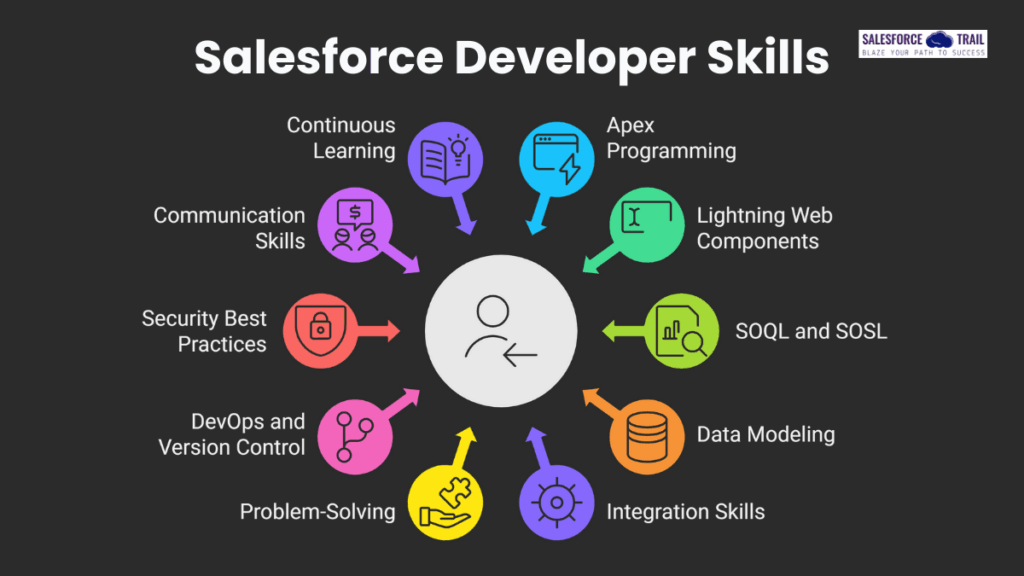
At the heart of Salesforce development lies Apex, Salesforce’s proprietary programming language. A strong command of Apex is non-negotiable for any developer. Apex enables you to write custom logic, perform complex business calculations, and build scalable applications within the Salesforce platform.
If you’re just starting, begin with Apex fundamentals like triggers, classes, and asynchronous operations. For experienced developers, mastery of advanced topics such as governor limits, exception handling, and best practices for bulkification is critical to building efficient solutions.
Expertise in Lightning Web Components (LWC)
In today’s Salesforce ecosystem, Lightning Web Components (LWC) have become the standard for creating dynamic and modern user interfaces. Understanding LWC means you can deliver responsive, high-performing apps that align with the Salesforce Lightning experience.
Skills you’ll need include JavaScript ES6+, HTML, CSS, and Salesforce’s base LWC library. Developers who can seamlessly combine Apex on the back end with LWCs on the front end are especially valuable in the market.
Strong Knowledge of SOQL and SOSL
A developer’s ability to query Salesforce data effectively is a must-have skill. SOQL (Salesforce Object Query Language) and SOSL (Salesforce Object Search Language) allow you to retrieve, search, and manipulate data efficiently.
Beyond writing basic queries, skilled developers understand optimization techniques, indexing, and avoiding performance bottlenecks, especially when working with large datasets.
Understanding of Salesforce Data Modeling
Every application depends on a solid data structure. As a developer, you must understand Salesforce data modeling, including objects, fields, relationships, and schema design.
Creating the right data model ensures scalability, data integrity, and smooth integrations. For beginners, start with standard objects; for advanced developers, focus on mastering junction objects, advanced relationship designs, and record-level security.
Integration Skills
Today’s Salesforce applications rarely operate in isolation. Businesses expect Salesforce to connect seamlessly with ERPs, marketing platforms, payment gateways, and other third-party tools.
Proficiency in integration patterns—REST APIs, SOAP APIs, and platform events—places you a step ahead. Knowledge of tools like MuleSoft, external services, and middleware solutions adds significant value to your developer profile.
Problem-Solving and Debugging
Being a great developer isn’t just about writing code; it’s about solving problems efficiently. Strong debugging skills and familiarity with Salesforce Debug Logs, along with using tools like the Developer Console, are crucial for diagnosing issues quickly.
Employers value developers who not only fix bugs but also anticipate and prevent them by writing robust, test-driven code.
Mastery of DevOps and Version Control
The Salesforce ecosystem has embraced DevOps practices to improve release management and collaboration. Knowing how to use tools like Git, GitHub, or Bitbucket for version control is critical for modern development teams.
Adding CI/CD knowledge with tools such as Gearset, Copado, or Jenkins makes you stand out, as businesses seek developers who can contribute to faster, safer deployments.
Read More: Top 10 Salesforce Job Boards You Must Know
Familiarity with Salesforce Security Best Practices
Security is a top priority for every Salesforce implementation. Developers must know how to apply Salesforce’s security model, including role hierarchies, profiles, permission sets, and field-level security.
Understanding secure coding practices also ensures that you protect sensitive data and comply with regulatory requirements like GDPR or HIPAA.
Communication and Collaboration Skills
Technical expertise alone isn’t enough. Salesforce developers often work closely with admins, consultants, and business stakeholders. Clear communication helps you translate business requirements into technical solutions, while collaboration ensures projects stay aligned and on track.
Developers with strong soft skills are more likely to grow into senior or architect-level roles.
Continuous Learning Mindset
The Salesforce ecosystem evolves rapidly, with three major releases each year. A successful developer must embrace a continuous learning mindset to stay updated with new features, tools, and best practices.
Trailhead, Salesforce certification paths, community events, and developer forums are excellent ways to keep your knowledge fresh and relevant.

Final Thoughts
Becoming a successful Salesforce Developer requires a balance of technical expertise and soft skills. From Apex and LWC to integration and problem-solving, the skills for Salesforce developers outlined above will help you not only meet current industry demands but also future-proof your career.
By consistently refining these skills, you’ll position yourself as a trusted developer who can build scalable, secure, and innovative Salesforce solutions.
FAQs
- What are the most important Salesforce developer skills for beginners?
Beginners should focus on Apex basics, SOQL queries, and understanding data modeling. These provide the foundation for advanced skills later. - Do Salesforce developers need to learn Lightning Web Components?
Yes, LWC is now the standard for building user interfaces in Salesforce. Learning LWC significantly increases your employability. - Are soft skills important for Salesforce developers?
Absolutely. Communication, collaboration, and problem-solving are equally important as technical knowledge in delivering successful projects. - How can I stay updated as a Salesforce developer?
Leverage Trailhead, Salesforce release notes, developer blogs, and community events to keep up with the latest updates.


Most Reads:
- How to Become a Salesforce Consultant: A Complete Guide to Success
- How to Become a Salesforce Solution Architect: A Complete Guide to Success
- Best Tips and Tricks to Ace Your Salesforce Interviews in 2025
- Dreamforce 2025 Registration is Open Now: Everything You Need to Know
- How to Crack the Salesforce Interview: Real Questions and Tips from Experts
Resources
- [Salesforce Developer]- (Join Now)
- [Salesforce Success Community] (https://success.salesforce.com/)
For more insights, trends, and news related to Salesforce, stay tuned with Salesforce Trail

Aman Sahu
A Chief Technical Architect at Bugendaitech and a Salesforce Architect with 9+ years of experience driving innovation and delivering scalable CRM solutions. As a leader and visionary, I specialize in bridging the gap between business goals and technology, focusing on Salesforce architecture, AI-powered solutions, and seamless integrations that drive efficiency and growth.
- Aman Sahu#molongui-disabled-link

- Aman Sahu#molongui-disabled-link
- Aman Sahu#molongui-disabled-link
- Aman Sahu#molongui-disabled-link