
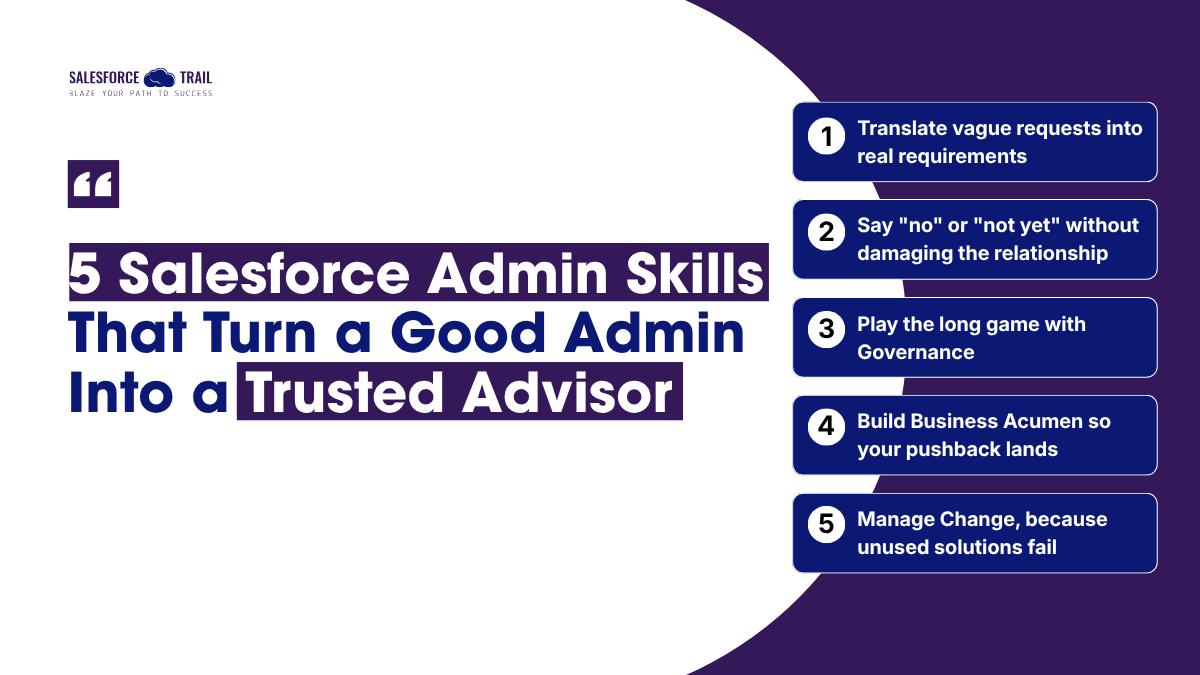
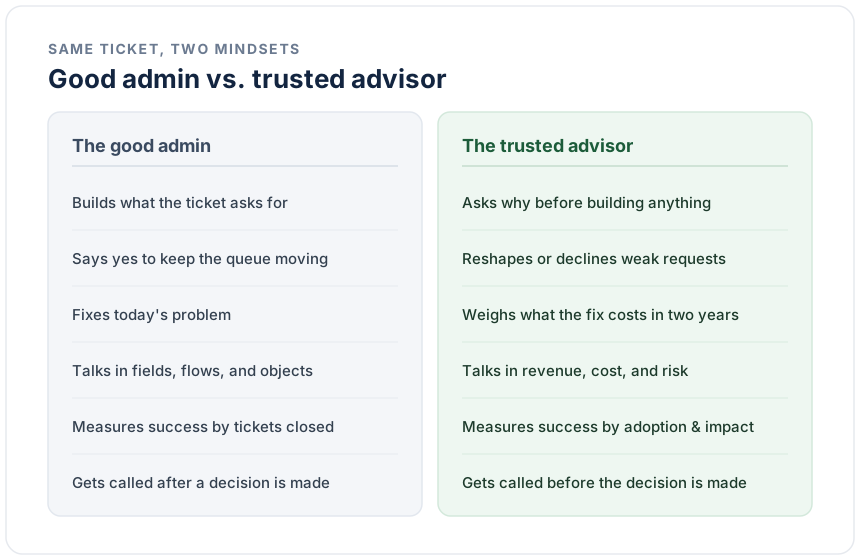
Every Salesforce org has a good admin. Someone who can build a Flow, fix a broken permission set, and keep the ticket queue moving. Fewer orgs have a trusted advisor – the admin who gets involved in the room before the decisions are made, not after, when leadership wants to know if an idea is actually worth pursuing.
If you’ve been building for a few years, you can probably feel the gap I’m talking about. You can make the platform do almost anything. So why does the next role – consultant, lead, architect feel like it’s behind a door you can’t find the handle for?
The truth I’ve seen play out across many teams is that the ceiling most admins hit isn’t technical. It’s a judgment gap. You’ve mastered how to build. The leap is learning whether and why to build, and that’s a different muscle entirely.
In Short Version
A good Salesforce admin builds what’s requested. A trusted advisor decides what’s worth building. The difference isn’t more technical skill – it’s judgment: turning vague requests into real requirements, pushing back on weak ideas without damaging the relationship, and protecting the org from long-term technical debt. Those are the Salesforce admin skills that actually get people promoted.
Table of Contents
The Order-Taker Trap
Most admins start as “order takers,” and many remain in that role for years without giving it a second thought. A stakeholder submits a ticket: “add this field,” “make that mandatory,” “give the whole team access to this report,” and you execute it. It creates the confusion that work is getting done. Tickets get closed. Everyone is happy for about a week.
This is the single biggest source of “technical debt” in the ecosystem, and it quietly suppresses your career growth.
Look at what actually goes wrong with CRM projects. Johnny Grow’s 2025 research puts the CRM failure rate at 55% for deployments that never hit their planned objectives, with about one in ten cancelled before they even go live. And when you dig into why, the causes aren’t technical. A 2026 analysis by LOW/CODE Agency found the top three culprits are poor user adoption (43%), bad data quality (34%), and weak training (22%). The riskiest stretch is months three to six after launch, once the honeymoon wears off.
Read that again. The platform rarely fails. The judgment around it does — the requirements nobody questioned, the process nobody mapped, the users nobody prepared. That judgment is the whole job of a trusted advisor.
A quick check: are you order-taking?
Three questions. Answer honestly.
- Do you ask why before you start building?
- Can you name the revenue, cost, or risk that each ticket in your queue is actually tied to?
- When was the last time you reshaped a request instead of just fulfilling it?
If those made you wince a little, good. That’s the gap. The rest of this is how you close it.
The Trust Equation: A way to think about the whole leap
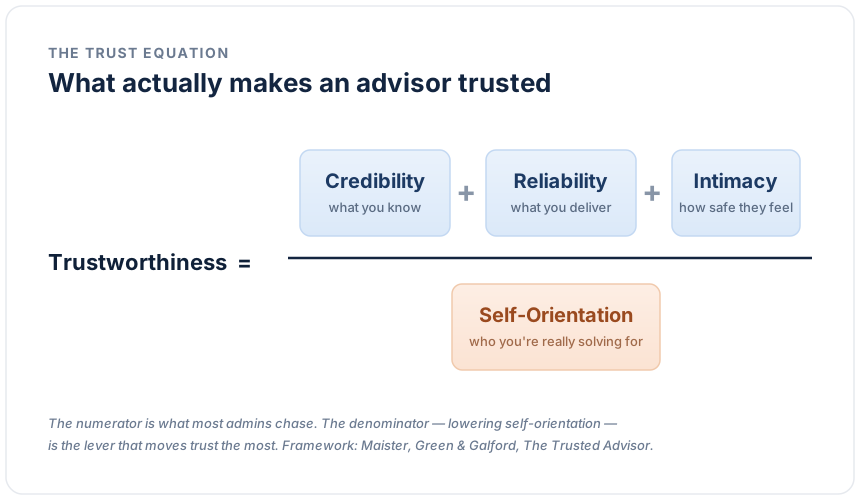
Back in 2000, David Maister, Charles Green, and Robert Galford wrote a book called The Trusted Advisor (there’s a 20th-anniversary edition from 2021 if you want the full thing). Buried in it is the most useful mental model I’ve found for this career transition, and almost nobody in the Salesforce world talks about it:
Trustworthiness = (Credibility + Reliability + Intimacy) ÷ Self-Orientation
Translate that into our world:
- Credibility – do you know the platform? Certs, correct answers, knowing that a validation rule won’t fix a bad process. This is where admins live.
- Reliability – do your releases ship on time and not break things on Friday afternoon? Do people trust your builds?
- Intimacy – do stakeholders feel safe bringing you a half-formed, slightly embarrassing idea? Or do they only come to you once they’ve already decided?
- Self-orientation – the denominator, and the one that decides everything. Are you solving for their outcome, or for your own: the chance to use a shiny new feature, the satisfaction of looking clever, the ticket count?
Most of us pour everything into the top two. They’re tangible. You can put a certification on LinkedIn. But Trusted Advisor Associates, the group Green built around the book, argues those rational factors are the weakest levers. The one that moves trust the most is lowering self-orientation – genuinely caring more about the client’s result than your own.
That’s why this jump can’t be certified. It’s a mindset shift. Every skill below is really just one part of that equation in disguise.
Skill 1: Translating Vague Requests into Real Requirements
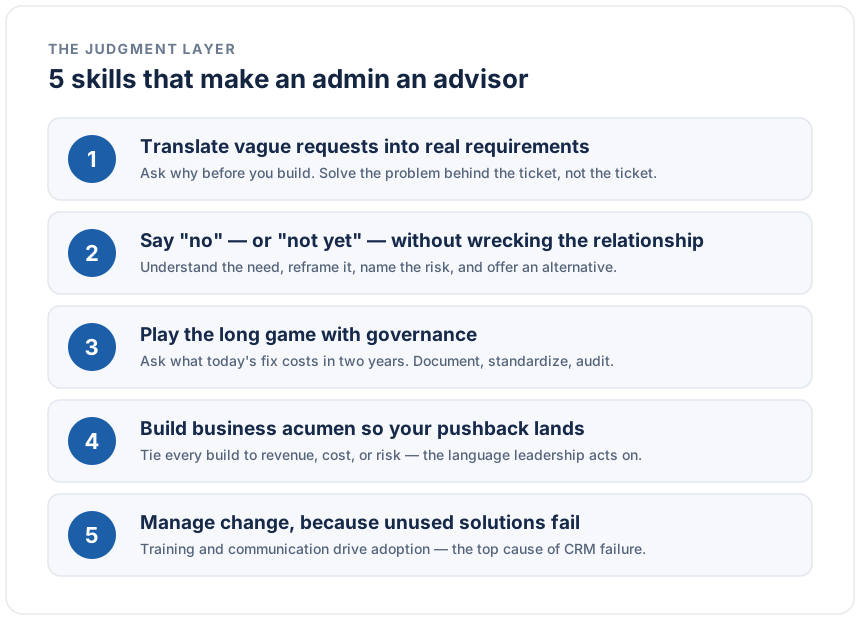
The most valuable sentence in this whole line of work is: “They asked for X, but they actually need Y.”
A good admin creates the field that was requested. An advisor pauses, asks what the other person wants to achieve, and often solves the real problem more simply, or discovers the field was never the answer at all.
Salesforce clearly considers this essential, as it has created a dedicated certification for it. The Salesforce Certified Business Analyst exam places the greatest emphasis on gathering requirements, identifying stakeholders, setting priorities, and obtaining sign-off. And a signal worth noticing: in May 2023, Salesforce dropped the Administrator cert as a prerequisite for the Business Analyst one. They decoupled the advisory skill from the button-clicking on purpose.
You don’t need the cert to practice the skill, though. Next time a request comes in, ask “why” a few times before you touch Setup. Map the current process before you design the future one. The admins I’ve watched get promoted are the ones who run the requirements conversation, not just the build that comes after.
Skill 2: Saying “no” (or “not yet”) without Damaging the Relationship
Order-takers say “yes” to everything and gradually lose ground. Advisors, on the other hand, are selective. The real skill lies in declining a request in a way that actually increases the other person’s trust in you rather than diminishing it – and if you look closely, this is precisely the ‘Trust Equation’ at work. It involves low ‘self-orientation’; your focus is on their best interests, not on protecting your own schedule.
There’s a pattern that works, and I’ll give you the actual shape of it:
- Never Say no first. Before responding to a request, understand the problem behind it.
- Reframe to the Real Need. The classic: someone asks you to “share all records with everyone.” What they usually need is visibility into one report. You can give them that without dynamiting the sharing model.
- If you genuinely have to decline, name the risk. Not “we can’t do that,” but “here’s the policy, here’s what it protects against, and here’s what I’d do instead.”
- Escalate when the stakes are high. You don’t have to be the one who owns a big, contentious call alone. Bring leadership in.
Delivering solutions people can actually rely on was never about saying yes to whatever lands in your inbox. It’s about knowing which yeses are worth it.
Skill 3: Playing the long game with Governance
A good admin fixes today’s problem. An advisor asks what today’s fix costs in two years.
This is a core component of Salesforce’s own ‘Well-Architected framework,’ which prioritizes attributes in a specific order: Trusted, Easy, and Adaptable. Most of the guidance provided under this framework, such as documentation, naming standards, design principles, and proper governance, shares a single objective: preventing long-term costs from exploding as the organization grows. Adopt a ‘declarative-first’ approach wherever possible, as it is less costly to maintain than writing code. Document as you work and conduct regular audits.
And this part is directly linked to your earnings. 10K Advisors’ 2025 Salesforce Talent Ecosystem Report reveals that the “Technical Architect” is the scarcest and fastest-growing role in this ecosystem, representing roughly 1% of the global supply, while demand surged by 27% against a mere 4% increase in supply. Why does this shortage exist? For years, organizations expanded without architectural oversight, eventually devolving into a state of disarray that was impossible to scale. An understanding of governance is now one of the rarest and most highly compensated skills you can offer. Developing this expertise begins long before the word “Architect” is even added to your job title.
Skill 4: Business Acumen, so your Pushback Lands
Advisors talk about the business, not just the platform. Every build ties back to one of three things: revenue, cost, or risk. If you can’t put a request in one of those buckets, you don’t yet understand it well enough to build it well.
This is also what earns you the right to push back. When you can tell a VP “this request adds two hours of admin work a week and doesn’t move a number anyone tracks,” you’re speaking their language, and the conversation changes. Salesforce’s official Admin Skills Kit lists Business Analysis and Product Management right alongside the other skills, reflecting how admins increasingly take on product-management responsibilities not just for building it, but for deciding what’s worth building at all.
A quick exercise: Take the next five tickets in your queue and, for each one, write down the associated revenue, cost, or risk. If you cannot do this, it means you are still merely taking orders. This isn’t a criticism; it is simply the first thing that needs to be fixed.
Skill 5: Change Management, because the Solution Nobody Uses is a Failure
You might create the most brilliant product of your career, but if no one adopts it, you could still fail. Do you recall the ‘adoption number’ mentioned earlier? Poor User adoption is the primary reason CRMs fail. This implies that the ability to bring people along through training, clear documentation, and communication about the change rather than just implementing it could well be the skill that delivers the highest ROI (Return on Investment) of all.
It’s no coincidence that Salesforce’s Admin Skills Kit puts Communication first among its fourteen skills and specifically calls out Change Management. The technical skills are what get you hired as an admin. The advisory ones are what get you promoted past it.
The Career Math: Is There Really a Ceiling to Advancement?
The answer is both yes and no. The role is becoming increasingly strategic and demanding, and many admins feel overwhelmed by a heavy workload. Many of them eventually wish to move beyond the ‘Admin’ title into roles such as Solution Architect, Developer, or Technical Architect. Most individuals find themselves in that two-to-ten-year career window where they either advance in a specific area or quietly stagnate at the same level.
Moving up the pay ladder leads to a better salary. While exact figures may vary depending on the source and region, you shouldn’t rely entirely on a single number; hiring guides like Mason Frank’s reveal a consistent pattern: there is a significant salary jump when moving from a junior to a senior level, followed by further increases when transitioning into roles such as Lead, Architect, or Consultant. Certifications help you get in the door – 84% of respondents in Mason Frank’s guide hold at least one, but a cert only proves credibility. It’s the numerator of the Trust Equation, not the whole thing. The top of the band is gated by the skills no exam fully tests.
How to Know You’re Ready to Move
You’re not ready because you passed another cert. You’re ready when:
- You can run a requirements workshop without anyone holding your hand.
- A new team member can understand your builds without coming to ask you what they do.
- Your manager can repeat your business impact back in a single sentence.
Hit those consistently, and if your current org has no room left to grow, that’s your signal to look at Business Analyst, Consultant, or Solution Architect roles.
Final Thoughts
Don’t try to overhaul how you work overnight. Pick three small things and do them for the next ninety days.
Ask “why” before your next five builds, and write down the business goal each time. Adopt one Well-Architected habit: a naming convention, a documentation standard, a monthly Optimizer review. And practice one diplomatic “not yet”: take a low-value request and reshape it into something better.
The difference between a good admin and a trusted advisor was never how much you can build. It’s the judgment to know what’s worth building, and the trust you earn by getting that call right, over and over, until people stop filing tickets and start asking your opinion. The title follows the behavior. Not the other way around.
Frequently Asked Questions (FAQ)
A good admin executes requests well. A great one questions the request first, ties it to a business outcome, and knows when the right answer is “not yet.” The gap is judgment, not technical depth.
Build the skills that consulting actually rewards: requirements gathering, stakeholder management, and business acumen. Practice running discovery conversations, learn to say no diplomatically, and start framing every build in terms of revenue, cost, or risk.
Communication comes first; it tops Salesforce’s own Admin Skills Kit. After that: requirements gathering, change management, stakeholder pushback, and the business sense to know why a request matters before you build it.
No, but it can stall if you stay a pure order-taker. The role is getting more strategic, and admins who develop advisory and governance skills move into consultant, business analyst, and architect roles — often the fastest-growing, best-paid seats in the ecosystem.
No. Salesforce even dropped the Admin cert as a prerequisite for it in 2023. The cert is useful as an external signal, but the underlying skills, discovery, requirements, and prioritization matter far more than the badge.
Don’t refuse outright. Understand the real problem first, then reframe toward what they actually need. If you still have to decline, explain the risk, offer an alternative, and escalate to leadership when the decision is above your pay grade.

Priya Rastogi
Priya is a 3x Salesforce Certified who believes in the power of continuous learning and collaboration. She’s passionate about exploring how Salesforce can simplify work, boost productivity, and create better user experiences. When she’s not experimenting with new features or automating processes, Priya enjoys connecting with fellow Trailblazers and sharing insights to help others grow in their Salesforce journey.
- Priya Rastogi

- Priya Rastogi
- Priya Rastogi
- Priya Rastogi