

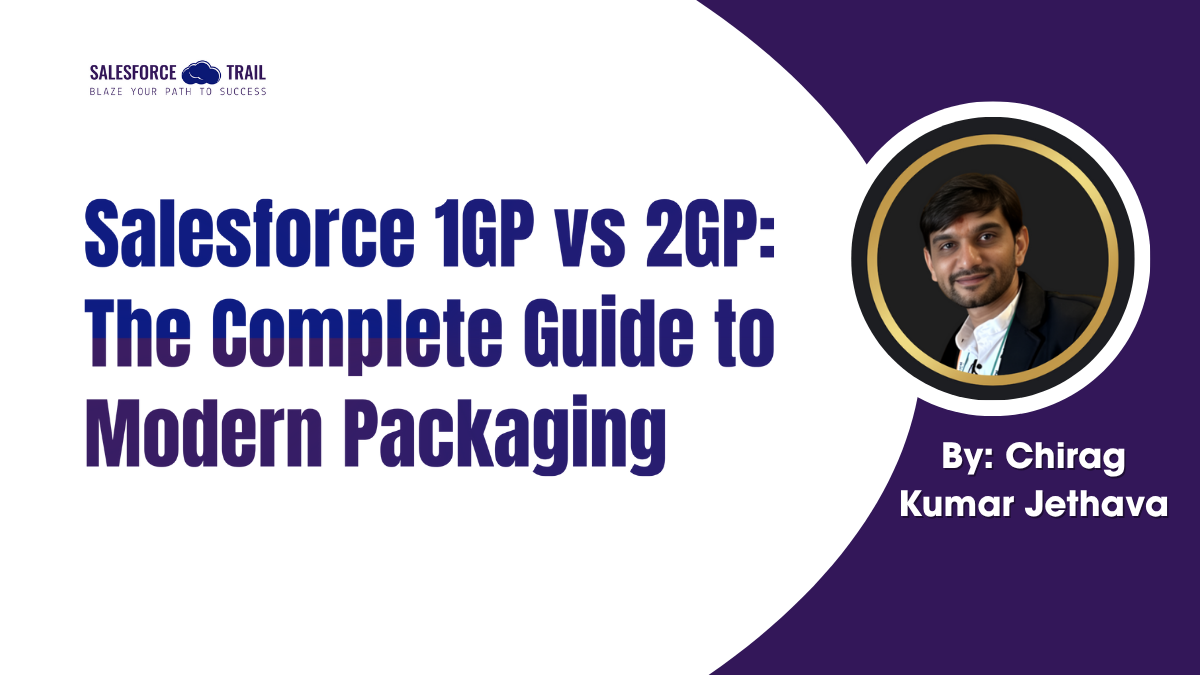
When building and distributing applications on the Salesforce Platform (for internal use or via the Salesforce AppExchange), one critical decision concerns how you package your app. Salesforce supports packaging models, and over time, the platform has evolved from the legacy First-Generation Managed Package (1GP) to the more advanced Second-Generation Managed Package (2GP).
In this blog, we’ll cover:
- What each packaging model is
- Key differences between Salesforce 1GP vs 2GP (architectural, metadata, versioning, tooling)
- Use-cases / when to choose which
- Migration considerations (for ISVs or internal apps)
- Best practices for 2GP (since that is the direction of the platform)
Table of Contents
What are 1GP and 2GP?
1GP – First-Generation Managed Package
- In the 1GP model, you build a managed package using a packaging org (typically a Developer Edition or Partner Developer Edition org) that holds your namespace, metadata, package versions, etc.
- The packaging org acts as the owner of the package. Metadata resides in that org.
- You assign a namespace prefix to the package; once assigned, the namespace is fixed.
- When you release versions of the package, you can upgrade subscribers, but the tooling and architecture of the 1GP model constrain you.
2GP – Second-Generation Managed Package
- 2GP is a newer packaging mechanism that aligns with modern software development practices: source-driven, CLI tooling, version control, and modular packaging.
- Instead of building in a single packaging org, you use a Dev Hub org, Salesforce CLI, scratch orgs, and source control (e.g., Git) as part of your development workflow.
- Metadata is maintained in source form; package versions are created and managed via CLI and automation rather than manual packaging org UI.
- You gain greater flexibility with regard to namespace usage, package dependencies, modularization, and CI/CD pipelines.
Key Differences between Salesforce 1GP vs 2GP
Here’s a breakdown of the major difference areas.
| Category | 1GP | 2GP |
|---|---|---|
| Where metadata is anchored | Metadata lives in the packaging org (the org owns the package) | Metadata lives in source (version control); Dev Hub owns the package; packaging org is decoupled. |
| Namespace assignment | A namespace is created in the packaging org; one namespace = one package. Once set, it cannot change. | A namespace is created in the namespace org and linked to Dev Hub; multiple packages can share the same namespace. |
| Versioning & patching | Linear versioning; patch orgs needed to create patch versions. | More flexible: create versions via CLI, no patch orgs; versioning supports branching and parallel development. |
| Dependencies & modularity | Less support for dependencies; harder to modularise or share code across packages. | Better support for package dependencies and modules, and for sharing code via the namespaceAccessible annotation. |
| Tooling and DevOps readiness | Packaging, versioning, and upgrades are more manual; org-centric workflows dominate. | Tooling via CLI + version control + modern workflows; supports CI/CD, scratch orgs. |
| Metadata coverage/limitations | Some metadata types are only supported in 1GP; there are limitations on updating and deleting components after release. | While improved, some metadata types are still not supported; deletion remains simpler with more flexibility. |
| Recommended target use-case | Legacy apps, when your team is not set up for source-driven development, or when metadata/component types require 1GP. | New apps, ISV scenarios, modular applications, teams equipped with Git, CI/CD, Salesforce DX. |
Some narratives / deeper explanation
- In 1GP, the org is the source of truth: you develop components in the packaging org, you create the package, and upgrades are tied back to the org. In contrast, 2GP flips it: your version control is the source of truth, development happens via scratch orgs, you create package versions from source, and publish.
- For example, code sharing across packages is more limited in 1GP: you often need to use global Apex and handle namespace limitations. In 2GP, you can use @namespaceAccessible and share code when packages share a namespace.
- Namespace flexibility in 2GP offers a big benefit: you can develop without an assigned namespace early, or share a namespace across packages. That gives ISVs or large app teams modularity options.
- For ISVs especially, 2GP supports modern workflows (version control, CI/CD, modularization), which aligns with industry best practices for software engineering. Given your background as a Senior Software Engineer, this is especially relevant.
- That said, there are still some caveats: feature-parity is not complete; some legacy metadata types might only be supported in 1GP; migration from 1GP to 2GP is non-trivial.
When to Use Which (Use-Cases & Decision Criteria)
Choose 2GP if:
- You are building a new managed package, especially for AppExchange, and want to adopt modern DevOps practices (source control, CI/CD, scratch orgs).
- You anticipate a modular architecture with multiple packages (core + extensions) or want to manage dependencies between packages.
- Your development team is comfortable with Salesforce DX, CLI, git workflows, branch/merge, and automation.
- You want more flexibility in versioning, packaging, upgrades, and possibly easier upgrades for subscribers.
- You want to future-proof your packaging strategy because the platform is increasingly orienting toward 2GP.
Consider 1GP if:
- You have an existing 1GP package that’s mature, widely installed, and you cannot easily refactor to 2GP right away.
- You are using metadata types or packaging features that are only supported (or better supported) in 1GP.
- Your development team has a simpler org-centric workflow and is not yet set up for scratch orgs, CLI, or version control.
- Your packaging complexity is low (single package, limited dependencies), and you do not require modularization or advanced DevOps.
Migration / Hybrid Considerations
- Salesforce currently offers migration opportunities/pilot programs to convert from 1GP to 2GP, but this is non-trivial and may require reorganising your package structure, namespace strategy, and subscriber upgrade path.
- It’s important to evaluate the “tech debt” and the cost of migration vs continuing with 1GP for certain modules.
- If you have a large installed base of 1GP subscribers, you must plan carefully for upgrades, backward compatibility, data conversion, etc. Some blogs note that the existing 1GP cannot simply “upgrade” to a 2GP package for subscriber orgs.
How 2GP Works – A High-Level Workflow
Set up Dev Hub & enable packaging
- Enable Dev Hub in a dedicated org (Partner Business Org or equivalent).
- Create or link your namespace (in a namespace org) and associate it with Dev Hub.
Source Setup & version control
- Create your Salesforce DX project (sfdx project) and keep all metadata/code in Git (or other version control).
- Use scratch orgs for development, testing, and validation.
Create the managed 2GP package
- Use CLI command sfdx force:package: create specifying “Managed” type, path, namespace, etc.
- Create package versions via sfdx force:package:version: create. You can mark versions as “beta” while developing.
- Promote the package version to “released” via sfdx force:package:version: promote.
Install / Upgrade
- Subscribers install the managed package version in their orgs (sandbox or production). You can install via UI or CLI.
- For upgrades, you can create new versions, upload them, and push upgrades (if allowed) or have subscribers install the new version. 2GP supports smoother upgrades than 1GP in many cases.
Dependencies / Modularization
- If you break your app into multiple 2GP packages, you can declare dependencies between them (in sfdx-project.json) so that the dependent package knows which other package version it requires.
Automation / CI/CD
- Because the workflow is source-driven, you can build CI pipelines: on merge to main branch → build package version → run tests in scratch org → promote version → deploy to AppExchange or internal distribution.
- This approach is far more aligned with typical modern software engineering practices than the older org-centric 1GP workflow.
Considerations & Limitations (Caveats)
- Some metadata types may still only be supported in 1GP or have limited support in 2GP. It’s vital to check the metadata coverage list.
- Upgrading or migrating from 1GP to 2GP is complex; you can’t always “lift and shift” seamlessly. Subscriber orgs, data, and configurations may need conversion.
- Because 2GP may still be evolving (feature gaps remain), some teams may encounter blocking scenarios—so a careful evaluation is required.
- For very small/simple apps or when your team doesn’t yet have the DevOps maturity (scratch orgs, version control, CLI), 1GP may still be more pragmatic.
- Testing upgrades and backward compatibility remain critical: Subscribers may have customizations, overlapping namespaces, or dependencies that complicate packaging logic.
Best Practices & Recommendations for ISVs / Senior Architects
- Adopt source-driven development: Use version control (Git), use scratch orgs, treat metadata as code. This aligns well with 2GP.
- Modularize your application: Instead of a monolithic package, break it into core + extensions (e.g., “CoreAnalytics”, “AdvancedReporting”, “IndustryAdapters”). Use 2GP’s dependency model.
- Design namespace strategy early: Decide if packages share a namespace or have separate namespaces; namespace reuse can enable shared libraries.
- Define semantic versioning: Use clear versioning (major.minor.patch) and communicate upgrade behaviour. 2GP supports better version control than 1GP.
- Automate your packaging pipeline: Use CI/CD to create package versions automatically when branches merge, run tests in scratch orgs, and validate installation.
- Plan upgrades from Day 0: Because you publish managed packages, removing or changing components post-release is restricted; review upgrade policies. 2GP gives better flexibility but still has constraints.
- Document metadata coverage and limitations: Keep track of any metadata types you use that may have packaging constraints; check Salesforce documentation.
- Communicate with subscriber orgs: If you’re an ISV, ensure you provide clear upgrade paths, dependencies, installation instructions, and support for sandbox testing.
- Monitor Salesforce roadmap: Because packaging models evolve, stay updated; 2GP is the direction for the platform.
- Maintain backward compatibility: Especially if you have subscribers/customizations, ensure your package upgrades don’t break their orgs; test thoroughly in sandbox subscriber orgs.
Final Thoughts
In summary:
- 1GP is the legacy packaging model: org-centric, simpler but less flexible, good for smaller/simple apps or teams without DevOps maturity.
- 2GP is the modern packaging model: source-driven, modular, supports dependencies, version control, automation—built for ISVs and modern engineering practices.
- For new development and especially for apps that you’ll distribute, target 2GP. But ensure you evaluate your team’s capabilities, metadata requirements, and subscriber impact.
- Given your role as a Senior Software Engineer / Salesforce Architect, positioning your organisation (or AppExchange offering) on 2GP is a smart move — but with thoughtful planning.


Most Reads:
- 10 Apps Every Admin Should Know to Simplify Work in Salesforce
- How I Learned to Send Data from LWC to Apex Using JSON.stringify and JSON.deserializeStrict
- Top 3 Takeaways from the Dreamforce 2025 Keynote: The Era of the Agentic Enterprise
- Dreamforce 2025 Main Keynote Top Announcements You Can’t Miss
- Your First 90 Days as a Salesforce Admin: A Step-by-Step Checklist
Resources
- [Salesforce Developer]- (Join Now)
- [Salesforce Success Community] (https://success.salesforce.com/)
For more insights, trends, and news related to Salesforce, stay tuned with Salesforce Trail

ChiragKumar Jethava
I am a Senior Salesforce Developer and Administrator with over 11 years of IT industry experience, including 7+ years of hands-on expertise in Salesforce. My background spans across Sales Cloud, Service Cloud, Field Service Lightning (FSL), Nonprofit Cloud, Data Cloud, and AI-powered solutions, with a strong focus on delivering scalable, business-driven Salesforce implementations. I specialize in Salesforce Process Automation (Flow, Validation Rules, Workflow, Process Builder, Approval Processes) as well as custom development using Apex Classes, Visualforce Pages, Batch Apex, Scheduled Apex, REST APIs, Web Services, Aura Components, and Lightning Web Components (LWC). With 13 Salesforce certifications, multiple superbadges, and recognition as an Agentblazer Legend, I bring both technical expertise and platform mastery to every project. I am passionate about optimizing business processes, integrating enterprise systems, and creating impactful Salesforce solutions that drive measurable success.
- This author does not have any more posts.