


Marc Benioff opened this year’s keynote with a question he clearly enjoys asking: Who’s going to win AI? He said it’s the wrong question. The winner isn’t a model. It’s whoever connects the best models to the context their business already sits on – the pipeline, the service history, the permissions, the workflows. All the stuff locked inside Salesforce that most people can only reach by opening the app and clicking around.
That framing set up everything that followed. If you missed the two-hour Dreamforce 2026 main keynote, here’s what actually got announced.
In short version
Dreamforce 2026 centered on the “Agentic Enterprise” and the launch of AIforce, a live interface layer that brings Salesforce data, workflows, and governance into tools like Claude, Slack, and Lightning. Salesforce also unveiled Koa, its first CRM reasoning model, a refreshed Agentforce agent lineup, and the Trusted Enterprise AI Harness for governing agents at scale.
Table of Contents
The Core Idea: Probabilistic meets Deterministic
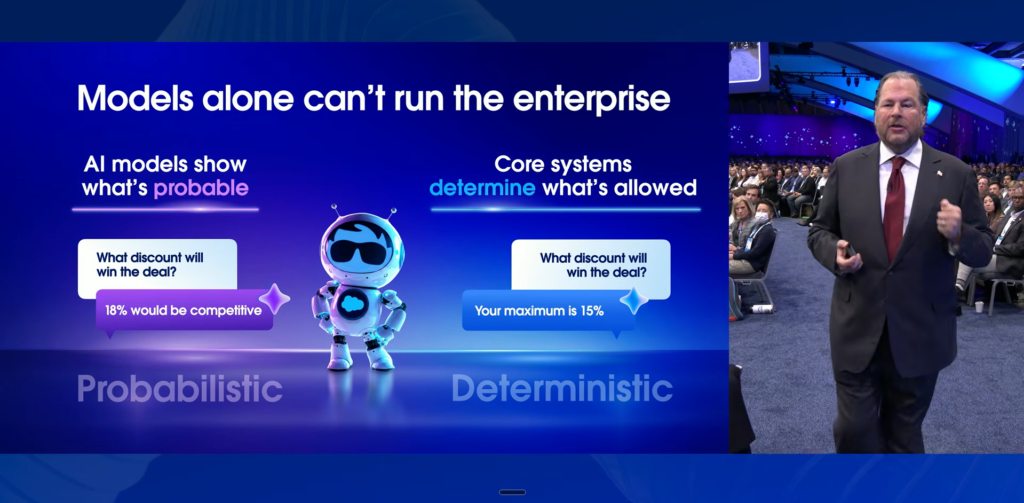
Benioff kept returning to one distinction, and it’s worth understanding because every announcement hangs off it.
AI models are probabilistic. They’re brilliant, but they guess. Ask one for a revenue number, and it’ll give you something plausible that might be quietly wrong. Salesforce, by contrast, is deterministic – it’s your single source of truth, the place where the number is the number.
The pitch is that you get real value only when you ground the probabilistic layer in the deterministic one. Salesforce describes its architecture as four layers stacked together: data (Data 360), apps and semantics (Customer 360), agents (Agentforce), and now a new interface layer on top. Keep that stack in mind. It’s the map for the rest of this.
AIforce: the Headline
This was the big reveal. AIforce is what Salesforce calls a “live interface layer” – a way to bring everything inside Salesforce (data, business logic, permissions, security, governance) to wherever you already work, instead of making you come to Salesforce.
Salesforce co-founder Parker Harris introduced the concept with a remark that most software companies would find unsettling: “why should you ever log into Salesforce again? Maybe you never will”. The point being that the UI was never the product. The trust you place in Salesforce to hold your data and enforce your rules – that’s the product. AIforce plugs that product into a new front end.
The reality is that the UI was never the actual product. The trust you place in Salesforce to keep your data secure and enforce your rules – that is the real product. AIforce connects that same product to a new front-end.
It launches on three surfaces:
- Claudeforce – Salesforce inside Anthropic’s Claude
- Slackforce – Salesforce context and actions inside Slack
- Agentforce Coworker – an AI teammate living inside the Lightning interface
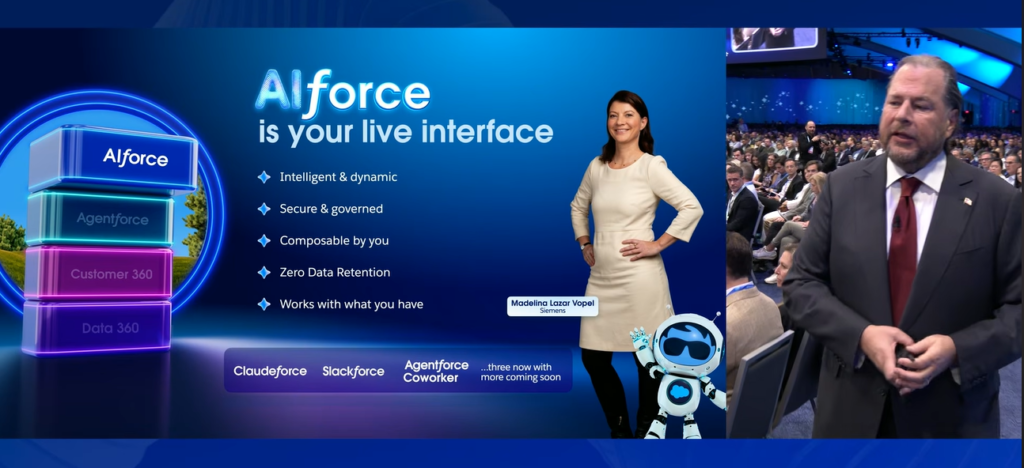
There were a few notable features. Its interface is ‘composable’ – meaning you can specify the view you want and obtain a functional view, rather than having to navigate through fixed layouts. Everything runs on your existing permissions, so an agent only sees what the person asking can see. And it’s built with Zero Data Retention, meaning your business data answers the question at hand and isn’t retained by the model provider. Under the hood, it’s powered by the Headless Toolkit, the open architecture that exposes Salesforce through MCPs, APIs, plug-ins, and skills.
Claudeforce and Salesforce in Claude
The Anthropic partnership got real substance. Claudeforce launches with Salesforce in Claude, which packs Salesforce intelligence into a prebuilt MCP server inside Claude. If you’ve ever tried to set up an MCP server, wire up authentication, and hand-map skills, you know how difficult it is. This tool simplifies all these processes at once.
It ships 37 pre-built sales skills covering prospecting through pipeline hygiene, plus the upcoming promise of analytics via Tableau and skills for service, marketing, commerce, and industries. For builders, there’s a separate Salesforce Development plug-in for Claude Code with more than 40 skills. Deloitte, GitLab, and Legora piloted it, and Salesforce in Claude is now in beta for all customers.
Koa: Salesforce’s first CRM Reasoning Model
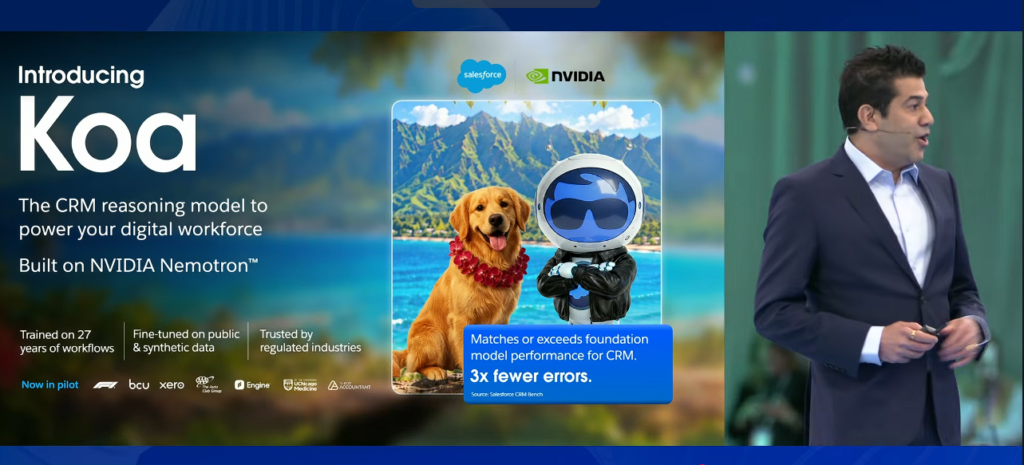
Jensen Huang did his walk-and-talk bit with Benioff, and the actual news from the NVIDIA partnership was Koa – Salesforce’s first CRM reasoning model, built by post-training NVIDIA’s (Nemotron).
For anyone who values trust, this is interesting: no customer data was used to train it. The training set was entirely synthetic, modeled on how enterprise workflows actually run across more than 14 industries. Salesforce controls the model weights and runs inference inside its own trust boundary, so nothing crosses the line during use. On Salesforce’s own CRM benchmark – real tasks like updating an opportunity or routing a case – the company reports Koa matching or beating leading models with roughly three times fewer errors.
Koa is in pilot now, with general availability expected in winter 2026 in U.S. regions.
Data 360 and the Trusted Enterprise AI Harness
The premise: models know everything about the world and nothing about your business. The Trusted Enterprise AI Harness closes that gap. It pulls together six capabilities: Trusted Context, Agency, Action, Governance, Security, and Models – into one composable architecture, with a new AI Control Plane as the single place to see, manage, and cost-control every agent across your org, including third-party ones.
The named products map onto it like this. Informatica gets your data AI-ready. Data 360 builds the trusted context, using zero-copy so you can reach data outside Salesforce without physically moving it. Tableau handles the business semantics, so “ARR” or “churn” means the same thing to every agent. Salesforce Guardian – the evolution of Shield and the Einstein Trust Layer – covers agent identity and data security, flagging agents that go rogue and data that isn’t classified. And Agent Fabric (MuleSoft, up-leveled) gives IT one registry to govern agents across providers, with dashboards for latency, error rates, policy violations, and token cost.
Availability here is more gradual: many of the underlying technologies exist today, with the unified experience rolling out starting early in Salesforce’s FY28.
The Customer 360 clouds, quickly
MaryAnn’s run through a quick overview of the cloud updates. Data vendors are now integrated into Hunter. ‘Contact Center as a Service’ (CCaaS) is launching in October, combining telephony and CRM into a single system. A campaign agent is being added to Marketing Cloud that automatically creates and optimizes campaigns. A renewal agent has been added to Revenue Cloud to identify accounts requiring contact and manage upsell opportunities. A ‘voice-to-text’ feature is coming to Field Service, allowing technicians to fill out forms without removing their gloves. Finally, IT/HR services are gaining a self-updating CMDB.
Final Thoughts
Pick one surface and get hands-on this week rather than waiting for the full stack to mature. If you’re a sales team, Salesforce in Claude is in beta and the fastest thing to try. If you’re an admin or architect, spend your time on the Harness, Guardian, and Agent Fabric material – the governance layer is what turns a flashy demo into something your security team will actually sign off on. And whatever you touch, confirm the availability status first, because a good chunk of what looked live on stage is still in pilot or months out.
Frequently Asked Questions
AIforce is a live interface layer that brings Salesforce data, workflows, permissions, and governance into external AI tools like Claude, Slack, and Lightning, so people and agents can work with Salesforce without opening the app. It launches with Claudeforce, Slackforce, and Agentforce Coworker.
Koa is Salesforce’s first CRM reasoning model, built on NVIDIA (Nemotron) and trained only on synthetic data. It’s designed for multi-step Agentforce workflows and runs inside Salesforce’s trust boundary. It’s in pilot now, with general availability expected in winter 2026 in U.S. regions.
Salesforce in Claude, the core of Claudeforce, is in beta for all customers. It includes a prebuilt MCP server with 37 sales skills, plus a separate development plug-in for Claude Code.
It’s Salesforce’s framework for governing AI at scale, combining six capabilities (context, agency, action, governance, security, models) with an AI Control Plane. Salesforce Guardian handles security, and Agent Fabric handles agent management across providers.

Priya Rastogi
Priya is a 3x Salesforce Certified who believes in the power of continuous learning and collaboration. She’s passionate about exploring how Salesforce can simplify work, boost productivity, and create better user experiences. When she’s not experimenting with new features or automating processes, Priya enjoys connecting with fellow Trailblazers and sharing insights to help others grow in their Salesforce journey.
- Priya Rastogi
- Priya Rastogi
- Priya Rastogi
- Priya Rastogi