










Healthcare organizations operate across geographies, specialties, and care models, making access management one of the most complex aspects of Salesforce Health Cloud implementations. Enterprise Territory Management (ETM) addresses this challenge by enabling structured, rule-based access to Accounts and related healthcare data. When combined with Health Cloud’s patient-centric architecture, ETM ensures the right teams engage with the right providers, facilities, and partners—without compromising data governance.

Table of Contents

Understanding ETM in the Context of Health Cloud

Enterprise Territory Management is a Salesforce feature designed to manage account access through territory hierarchies, rather than traditional role hierarchies. In Health Cloud, ETM is commonly used to manage provider networks, hospital systems, laboratories, and payer organizations.

Unlike standard Sales Cloud implementations, healthcare organizations often require multi-dimensional territory logic—such as geography combined with specialty, facility type, or service line.

Core Components of ETM

  1. Territory Models define the overall structure and versioning of territories. Health Cloud customers typically maintain a single active model aligned with their operational regions.
  2. Territory Types categorize territories into various types, including Geographic, Specialty-Based, and Facility-Based. This classification simplifies reporting and governance.
  3. Assignment Rules automate territory allocation using criteria like zip code, provider specialty, or healthcare facility classification.
  4. User Associations determine which care managers, regional managers, or operational teams gain access to accounts assigned to a territory.

ETM Architecture Flow in Health Cloud

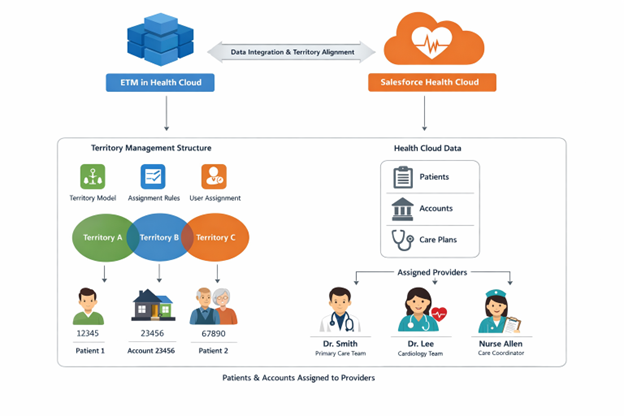
Enterprise Territory Management in Health Cloud operates as a layered architecture that separates data ownership, access control, and care delivery context. This separation is especially important in healthcare environments where data sensitivity and compliance are critical.

At a high level, the architecture consists of:

  • Territory definition and assignment (ETM layer)
  • Healthcare data management (Health Cloud layer)
  • User access and care team collaboration (Experience layer)

The architecture image illustrates how these layers interact without directly exposing patient data through territories.

ETM in Salesforce
Caption: Salesforce

Step-by-Step ETM Flow in Health Cloud

  1. Source Data Creation

  • Accounts represent hospitals, clinics, labs, and payer organizations.
  • Provider records store physician and specialist information.
  • Patient data is managed through Person Accounts and clinical objects in Health Cloud.

Territories do not directly control patient records. Instead, they control account-level access, which then determines contextual visibility.

  1. Territory Model and Hierarchy

A single active Territory Model defines the organizational structure.

Territories are grouped by:

  • Geography (State, City, Zip Code)
  • Specialty (Cardiology, Oncology, Primary Care)
  • Facility Type (Hospital, Diagnostic Center)

This hierarchy allows one account to belong to multiple territories, which is common in healthcare.

  1. Assignment Rules Execution

Assignment rules evaluate:

  • Account zip code
  • Facility specialty
  • Network affiliation

When criteria match:

  • Account is assigned to one or more territories.
  • Assignment happens automatically during insert or update.

This process removes dependency on manual sharing rules.

  1. User Association and Access Control

Users such as:

  • Care Coordinators
  • Regional Care Managers
  • Operations Leads

are associated with territories using Read-Only or Read/Write access.

Once associated:

  • Users gain access to all accounts within that territory.
  • Access extends to related Health Cloud data through relationships.
  1. Health Cloud Contextual Visibility

Health Cloud uses:

  • Care Plans
  • Care Gaps
  • Patient Timelines

These are not controlled by ETM, but ETM ensures that only authorized users reach the accounts that surface this patient context.

This keeps:

  • Patient privacy intact
  • Care delivery aligned with territory boundaries

How ETM Works with Health Cloud Data Model

Health Cloud introduces objects such as Person Accounts, Care Programs, and Provider data. ETM does not control patient record visibility directly but governs access to Accounts linked to providers, hospitals, and partner organizations.

By controlling account access, ETM indirectly ensures that care teams only view patient and clinical context relevant to their assigned regions or specialties.

Practical Healthcare Example

Consider a national hospital network operating across multiple states. Territories are created based on zip code ranges and hospital specialties such as cardiology or oncology.

When a new hospital account is created with a specific zip code and specialty, ETM assignment rules automatically assign it to the correct territory. Regional Care Managers and Operations Leads associated with that territory gain immediate access.

This approach eliminates manual sharing rules and ensures scalability as the provider network grows.

Best Practices for ETM in Health Cloud

  • Avoid overly complex assignment rules that are difficult to maintain. Prefer data normalization using reference objects where possible.
  • Validate territory access using test users representing real healthcare roles such as Care Coordinator or Regional Director.
  • Document territory logic clearly to support audits and compliance reviews common in healthcare organizations.

Conclusion

Enterprise Territory Management plays a foundational role in scaling Salesforce Health Cloud implementations. By combining structured territory models with healthcare-specific data, organizations can maintain secure, efficient access while supporting patient-centric operations.

Abhishek Gupta (Salesforce Trail)
Abhishek Gupta
Senior Technical Consultant  abhishekgupta2@salesforce.com

Abhishek (STC @Salesforce) is a Salesforce professional with hands-on experience in Health Cloud, Enterprise Territory Management, and scalable Salesforce architecture. He has worked on designing territory models, access strategies, and healthcare-focused solutions that align business needs with platform best practices. Passionate about continuous learning, Abhishek enjoys sharing practical Salesforce insights through blogs and community contributions to help others build efficient, real-world implementations.


Share.
Leave A Reply

Exit mobile version