

If your feed seemed to be dominated by talk of Agentforce this year, it wasn’t just your imagination. There has been a shift in how Salesforce talks about itself and, more importantly, in how it actually operates.
To put it simply: 2026 is the year Salesforce stopped being a CRM you use and became a platform you direct. That might sound like marketing speak, but when, as an admin, you see an agent automatically close a case, you find yourself wondering whether to feel relieved or anxious.
This isn’t an exaggeration. For each of the seven changes outlined below, I’ll answer the question most of us are asking ourselves: What does this mean for my job, my organization, and the next 12 months? By the time you finish reading, you’ll feel informed and prepared, not anxious.
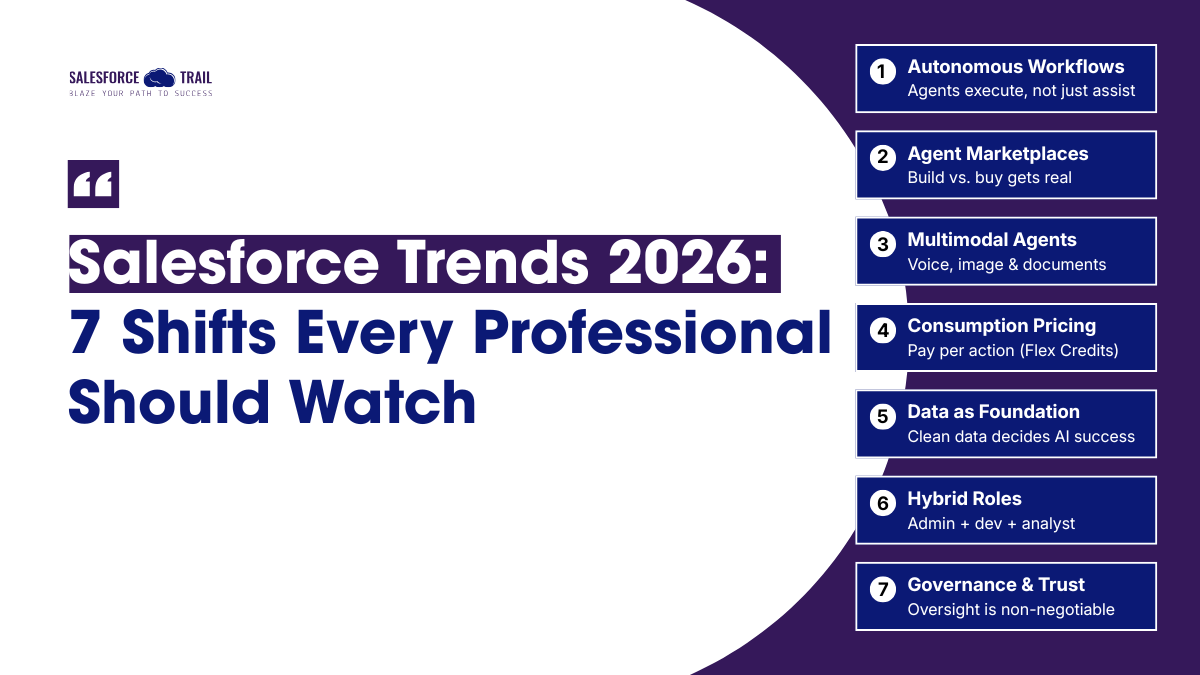
In-Short: The biggest Salesforce trends of 2026 are autonomous AI agents that execute full workflows, agent marketplaces, multimodal (voice and document) reasoning, consumption-based Flex Credits pricing, Data 360 as the AI foundation, blended admin-developer roles, and governance becoming a required skill. Most are generally available now — not on the roadmap.
Table of Contents
Shift 1 — Autonomous Workflows: From “Assist” to “Execute”
The old generation of AI helped you write. This one does the job.
The difference is easy to feel in a real example. A customer requests a return. The agent validates the shipping address, generates the replacement order, and sends the confirmation — three actions, one short conversation, no human touching the keyboard. Agentforce reached general availability on October 29, 2024, and the Agentforce 360 release at Dreamforce ’25 (October 13, 2025) leaned further into this, with a conversational builder and hybrid reasoning running on the Atlas Reasoning Engine.
I’ll be honest, though: adoption out of the gate was slower than the keynotes suggested. Plenty of orgs turned agents on, watched them fumble an edge case, and turned them back off. That’s normal. The tech is real; the operational muscle to use it well is still being built.
What this means for you. Your job stops being “build the automation” and starts being “design the agent’s judgment” — its topics, its actions, and crucially, when it should escalate to a human. For your org, don’t boil the ocean. Pick one or two high-volume, low-risk processes and hand those off first. And this quarter, put one question to leadership: which decisions are we comfortable letting an agent make with no human in the loop? If nobody’s answered that, you’re not ready to scale.
Shift 2 — Agent Marketplaces: “Build vs. Buy” Becomes a Real Decision
For years, “build vs. buy” mostly meant apps. Now it means agents.
AgentExchange launched on March 4, 2025, with over 200 partners. By TDX 2026, Salesforce had unified AppExchange, Slack Marketplace, and the agent ecosystem into a single platform, backed by a $50 million Builders Fund. The benefit is that, instead of building everything from scratch, you can now access pre-built agent actions or templates.
That’s genuinely useful. It’s also a new kind of decision, because the thing you’re installing doesn’t just sit there — it reads your data and takes actions on your behalf.
What this means for you. Treat a marketplace agent with more suspicion than a static app, not less. Build yourself a short evaluation checklist: what data it touches, what actions it can trigger, how it handles failure, and test in a sandbox before it goes anywhere near production. “Buy” is a real option now. It’s just not a free pass on due diligence.
Shift 3 — Multimodal Agents: Beyond the Text Box
Agents used to live in a chat window. Now they listen, look, and read.
Agentforce Voice became generally available on October 21, 2025, enabling agents to handle spoken conversations, not just typed ones. Regarding documents, agents can now understand complex materials, including PDFs, tables, and even flowcharts, and extract relevant information before formulating a response.
It is important to note that Voice was initially launched in English in the US and Canada. If your customers are located elsewhere or speak other languages, please verify coverage before making any internal commitments, as global availability may change.
What this means for you. Audit your unstructured content. All that knowledge trapped in old PDFs and process diagrams just became something an agent can actually use — that’s an asset, not dead weight. And if you’re tempted by voice, pilot it where call volume genuinely justifies the cost (see the next shift on why cost matters more than it used to). Don’t roll it out everywhere because it demos well.
Shift 4 — Consumption Pricing: Learning to Think in Cost-Per-Action
This is the trend nobody puts on a slide, but everybody feels in the budget meeting.
Salesforce introduced a consumption model called ‘Flex Credits’ in May 2025. Instead of paying on a per-seat basis, you pay for the specific work the agent does. Salesforce lists the rates on its pricing page; since these rates are subject to change, I recommend checking the live ‘Agentforce’ pricing page directly rather than relying on outdated information found in blog posts. Essentially, there is a cost associated with every task an agent performs.
That reframes a lot. A poorly scoped agent isn’t just a clunky user experience anymore. It’s a line item.
What this means for you. Before you scale anything, model the cost-per-action for your top few workflows. Multiply it out by real volume. Then, and I can’t stress this enough, bring finance into the conversation early, not after the first surprising invoice. The new skill here is forecasting consumption the same way you used to forecast license counts. Salesforce’s Digital Wallet gives you the visibility; use it.
Shift 5 — Data Is the New Bottleneck
A truth of the agentic era is this: your AI is only as good as the data behind it. Bottlenecks arise not from features, but from data.
That is why, at Dreamforce ’25 (October 14, 2025), Data Cloud was rebranded as Data 360 and introduced as the grounding layer for all Agentforce operations. And this gap is very real. In Salesforce’s 2026 Connectivity Benchmark Report, which surveyed over 1,000 IT leaders, 96% of organizations reported facing obstacles in leveraging their data for AI, with 40% citing legacy architectures and disconnected systems as the primary hurdles.
Read that again. Almost every org has a data problem standing between them and working AI.
What this means for you. Do the unglamorous cleanup before you scale agents, not after. In practice, that groundwork often takes longer than the agent deployment itself — plan for it. And notice what this does to your career: data modeling and identity resolution used to be back-office chores. They’re now some of the most valuable skills you can have.
Shift 6 — The Rise of Hybrid Roles
The defined boundaries of work are disappearing. The distinction between administrators, developers, analysts, and strategists has become more blurred than ever before.
Admins increasingly find themselves governing a digital workforce rather than configuring a platform. Developers spend less time writing every line and more time directing agents to do it. Salesforce’s own admin blog describes exactly this evolution. And the pressure is documented: in Salesforce’s State of IT research, more than 80% of developers said they believe AI will soon be a fundamental job requirement, while over half admitted they don’t yet have the skills for it. Salesforce also launched the Agentforce Specialist certification (AI-201) on March 3, 2025, to help close that gap.
If that stat makes you tense, breathe. It’s not a threat notice.
What this means for you. Pick a specific area and dive deep into the data, whether through Data 360, agent creation, or governance. It is better to have deep expertise in one area than a general understanding of many areas. Also, consider where your true value lies: decision-making capabilities, business context, and system design—these are things an agent cannot replicate. Their value will only increase, not diminish, by 2026.
Shift 7 — Governance and Trust as a Core Skill
When agents merely offered suggestions, it was easy to ignore a bad one. But when agents perform tasks, monitoring them becomes essential.
Salesforce’s answer is the ‘Einstein Trust Layer.’ It masks personal data, enforces zero data retention with the underlying model, detects toxicity, and logs every interaction to maintain an audit trail. That last point is far more critical than it might seem. Yet, there are still gaps in the broader ecosystem picture: same 2026 connectivity benchmark, only 54% of organizations reported having a centralized governance framework for their agents, and nearly half of the agents were still operating in silos rather than as part of a coordinated system. This is how “Shadow AI” creeps into systems.
The mental shift is simple. You now need to know what the agent did, not just what it said.
What this means for you. Become the person who can answer, cleanly, “what did the agent do, and can we prove it?” Learn the Trust Layer’s audit trail, how permission contexts scope what an agent can touch, and how to design escalation paths. Then get leadership to answer the question everyone avoids: who owns oversight when an agent gets it wrong? Whoever can facilitate that conversation becomes indispensable.
The Bottom Line: Oriented, Not Anxious
Step back, and the seven shifts tell one story. The platform now works for you but only if you learn to direct it well.
None of this diminishes the importance of the professional who understands the business. In fact, it actually enhances that person’s value, because someone ultimately has to decide what constitutes “good,” what the boundaries are, and when to override a machine’s decision. That person could be you.
So, the next step for you, and I’d genuinely do it this week: pick a single shift from this list the one that sits closest to your current role and take one concrete action on it. Model the cost of one workflow. Audit one messy data source. Write the escalation rules for one agent. You don’t need to be ahead of all seven. You need to stop watching and start moving on one.
Frequently Asked Questions (FAQ)
Autonomous AI agents that run full workflows, agent marketplaces like AgentExchange, multimodal agents that handle voice and documents, consumption-based Flex Credits pricing, Data 360 as the AI data foundation, blended admin-developer roles, and governance becoming a core skill.
No, but the role is changing. Admins are shifting from configuring a platform to overseeing and governing agents. The demand is moving toward judgment, data quality, and oversight, which are things agents can’t do for themselves.
Salesforce prices Agentforce through Flex Credits, a consumption model where you pay per action rather than only per seat. Because the published rates change, check Salesforce’s live Agentforce pricing page for current figures before budgeting.
Data 360 is the new name for Salesforce Data Cloud, rebranded at Dreamforce ’25 in October 2025. Same core purpose — unifying your data — but now positioned explicitly as the grounding layer that makes Agentforce agents accurate.
The Agentforce Specialist certification (AI-201), launched in March 2025, is the most direct credential for building and configuring agents. It’s a strong starting point if you want to stay relevant in the agentic era.
It’s real and in production at many organizations, though adoption started slower than the marketing implied. The technology is generally available; what’s still maturing is the operational discipline — clean data, cost control, and governance — needed to run it well.

Priya Rastogi
Priya is a 3x Salesforce Certified who believes in the power of continuous learning and collaboration. She’s passionate about exploring how Salesforce can simplify work, boost productivity, and create better user experiences. When she’s not experimenting with new features or automating processes, Priya enjoys connecting with fellow Trailblazers and sharing insights to help others grow in their Salesforce journey.
- Priya Rastogi
 September 16, 2026
 - Priya Rastogi
- Priya Rastogi
- Priya Rastogi